
Power Vent vs. Direct Vent Water Heater: Twin Cities Guide
Key Takeaways
- Most Twin Cities homeowners reach this decision because a new furnace left the old chimney unusable, not because they were shopping for an upgrade.
- An orphaned water heater on an oversized, cold chimney is a backdraft and carbon monoxide risk. That is a safety problem, not an efficiency preference.
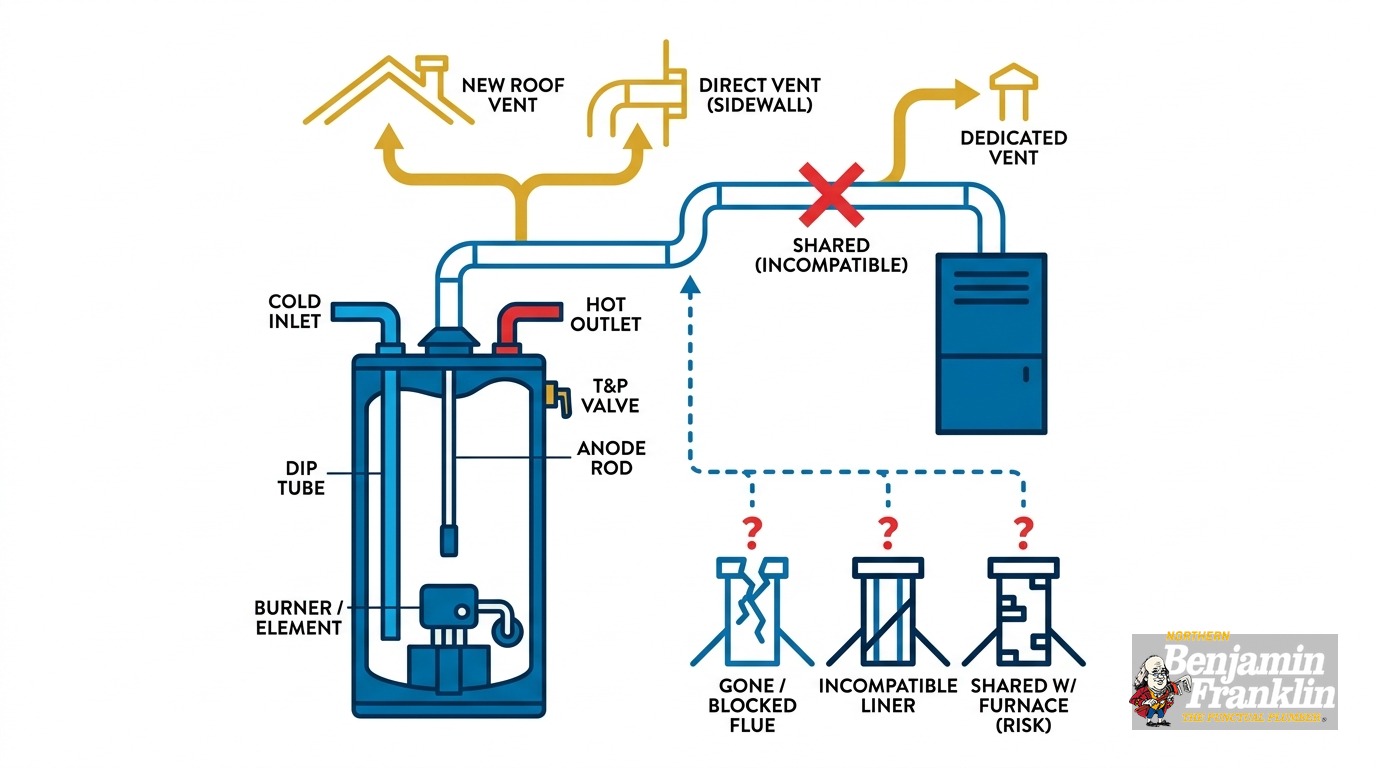
- Power vent and direct vent both solve the orphaned-flue problem by routing exhaust through a sidewall pipe instead of a masonry chimney.
- Direct vent is the safer combustion design: sealed off from indoor air, no backdraft pathway. Power vent is the more flexible installation: handles longer runs and interior locations.
- Direct vent sidewall terminations can ice over in Minnesota winters. Cap selection and termination height are required, not optional.
- Minnesota requires a permit for every water heater replacement. Work must be done by a licensed plumber.
- Xcel Energy offers rebates of $75 to $250 on qualifying gas models. Verify current amounts before purchasing.
- Our On-Time Guarantee(R) means we arrive in the window you choose, or we pay you $5 for every minute we are late, up to $300.
Why Do Twin Cities Homeowners End Up Choosing Between These Two Options?
Answer capsule: Usually, a new condensing furnace left the water heater alone on a shared masonry chimney that is now oversized and cold. That is called an orphaned water heater. It is a safety problem that forces a venting change, often on a short timeline before the next heating season.
Here is what happens. You replace an older 60%-efficient furnace with a modern 90%-efficient condensing unit. The new furnace exhausts through a small PVC pipe running horizontally to an exterior wall. It no longer uses the masonry chimney.
Your water heater, though, still connects to that chimney. Before the upgrade, two appliances shared the flue. Together, they produced enough heat and exhaust volume to keep the chimney warm, maintain an upward draft, and prevent condensate from collecting in the liner. With the furnace gone, the water heater is alone. The American Society of Home Inspectors calls this the orphaned water heater problem and notes it is most common in homes built between roughly 1900 and 1980, designed around shared masonry flues and 60%-efficient appliances. The Twin Cities has a large stock of exactly these homes.
An oversized, cold chimney cannot reliably pull combustion gases upward. Those gases, including carbon monoxide, can drift back into the living space. The Minnesota Department of Health reports an average of 14 deaths and approximately 300 emergency department visits per year from unintentional CO poisoning statewide; water heaters and furnaces are named contributing sources. CO-related ER visits more than double between September and November and peak in February. That is the season when a cold chimney is most likely to fail and least likely to be inspected.
An orphaned water heater is a safety hazard. Both power vent and direct vent water heaters solve it by removing the unit from the old chimney and routing exhaust through a smaller, dedicated pipe to an exterior sidewall.
What Is the Difference Between Power Vent and Direct Vent?
Answer capsule: A power vent draws combustion air from the room and uses an electric blower to push exhaust out through a single PVC pipe. A direct vent uses a sealed two-pipe system: one pipe draws outside combustion air in, and a second exhausts gases back out. No blower, no indoor air consumed.
Both vent horizontally through a sidewall rather than vertically up a chimney. That is where the similarity ends.
Power vent: The burner draws air from the room the water heater sits in. An electric blower forces exhaust through a PVC vent pipe to an exterior wall. Because the blower creates positive pressure in the vent, the pipe can run a longer horizontal distance and make more turns than a gravity-draft system allows. The water heater does not need to be close to an exterior wall. It does need a nearby standard 120-volt electrical outlet.
Direct vent: The unit uses a sealed, concentric or two-pipe system. One pipe draws outside air directly into the combustion chamber. The other exhausts combustion gases back outside through the same wall penetration. Because combustion air comes from outdoors and the burner is fully sealed from the living space, there is no pathway for exhaust to back-draft into the home. The DOE describes direct-vent sealed-combustion appliances as ones that “eliminate the possibility of backdrafting” and identifies them as the safest combustion appliance type when installed in a home’s conditioned space. The trade-off is proximity: the water heater must be close enough to an exterior wall that both pipes can reach the termination within the manufacturer’s maximum run length.
How Do I Know If I Need a Power Vent Water Heater?
Answer capsule: You likely need a power vent if the water heater is in an interior basement location with no practical path to an exterior wall within direct vent run limits, or if routing two pipes to the sidewall would require cutting through finished walls. A licensed plumber can confirm in one visit.
Situations that point toward power vent:
- The water heater sits in the middle of the basement with interior walls on all sides.
- The shortest path to an exterior wall exceeds the direct vent manufacturer’s maximum run length, typically 40 to 50 equivalent feet, though this varies by model and BTU input.
- Running two pipes side by side, or a concentric pipe set, to the exterior would require opening finished walls or soffits.
- A 120-volt outlet is already within reach, or adding one is straightforward.
Power vent gives the installer flexibility on where to terminate the exhaust. The blower handles longer runs and more elbows without sacrificing draft performance. The limitation to understand: the blower is a mechanical component that will eventually wear. When it fails, the unit shuts down as a safety precaution. That is the correct outcome, but it means a repair call. Annual maintenance checks the blower and catches wear before it becomes an emergency on the coldest night of January.
What Is Better, a Power Vent or Direct Vent Water Heater?
Answer capsule: Neither is universally better. Direct vent is the safer combustion design. Power vent is the more flexible installation. The right choice depends on where your water heater sits relative to an exterior wall and how far the vent pipes need to run.
Here is the comparison:
Direct vent strengths:
- Sealed combustion. No indoor air consumed, no backdraft pathway.
- No moving parts in the vent system. Fewer components to fail over time.
- Quieter operation. No blower running during the heating cycle.
- DOE identifies sealed-combustion direct vent as the safest combustion appliance type for conditioned interior spaces.
Direct vent limitations:
- The water heater must be close enough to an exterior wall to keep both pipe runs within manufacturer limits.
- In sustained sub-zero temperatures, condensate at the sidewall termination can freeze. (Covered in detail below.)
- Terminal height above grade must account for Minnesota snow accumulation, which can be substantial.
Power vent strengths:
- More flexible vent routing. Long horizontal runs with multiple elbows are manageable.
- Only one wall penetration required. No second pipe for combustion air intake.
- Good fit when the water heater is in a fixed interior location.
Power vent limitations:
- Requires electricity. Adds a component that can fail.
- The blower is audible during operation. In a finished basement, it is noticeable.
- Draws conditioned indoor air for combustion, a modest factor in tightly air-sealed homes.
For most Twin Cities basements where the water heater is near an exterior wall or the rim joist, direct vent is often the cleaner and safer option. When the water heater is deeper in the basement, power vent is typically the practical answer.
If you are weighing a switch to tankless heating alongside this venting decision, a side-by-side look at tank vs. tankless options covers that decision separately. And if you want to understand the full cost range before your consultation, the breakdown of tankless replacement costs in Minnesota is a useful reference.
Are Power Vent Water Heaters Worth It?
Answer capsule: Yes, when your layout requires one. If a direct vent install would mean cutting through finished walls, running pipes past manufacturer length limits, or relining a masonry chimney, power vent is the right tool. The blower adds a maintenance consideration, but it is manageable with routine service.
The alternative that occasionally comes up is relining the chimney and keeping a naturally drafted water heater on it. For most Twin Cities homes with an orphaned flue, this rarely makes economic sense.
A chimney liner must be sized precisely to the water heater’s BTU input and flue requirements. An oversized or undersized liner undermines the draft. When you add the liner cost, the installation labor, and the fact that the single appliance is still in a flue system designed for two, the economics seldom favor relining over a sidewall-vented unit. A new power vent or direct vent water heater is also more efficient than the older naturally drafted equipment it replaces.
Power vent and direct vent units are both widely available. The appliance cost is similar between the two types at comparable capacity. The project cost difference comes from run length, the number of elbows, any electrical work required, and local permit fees. Those variables matter more than the choice between vent type.
Does Minnesota Have Different Code Requirements for Water Heater Venting?
Answer capsule: Yes. Minnesota deleted all UPC venting sections from its Plumbing Code. Combustion appliance venting is governed by Minnesota Rules chapter 1346 instead. National guides that cite UPC venting rules do not apply here.
Minnesota Plumbing Code chapter 4714, part 4714.0509, deletes UPC sections 509.0 through 509.15, including all tables and figures, in their entirety. Gas-burning appliance venting is governed by Minnesota Rules chapter 1346, the Minnesota Mechanical and Fuel Gas Code. That is the document that controls sidewall venting installations in this state.
Under chapter 1346, sidewall exhaust terminations must be at least 3 feet from doors, operable windows, and non-mechanical air intakes. That clearance requirement applies to both power vent and direct vent terminations.
Every water heater replacement requires a plumbing permit under Minnesota Plumbing Code section 4715.0120. The gas connection may require a second permit under chapter 1346. Work must be performed by a licensed plumber under Minnesota Statutes section 326B. The permit inspection confirms the termination clears the 3-foot requirement and the gas connection is secure.
Skipping the permit carries real risk. An unpermitted water heater can surface as an open item in a home inspection at resale. It can hold up a transaction or require a retroactive inspection. Pull the permit. It costs little relative to the job and protects both the installation and the next owner.
Can Direct Vent Terminations Ice Over in a Minnesota Winter?
Answer capsule: Yes, and this is a real failure mode in cold climates that most national guides skip entirely. In sustained sub-zero temperatures, exhaust condensate can freeze at the sidewall cap, block the termination, and cause the unit to shut down. Proper cap selection and placement height prevent it.
A direct vent water heater exhausts warm, moist combustion gases through a sidewall pipe. When outdoor temperatures drop well below zero and stay there for days at a stretch, as they do every winter in the Twin Cities, that moisture can freeze at or near the termination cap. Heating professionals have documented ice buildup at direct vent terminations as a confirmed failure mode in very cold climates, sometimes large enough to fully block the opening and trigger a unit shutdown.
The checklist for a Minnesota direct vent install:
- Use a cold-climate termination cap rated for freeze conditions. Not every standard cap handles repeated freeze-thaw cycling the same way.
- Mount the termination high enough above grade to stay clear of snow accumulation. NFPA 54 and the International Fuel Gas Code require at least 12 inches above grade. In Minnesota, where a single storm can leave 12 to 18 inches of accumulation, that is a practical minimum, not a comfortable margin.
- Inspect the termination area each fall before the heating season starts. A light frost coating is easy to clear. An ice plug discovered in late January means no hot water on a cold night.
- Keep the area around the termination free of snow drifts and anything piled against the foundation that could restrict airflow.
Your plumber should walk through termination placement and height with you during the site assessment. If they do not raise this topic in a Minnesota install, ask directly.
Are There Rebates for High-Efficiency Gas Water Heaters in Minnesota?
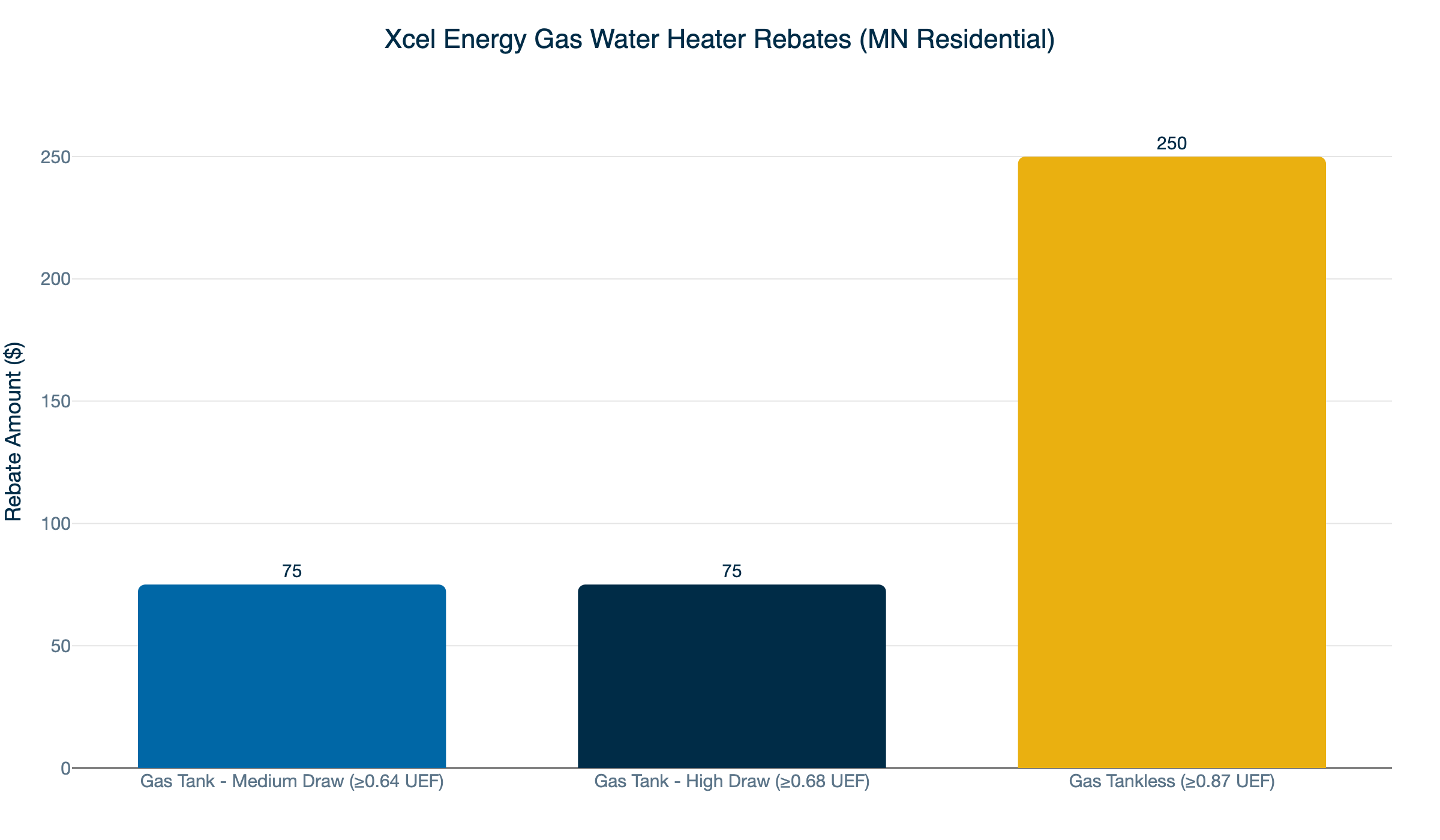
Answer capsule: Yes, if you are served by Xcel Energy. Qualifying gas standard tanks earn $75. Gas tankless units at 0.87 UEF or higher earn $250. Electric heat pump water heaters can qualify for $400 to $500. Verify current amounts at the Xcel rebate portal before purchasing, as program terms change.
Xcel’s current MN Residential Rebate Summary lists the following for gas water heaters:
- Gas standard tank, medium draw (0.64 UEF or higher): $75
- Gas standard tank, high draw (0.68 UEF or higher): $75
- Gas tankless (0.87 UEF or higher): $250
Storage tanks 55 gallons or larger are not eligible. Rebates are paid by check, and Xcel notes to allow up to 8 weeks for payment.
The UEF figure for a specific model is on its EnergyGuide label. DOE replaced the older Energy Factor (EF) rating with Uniform Energy Factor (UEF) in 2014. When comparing specs across different eras, confirm you are reading the same metric before drawing efficiency conclusions.
If a heat pump water heater is on your list alongside the venting question, the guide to heat pump water heaters for Minnesota basements covers whether the efficiency advantage holds when basement temperatures drop below 50 degrees Fahrenheit in winter.
Schedule a Venting Assessment Before Heating Season
If your home has a recently upgraded condensing furnace and a naturally drafted water heater still on the old chimney, do not wait for the CO detector to alert you. The orphaned-flue risk grows as outdoor temperatures fall and the chimney stays cold.
Northern Benjamin Franklin Plumbing is locally owned and operated in the Twin Cities. Our licensed plumbers assess venting configurations, pull the required permits, and install both power vent and direct vent water heaters throughout Minneapolis, St. Paul, Blaine, Bloomington, Brooklyn Park, Coon Rapids, Maple Grove, and the surrounding metro.
Our On-Time Guarantee(R) means we arrive in the window you choose. If there is any delay, it’s you we pay! That is $5 for every minute we are late, up to $300. If your project involves a full replacement, ask about financing options when you call.
Call (763) 296-1844 or book your water heater assessment online.
Frequently Asked Questions
Can you replace a power vent water heater with a direct vent? +
Need a technician now?