
Tankless Water Heater Sizing Minnesota: Cold-Water Guide
Key Takeaways
- Minneapolis and St. Paul city water comes from the Mississippi River. In January, it arrives very cold, per USGS stream gauge data. That is your worst-case inlet temperature for sizing.
- Reaching 120°F from a 37°F inlet requires an 83°F temperature rise. Box ratings are tested at 35-45°F rises. That gap is not small, and it changes which units are worth buying.
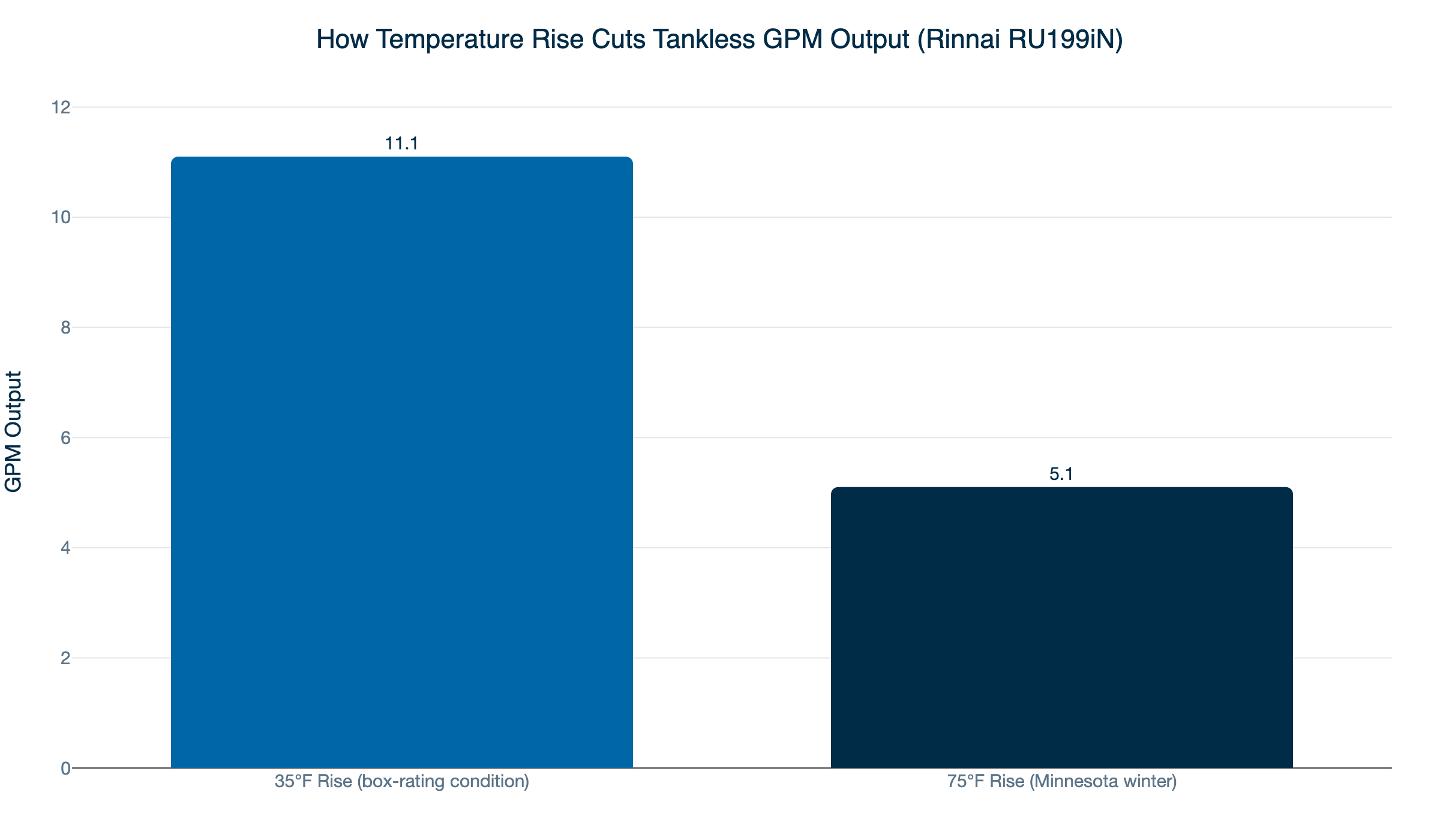
- A unit rated at 11.1 GPM at a 35°F rise produces just 5.1 GPM at a 75°F rise. Same unit, more than half the flow. That curve is real and it defines cold-climate sizing.
- Homes on private wells see more stable groundwater near 46-47°F year-round. The math is still colder than national guides assume, but less demanding than city water in deep winter.
- Minnesota requires a permit for every water heater installation under MN Rules Chapter 4714.
- CenterPoint Energy and Xcel Energy both offer rebates on qualifying gas tankless units. Financing is available for larger installs.
The box on a tankless water heater shows a GPM rating. That number was measured at a comfortable temperature rise, not at the conditions your pipes see in January. In the Twin Cities, the gap between box rating and real-world output can be several gallons per minute. Getting the size right before the install is the only way to avoid that shortfall.
What Does Tankless Water Heater Sizing Mean?
Sizing means matching a unit’s flow rate and BTU output to your home’s peak hot water demand. Get it right and every tap runs hot, even with two showers and the dishwasher running. Get it wrong and you get a lukewarm trickle when demand spikes.
The two variables that drive sizing are GPM (gallons per minute, your peak demand) and temperature rise. Temperature rise is the degrees the unit must add from inlet to outlet. A unit’s rated GPM is always tied to a specific temperature rise. Change the rise and the output changes too.
Manufacturers test their units at a 35-45°F temperature rise. Those conditions reflect a mild-climate inlet in the 70-80°F range. They do not reflect a January morning in Maple Grove when the water off your main line is 37°F.
A 2023 DOE rulemaking raised efficiency standards for gas tankless water heaters. That pushed manufacturers toward higher-UEF condensing units. Those units are more efficient. But even the most efficient unit loses output when the inlet temperature drops. Efficiency and cold-climate output are separate things.
Tankless water heater sizing Minnesota is a harder problem than sizing for Atlanta or even Chicago. The starting point is colder, the required rise is steeper, and the margin for error is smaller.
How Cold Is Minnesota’s Incoming Water?
In the winter months, Minneapolis and St. Paul city water can drop to around 37°F. That is the real floor for most Twin Cities homeowners on municipal water. Plan your sizing around that number.
Both cities draw from the Mississippi River. River water tracks outdoor temperatures through the seasons. The Mississippi falls below 40°F for roughly four months each year, per USGS water resources data for the Minneapolis-St. Paul area. A January average near 37°F is consistent with that record.
The USGS continuous groundwater monitoring network in Minnesota tracks seven statewide sites. If you are on a private well, that data points toward regional aquifer temperatures in the mid-40s year-round, with relatively little seasonal swing. That is a more favorable inlet temperature than city water in January, and it changes the sizing calculation.
This distinction is something most national guides skip entirely. They treat “northern states” as a single inlet band of 37-42°F without acknowledging that your water source determines where in that band you land.
There is a second reason cold inlet temperatures matter beyond GPM output. Cold water in the heat exchanger means the combustion system works harder for longer every time a tap opens. In real conditions, the unit rarely operates at the steady-state efficiency implied by the UEF rating.
Why Is the Box Rating the Wrong Number to Shop By?
The box rating is the GPM at a test-bench temperature rise, not at the 83°F rise your system needs on the coldest mornings. Using it as your target is how homeowners end up under-sized.
Here is how steep the output curve is. A unit rated at 5.0 GPM at a 35°F rise produces approximately 3.2 GPM at a 55°F rise. Same unit, roughly 36% less output, because the inlet dropped 20°F. A high-output unit rated at 11.1 GPM at a 35°F rise drops to 5.1 GPM at a 75°F rise. That is a 54% reduction.
Apply those numbers to January in the Twin Cities. Your inlet water arrives cold in winter. Your target outlet temperature has a ceiling set by MN Rules Chapter 4714 for bathtubs and shower fixtures. Required temperature rise: 83°F. A unit advertised as 9 GPM on the shelf may only deliver 4-5 GPM under those conditions.
A typical simultaneous load in a four-bedroom Twin Cities home looks like this:
- Two showers: 2.0 GPM each = 4.0 GPM
- Kitchen faucet: 1.5 GPM
- Total peak demand: 5.5 GPM
A “9 GPM” unit rated at a 35°F rise may not cover that load on the coldest morning of the year. The BTU output did not change. What changed is how much of that output is going into temperature rise versus flow volume. When the rise is steep, the flow pays the price.
Shopping by the box number is the most common sizing mistake in cold climates. The number to shop by is the manufacturer’s actual output at your required temperature rise.
How Do You Size a Tankless Water Heater for a Twin Cities Home?
Start with your worst-case inlet temperature, calculate the required temperature rise, look up the unit’s output at that rise, and add a cold-climate buffer. Do not use the box GPM as your target.
Here is the step-by-step:
1. Find your inlet temperature. On Minneapolis or St. Paul city water, use 37°F as your January floor. On a private well, 46-47°F is a reasonable regional baseline.
2. Set your target outlet temperature. The Minnesota Plumbing Code sets 120°F as the maximum at tubs and showers. Use 120°F as your sizing ceiling.
3. Calculate the required temperature rise. City water: 120 minus 37 equals 83°F. Well water: 120 minus 47 equals 73°F.
4. Count your peak simultaneous demand. Add up every fixture that could run at the same time. Two showers at 2.0 GPM each, a kitchen faucet at 1.5 GPM, and a bathroom sink at 1.0 GPM put you at 6.5 GPM. A two-shower, no-faucet scenario is 4.0 GPM. Know your household.
5. Look up the unit’s output at your temperature rise. Do not use the box rating. Pull the manufacturer’s performance table and find the output at 80-85°F rise. If that number is not on the box or in the spec sheet, ask your plumber to run it for you before you commit to equipment.
6. Add the cold-climate buffer. Sizing guides for northern states recommend adding 25-30% to your calculated peak demand. For homes with high simultaneous use, a cascade install (two units running in parallel) is the more reliable solution than pushing one unit to its ceiling.
Running those numbers for a typical city-water home with a 5.5 GPM peak demand: add 30% and you need 7.2 GPM at an 83°F rise. That is a demanding specification. It points toward the high-output category or a parallel install. It is also why a quick “grab something off the shelf” approach to tankless sizing fails in Minnesota far more often than it does in warmer climates.
What Minnesota Code Requires Before You Install
You cannot swap in a tankless water heater in Minnesota without a permit. MN Rules Chapter 4714 requires a plumbing permit for any water heater installation or replacement. If the unit is gas, the gas work falls under MN Rules Chapter 1346 as well.
Any unit installed in Minnesota must carry certification from a nationally recognized testing laboratory (UL or CSA). Gas instantaneous water heaters must conform to ANSI Z21.10.3. A unit purchased overseas or from an uncertified channel cannot be legally installed in the state, no matter how efficient the spec sheet claims.
The temperature limits in the code also inform sizing. The maximum at bathtubs and whirlpool tubs is 120°F. The maximum at public lavatories is 110°F, where an ASSE 1070 or ASSE 1084 device is required. Those ceilings are the outlet temperatures to use when you calculate your temperature rise. Setting the unit higher than the code allows wastes energy and requires a mixing valve at the fixture to bring the temperature back down.
Our team handles permits, schedules inspections, and manages the paperwork. You do not have to navigate the municipal process yourself.
Does It Matter Whether You Have City Water or a Private Well?
Yes. The water source determines your winter inlet temperature. City water and well water in the Twin Cities do not behave the same way in January.
Minneapolis and St. Paul pull from the Mississippi River. River water follows seasonal air temperatures and drops to roughly 37°F in winter. That is the colder of the two scenarios and the one that demands the most aggressively sized unit.
Homes on private wells draw from the regional aquifer. USGS groundwater monitoring data for Minnesota confirms that aquifer temperatures are relatively stable through the year. Coldwater Spring in Minneapolis, one of the most documented groundwater points in the metro, has held a consistently cold temperature throughout its recorded history. That figure is widely used as a proxy for regional residential well water temperature.
The practical difference is meaningful. A well-water homeowner sizing for a 73°F rise instead of an 83°F rise will get noticeably more output from the same unit. It does not eliminate the cold-climate penalty, but it reduces it enough to change which units belong on the shortlist.
National sizing calculators that assume a 50-65°F inlet will over-estimate your unit’s output regardless of source. The only reliable starting point is the number that reflects your actual water supply.
What About Condensate Freezing at the Vent?
High-efficiency condensing units produce acidic condensate, and that liquid can freeze at the vent termination when outdoor temperatures fall below zero. This is a real failure mode in Minnesota winters, and most national guides say nothing about it.
Condensing units are what you need to hit the ENERGY STAR minimum UEF required for utility rebates. They extract heat from exhaust gas, which causes water vapor to condense inside the unit during operation. That condensate drains away under normal conditions. The problem occurs at the vent termination.
When outdoor temperatures drop to -10°F or colder, which is a routine Minnesota winter event, condensate that reaches the vent outlet can freeze and partially block the exhaust. A blocked vent triggers the unit’s safety shutoff. You wake up to no hot water and a frozen vent pipe that has to be cleared before the unit will restart.
The fix is a proper cold-climate vent installation. That means the correct vent material for the unit (typically CPVC or stainless steel, depending on the manufacturer), the right clearances from the wall and grade, and in many cases a drain provision at the vent outlet to prevent pooling. This is not a step to skip on a Minnesota install. A plumber who works in this climate knows the termination details that prevent the failure. A warm-climate spec sheet does not.
Are There Rebates for Tankless Water Heaters in Minnesota?
Yes. CenterPoint Energy and Xcel Energy both offer cash rebates on qualifying gas tankless units in Minnesota. They are worth checking before you choose your equipment.
CenterPoint Energy offers a $500 rebate for residential natural gas customers replacing a water heater with a qualifying gas tankless unit rated 0.87 UEF or higher. New equipment only. The 2026 program runs January 1 through December 31, 2026.
Xcel Energy offers $250 for qualifying gas tankless units that meet the minimum UEF requirement. Medium draw (2.8-4 GPM) and high draw (4+ GPM) models both qualify. The program runs through the 2024-2026 cycle.
Confirm current dollar amounts with your utility before signing a contract. Rebate programs can update terms mid-cycle, and eligibility requirements may have shifted since these figures were published.
The 0.87 UEF threshold aligns with the condensing units that also happen to handle Minnesota’s cold-climate BTU demands best. The rebate and the performance requirement point in the same direction: go condensing, and go with a unit sized for your actual winter inlet temperature, not a national average.
For a whole-home tankless conversion, the total project cost including equipment, venting, and labor can be substantial. Financing is available for qualifying installs. Ask about your options when you call.
Ready to Get the Size Right?
Tankless water heater sizing Minnesota starts with one number most homeowners do not know: your January inlet temperature. For city-water homes in Minneapolis, St. Paul, and the surrounding metro, that number is roughly 37°F. From there, the math is straightforward: calculate the required temperature rise to 120°F, find the unit’s actual output at that rise, add a cold-climate buffer, and confirm the vent installation handles condensate in deep cold.
Our locally owned team serves Minneapolis, St. Paul, Blaine, Bloomington, Brooklyn Park, Coon Rapids, Maple Grove, and the greater Twin Cities metro. When you book with Northern Benjamin Franklin Plumbing, you get the On-Time Guarantee(R): we arrive in the window you choose, or we pay you $5 for every minute we are late, up to $300. “If there is any delay, it’s you we pay!”
Call (763) 296-1844 or book your water heater consultation online.
For more on water heater decisions in Minnesota, read our breakdown of tank vs. tankless water heaters, the full cost breakdown for replacing a water heater with a tankless unit in Minnesota, and our maintenance guide for descaling a tankless unit each year.
Frequently Asked Questions
What size tankless water heater do I need for a Minnesota home? +
Why does my tankless water heater produce less hot water in winter? +
Do I need a permit to install a tankless water heater in Minnesota? +
Are there rebates for tankless water heaters in Minnesota? +
Need a technician now?