
Water Heater Backdrafting Carbon Monoxide: Twin Cities Risk
Key Takeaways
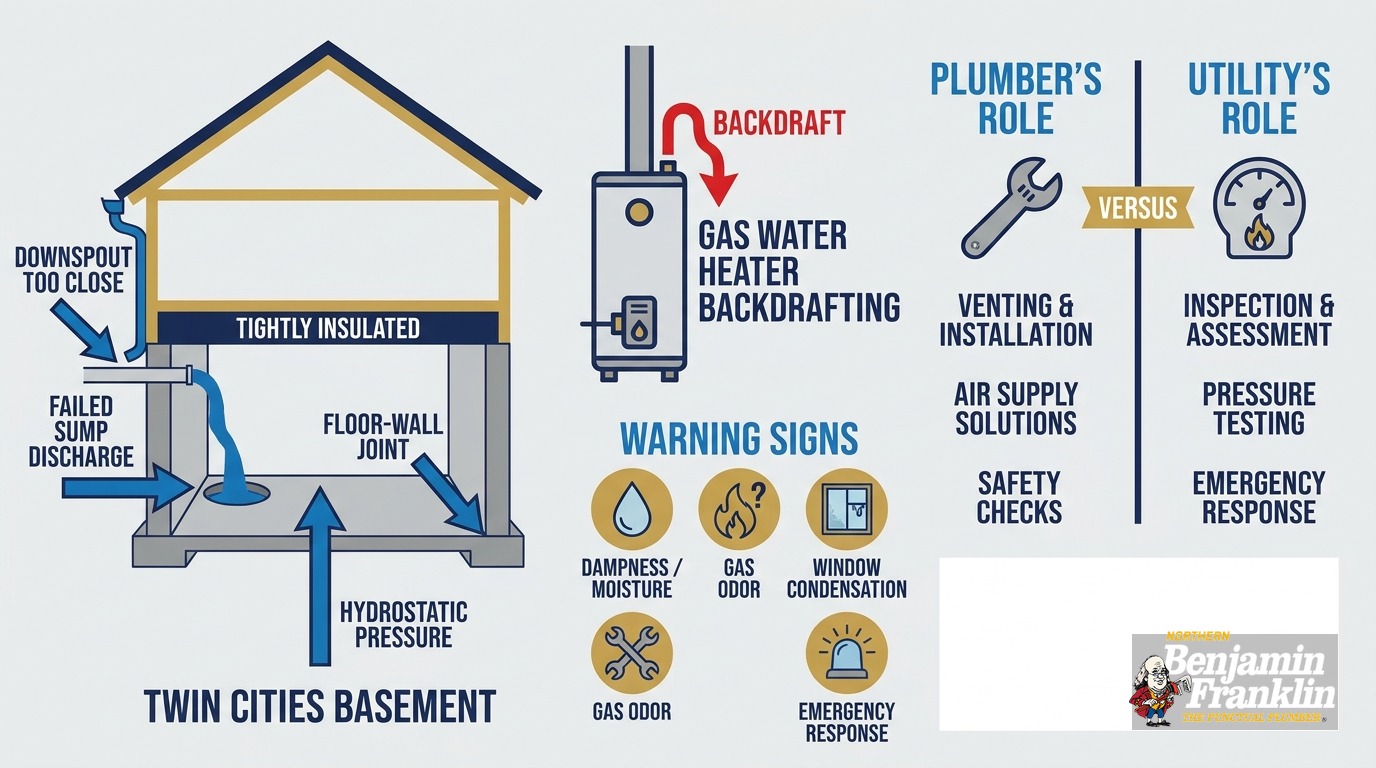
- Backdrafting happens when exhaust from a gas water heater flows back into your home instead of up the flue.
- Tighter homes make it worse. Air sealing and insulation leave spilled gas nowhere to go.
- A basement can pass a test at rest and still fail when the dryer, bath fan, and range hood run.
- Warning signs include soot on top of the tank, melted plastic near the gas pipes, and a flue that slopes the wrong way.
- Backdrafting rarely trips a CO alarm on its own, so do not rely on the alarm alone.
- The gas utility audit tests for the problem. A licensed plumber fixes it under a permit.
- Locally owned and operated Northern Benjamin Franklin Plumbing handles the plumbing side. Call (763) 296-1844 or book online.
What Is Water Heater Backdrafting?
Water heater backdrafting is when combustion gases spill back into your home instead of leaving through the flue. Those gases include carbon monoxide (CO), a colorless, odorless gas. A heater that is backdrafting can put CO into the air your family breathes.
A gas water heater burns fuel to heat water, and that makes exhaust. On most older tank units, the exhaust rises on its own through a vent pipe and leaves through a chimney or a metal flue.
That only works if the air pressure in your basement is right. The hot exhaust needs a clear path up and out. If something blocks it or pulls the other way, the gases drift into the room.
Plumbers call the first problem “spillage” and the full reversal “backdrafting.” You will hear both words. Both mean exhaust is entering the house.
We are a locally owned and operated Twin Cities plumbing company. We see this most in homes that have been updated for energy savings. The upgrade is a good one. The water heater just has to keep up with it.
Why Do Tight Twin Cities Basements Cause Backdrafting?
Tight, insulated basements cause backdrafting because the water heater cannot draw enough air, and other fans can pull exhaust back down the flue. Air sealing removes the leaks that once gave the heater air and relief. Spilled gases then stay inside.
Picture a typical Minneapolis or St. Paul house. Many were built decades ago and leaked air everywhere. That was wasteful, but it also let an old water heater breathe.
Then the owners added insulation. They sealed rim joists and sill plates. They replaced old windows. Heating bills dropped.
The Minnesota Center for Energy and Environment (MNCEE) makes this link directly. Air sealing and insulation make a home tighter, so spilled gas has nowhere to go. Their advice is to fix any spillage before that work, and to use sealed, power-vented equipment as part of it.
Our long heating season adds to the risk. For months, windows stay shut and the house stays closed up. Furnaces, fireplaces, and fans all run together. A flue that behaves in October may struggle in January.
Competing fans pull the wrong way
Other machines in your home also move air out. MNCEE notes that range hoods, bath fans, and dryers have “powerful fans and motors” that can pull gases back down the flue. The group advises against running several at once.
Take a winter evening. The dryer is running. Someone is cooking under a strong range hood. A bath fan is on upstairs. Each one pushes air out of the house, and the house pulls replacement air from wherever it can.
In a tight home, one easy source is the water heater flue. The air comes down the vent pipe and carries exhaust with it.
That is how a basement can pass a test at rest and still fail. The only way to know is to test with the fans on. Ask any tester whether they do that.
Other causes to know
Tightness is not the only cause. Others show up in Twin Cities homes too:
- Orphaned vents. A furnace upgrade to a high-efficiency model often vents out the side of the house. The water heater is left alone in the old chimney. MNCEE says it may not draft well enough there.
- Poor vent slope. Natural-draft vents need a minimum upward slope of 1/4 inch rise per foot of run. Sagging or long horizontal runs make spillage more likely.
- Disconnected or damaged flue pipe. A loose joint lets exhaust leak into the room before it reaches the chimney.
- Aging equipment. Corrosion and rust can open holes in a flue over time.
How Do You Know If Your Water Heater Is Backdrafting?
You can spot backdrafting by checking for soot, melted parts, and a flue that slopes down, then running a smoke or flame test at the draft hood. If smoke is pushed away from the hood while the burner fires, the heater is spilling exhaust. Call a plumber right away.
The Pacific Northwest National Laboratory runs the Building America Solution Center. Its guide lists these warning signs of gas water heater backdrafting:
- Melted plastic rings or washers on the gas pipes
- Soot spots on the top of the tank
- A disconnected flue pipe
- A flue pipe that slopes down rather than up
Check each one with the heater off and cool. Use a flashlight. Do not touch the flue while it is hot.
The lighter or incense test
The same guide describes a simple draft test. Run the heater so the burner is firing. Hold a lighter or an incense stick at the draft hood. The draft hood is the open collar where the flue pipe meets the top of the tank.
If the smoke or flame is “pushed away from the hood,” the heater is backdrafting. Healthy draft pulls the smoke up into the hood.
Take care with this test, because you are holding a flame near a gas appliance. If you smell gas, do not use a flame. Leave the house on foot and call 911 and your gas utility from outside.
Test again with the fans on
One pass or fail at rest does not tell you much. Repeat the smoke test with the dryer, bath fans, and range hood running. Close interior doors, too. This is the “fans on” test, and it is where many tight basements fail.
You are not the final word here. You are looking for a reason to call someone. The PNNL guide says to call a plumber “as soon as possible” if you see these signs. We agree.
Why Does My Water Heater Set Off the Carbon Monoxide Alarm?
A water heater sets off a CO alarm when exhaust spills into the room, a flue is blocked or disconnected, or the burner is running poorly. Treat any alarm near a gas appliance as real. Get everyone outside, call 911, and have the system inspected before you use it again.
The more useful question may be the reverse. Why does a backdrafting heater so often stay quiet?
The research behind this post found that a backdrafting heater rarely trips a CO alarm in several top explainers. We could not confirm that on a single linked page, so take it as a caution, not a rule. Spillage can come in short bursts. It can happen only when certain fans run. An alarm in a hallway may never see it.
A quiet alarm, then, is not proof of safety. It is one layer of protection.
What the law asks for
The Minnesota Department of Health (MDH) lists water heaters among common household CO sources. MDH also notes that detection is required in new construction and when installing boilers and water heaters, under fire and boiler codes.
Minnesota Statute 299F.50 asks for at least one operational CO alarm within 10 feet of every room legally used for sleeping. MDH says alarm lifespan is typically 5 to 7 years. Check the date on yours.
The PNNL guide lists a combination gas and CO alarm at about $50 to $60. That is their figure for the alarm, not a quote for any work from us. It is a small cost next to the risk.
If the alarm sounds
Do not open windows and wait. Do not try to find the source first. Take these steps:
- Get everyone out of the house, including pets.
- Call 911 from outside.
- Stay out until emergency crews say it is safe.
- Do not relight or restart the heater yourself.
- Schedule a licensed plumber to inspect the water heater and venting.
What Are the Symptoms of Carbon Monoxide Poisoning?
Early CO poisoning feels like the flu without the fever: headache, dizziness, nausea, and tiredness. The clues that point to CO are feeling better away from home, everyone getting sick at once, and symptoms that worsen when fuel-burning equipment runs. If you suspect CO, leave and call 911.
MDH offers a helpful way to tell CO from the flu. Look for these CO versus flu clues:
- You feel better when you are away from home.
- Everyone in the house gets sick at the same time.
- Pets seem ill.
- There is no fever or body aches.
- Symptoms worsen when fuel-burning equipment runs.
Winter makes this hard to catch. Flu season and CO season overlap in Minnesota, so a family with sniffles and headaches may blame a virus for weeks.
The stakes are real. MDH reports that Minnesota averages 14 unintentional CO deaths per year and about 300 emergency department visits per year. The same page says the CDC estimates about 400 unintentional CO deaths per year in the U.S.
Not every one of those cases comes from a water heater. But a water heater is one of the sources on the list. That is reason enough to check yours.
Who Tests for Backdrafting, and Who Fixes It?
The gas utility’s energy audit tests for spillage, and a licensed plumber or other contractor installs the fix. These are two different jobs. Knowing the split saves time and keeps you from waiting on the wrong phone call.
Many homeowners assume the utility will repair the problem. We found no source showing that. MNCEE describes it this way: Xcel Energy and CenterPoint Energy customers can ask for equipment testing during an energy audit by a certified auditor. The audit tests. It does not replace your water heater.
If no audit is available, or there is an immediate safety issue, MNCEE says to contact a heating or plumbing contractor to install sealed, power-vented equipment.
Here is how the roles line up:
| Step | Who handles it |
|---|---|
| Ask about equipment testing | You, through your gas utility’s energy audit |
| Run the test, with fans on | Certified auditor |
| Replace or fix the water heater and venting | Licensed plumber |
| Pull the permit and schedule inspection | Licensed plumber |
| Keep CO alarms current | You |
MNCEE’s free Energy Advisor Service can help you start. Its number is 612-244-2484. Ask about audit options and testing.
Where we fit in
We are plumbers, and water heaters, gas lines, and venting at the heater are plumbing work. We can inspect the unit, check the flue, and explain your options. We replace the water heater when that is the right fix.
We do not do heating, cooling, or electrical work. If the cause turns out to be a furnace or other heating equipment, we will say so and point you to the right sister company.
If you smell gas at any point, leave first. Then call. A gas smell is an emergency, not a scheduling question.
What Are the Fixes for a Backdrafting Water Heater?
The lasting fix is a sealed combustion path. That means a power-vented or direct-vent gas water heater, or a heat pump water heater, which burns no fuel. A simple vent repair may be enough only when the home is not tight and the problem is minor.
Start with the least invasive option, then move up as needed.
Repair the existing vent
Sometimes the cause is plain. A flue joint came loose. A vent run sags. The pipe lost its upward slope. A plumber can reconnect it, reslope it, or replace the damaged section.
This works when the house is not especially tight and the heater is in good shape. It is less reliable in a sealed-up basement, where a repaired vent can still fail when the fans run.
Switch to a power-vented water heater
MNCEE’s recommended fix is a power-vented water heater (PVWH). It seals combustion gases off from living space. A fan pushes exhaust out through a pipe, often through a sidewall.
That removes the dependence on natural draft, so competing fans matter far less. In many layouts the vent can also use smaller, easier-to-run plastic pipe.
MNCEE lists the cost at about $5,000. That is their figure, not a quote from us. Your price depends on the vent route, access, and permit. We give real quotes after we see the job.
For a closer look at the venting types, read our guide to power vent versus direct vent water heaters in Minnesota.
Consider a heat pump water heater
MNCEE also names a heat pump water heater as a fully electric alternative. It burns no fuel, so it makes no combustion exhaust to spill.
It suits some basements better than others, because it needs space and air around it. We cover the tradeoffs in our post on heat pump water heaters in Minnesota.
Think about the replacement timeline
MNCEE says to replace water heaters every 10 to 12 years. If yours is near that age and shows warning signs, replacement often makes more sense than patching.
Budget is a fair concern. Our breakdown of gas water heater replacement costs in the Twin Cities explains what drives the price. For larger jobs, we also offer financing. Ask when you call.
Do You Need a Permit to Replace a Water Heater in Minnesota?
Yes, in most Twin Cities suburbs. Cities enforce the state plumbing code, and that code calls for a plumbing permit when you install or replace a water heater. A licensed plumbing contractor normally handles the permit and the inspection for you.
Maplewood states that “A plumbing permit (PDF) is required for replacing plumbing fixtures and for installing or replacing a water heater per the state plumbing code.”
Brooklyn Park says the Minnesota Plumbing code requires a plumbing permit for any changes to the plumbing system, and water heaters are covered. A homestead owner may apply and do the work.
Doing it yourself is legal in some cases. But a gas water heater with venting is not a casual weekend project. A wrong vent can create the exact hazard this post describes.
What a licensed company must have
For a company, Brooklyn Park requires a valid Plumbing Contractor license on file at the MN Department of Labor and Industry. It also needs a licensed Master Plumber of Record. Gas piping work also needs a current Mechanical Contractor Bond on file with the state Department of Labor and Industry.
Ask any company you hire about all of this. It takes one quick question.
Rules vary by city. We have not confirmed every Twin Cities permit office. Your plumber should know the local requirements for your address. We also cover this topic in more depth in our post on gas line safety and permits in Minnesota.
What Should You Do This Week?
Test for draft with the fans on, check your CO alarms, and call a licensed plumber if you see any warning sign. Then ask your gas utility about an energy audit. Do these before any air sealing or insulation project.
Use this short checklist:
- Look at the heater. Check for soot on top, melted plastic near gas pipes, and a loose or downward-sloping flue.
- Run the draft test. Do it while the burner fires. Then repeat it with the dryer, bath fans, and range hood on.
- Check your alarms. Put one within 10 feet of every sleeping room. Replace any that are past their 5 to 7 year life.
- Check the date. Find your water heater’s age. Our guide to decoding a water heater serial number helps.
- Plan before weatherizing. If you are about to air-seal or add insulation, test and fix first.
- Make the call. If anything looks off, book an inspection.
Do not wait for symptoms. By then, you may have been exposed for a while.
Is a Tight Home a Bad Thing?
No. Tight homes save energy and stay comfortable. The goal is to match your equipment to the house you have now, not to leave leaks in the walls.
An open-flame, atmospheric water heater in a sealed basement is a mismatch. A sealed-combustion or electric unit fits a tight home far better. Fix the match, and you keep the savings without the risk.
That is why the order of work matters. Test and fix venting first. Then seal and insulate. A good energy auditor and a good plumber will both tell you the same thing.
How We Help
We are Northern Benjamin Franklin Plumbing, locally owned and operated in the Twin Cities. We know our basements. We know the older homes in Minneapolis and St. Paul, and the newer builds in Blaine, Maple Grove, and Coon Rapids.
When you call, we will:
- Inspect your water heater, flue, and gas connections
- Explain what we find in plain language
- Show you your options, from vent repair to a sealed replacement
- Pull the permit and handle the work to code
- Quote the job in writing before we start
We also back our schedule with the On-Time Guarantee(R). We arrive in the window you pick, or we pay you $5 for every minute we are late, up to $300. If there is any delay, it’s you we pay!
Our work is also backed by a 100% satisfaction guarantee.
Explore our full range of water heater services to see what we can do for your home.
Get It Checked Before the Next Cold Snap
A backdrafting water heater is quiet. It does not announce itself. In a tight Twin Cities basement, it can spill exhaust for months without a single obvious clue.
A short inspection can tell you whether your flue, your fans, and your water heater work together. If they do not, a sealed replacement can solve it for good.
Call Northern Benjamin Franklin Plumbing at (763) 296-1844 or book online. We will give you a clear answer and an honest quote.
Frequently Asked Questions
Is it safe to sleep in a room with a water heater? +
Do I need a permit to replace a gas water heater in Minnesota? +
How often should a gas water heater be replaced? +
Need a technician now?