
Pipes Sweating Condensation Basement: The Minnesota Answer
Key Takeaways
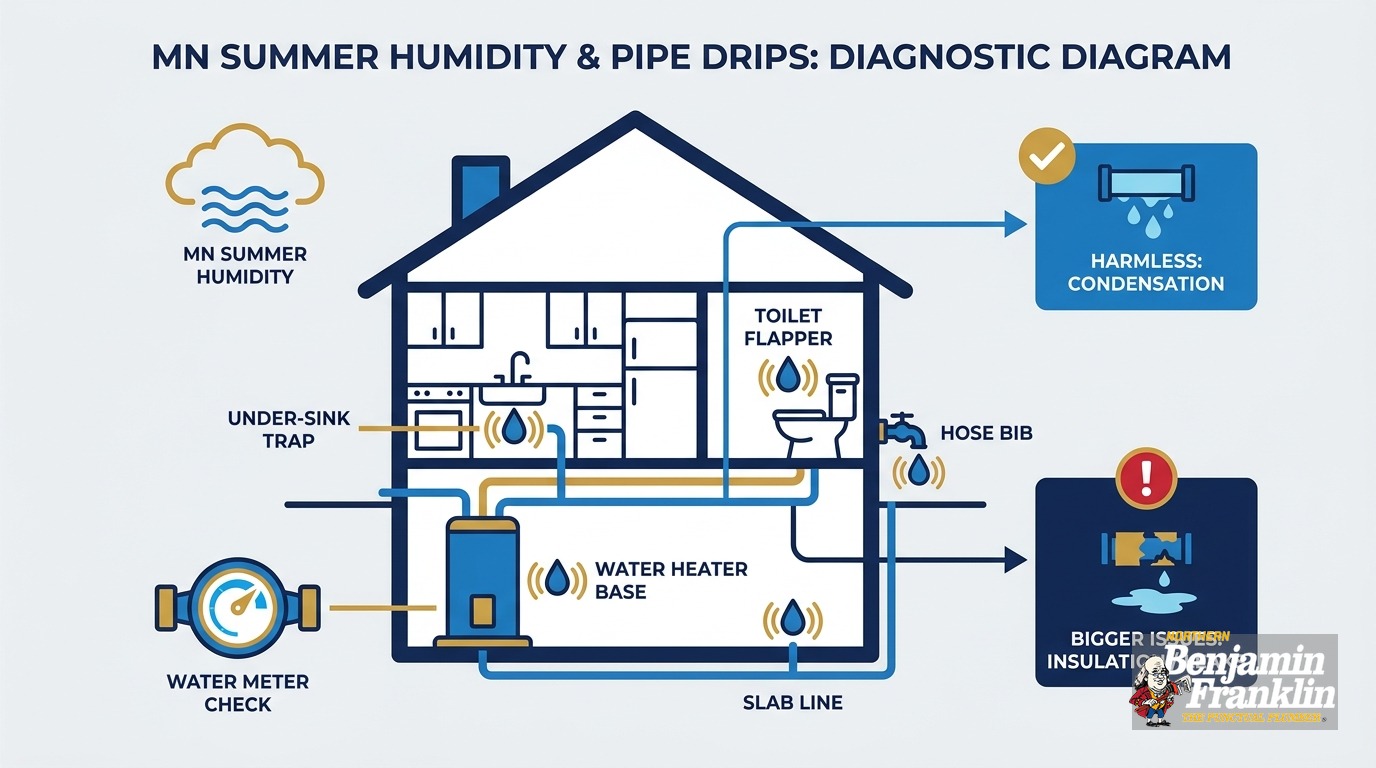
- Pipes sweating condensation in your basement is a physics problem, not a plumbing defect. In a Minnesota summer, uninsulated cold water pipes will drip.
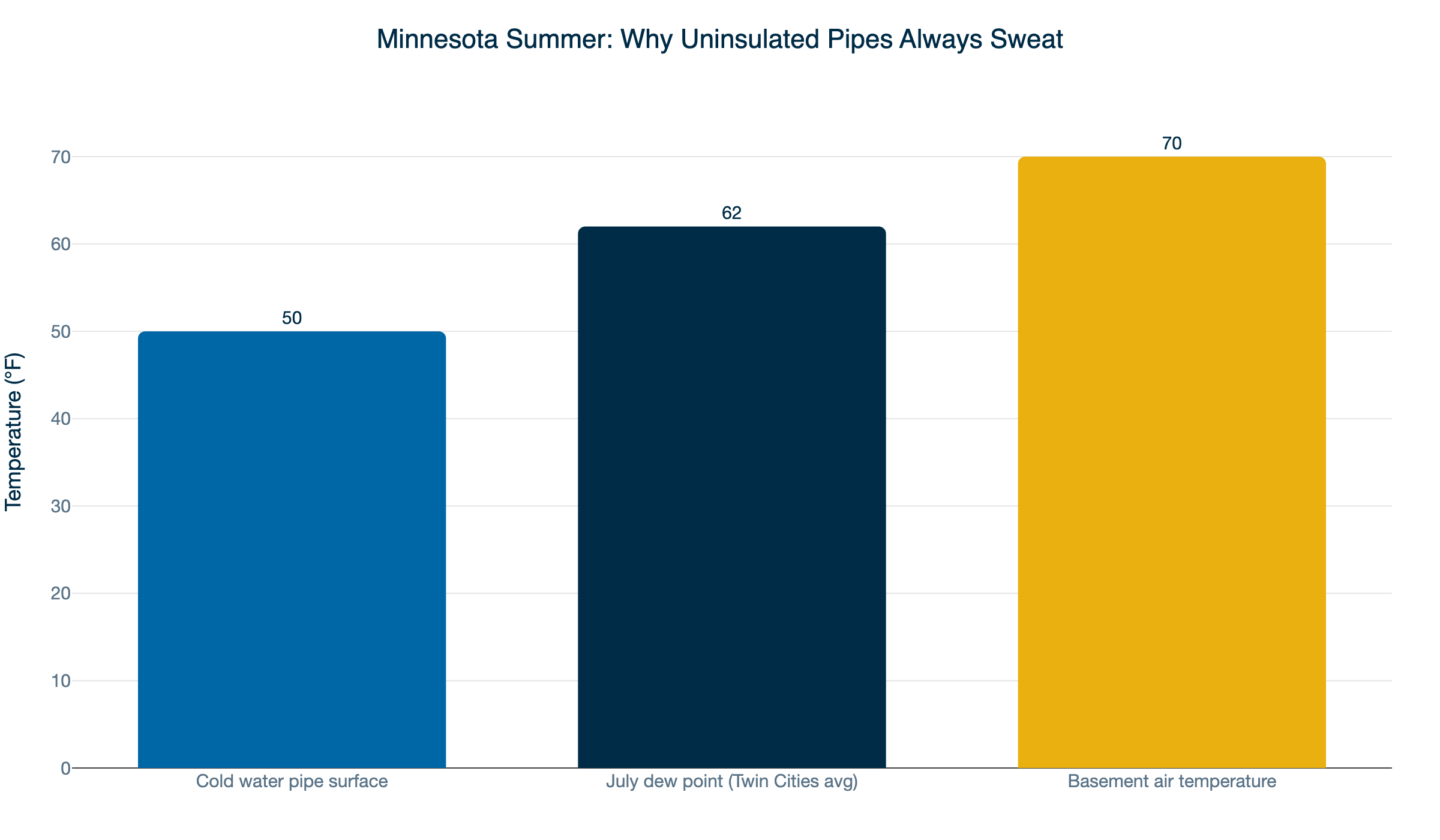
- Cold water pipes run around 50°F year-round. Twin Cities July dew points regularly reach 60-65°F. Any uninsulated pipe surface below the dew point will collect moisture.
- Left unaddressed across an entire summer, persistent dripping damages joists and subfloor and creates conditions for hidden mold growth inside wall cavities.
- The standard fix is two steps: foam pipe insulation plus a basement dehumidifier set to maintain humidity below 50%.
- If pipes still sweat after insulation, check for gaps in the foam, an undersized dehumidifier, or moisture intruding from the foundation.
- Use the dry paper towel test to separate condensation from a slow leak. Condensation spreads evenly around the pipe; a leak concentrates at a joint or drip point.
- For anything you cannot diagnose or access, call (763) 296-1844 or book online with Northern Benjamin Franklin Plumbing.
Why Minnesota Basements Have This Problem More Than Most
Cold water pipes in Minnesota deliver water at roughly 48-52°F year-round. That temperature traces back to groundwater deep below the frost line. Minnesota’s frost design depth for the Twin Cities metro runs around 42 inches. Water service lines are buried below that depth. Incoming water stays cold regardless of the season.
In July, your basement air might sit at 68-72°F. More importantly, the dew point of that air - the temperature at which moisture begins to condense out of it - often reaches 60-65°F during a typical Twin Cities summer. During humid stretches, dew points push into the upper 60s and low 70s.
A pipe surface at 50°F inside air with a 63°F dew point will sweat, without exception. The EPA puts it plainly: “As the temperature goes down, the air is able to hold less moisture. This is why in cold weather moisture can condense on cold surfaces.” A cold water pipe is exactly that: a cold surface inside warm, humid summer air.
Most articles about sweating pipes skip this explanation. They jump straight to “wrap it in foam” without explaining why. Understanding the dew point tells you whether you have a simple fix or whether the humidity in the space itself is the real driver - and those two problems have different solutions.
Minneapolis draws its water from the Mississippi River, treated at the Hiawatha Water Treatment Plant. Summer river water arrives warmer than deep groundwater - roughly 55-65°F at intake versus groundwater’s 48-52°F - but still well below summer dew points. The physics holds either way.
Is the Pipe Actually Sweating, or Is It a Leak?
The short answer: Dry the pipe completely. Wrap the suspect section in dry paper towels and wait one hour. Condensation spreads moisture evenly around the full pipe circumference. A leak concentrates moisture at a joint, a specific point on the pipe wall, or the lowest spot on the run.
This is the step most plumbing articles skip, and it is the most important one you can take. A wet pipe and water on the floor look the same whether the source is humid summer air or a cracked fitting. Wrapping an actively leaking pipe in foam insulation does not fix the leak. It hides it while the water keeps working into the framing.
Here is the test:
- Wipe the pipe completely dry with a clean cloth.
- Wrap several layers of dry paper towels around the suspect section, covering any joints and fittings.
- Secure them loosely with tape and leave them undisturbed for 60 minutes.
- Unwrap and read the pattern.
Moisture spread evenly around the full circumference points to condensation. Moisture concentrated at a joint, a fitting, or a single consistent low point points to a leak.
A pinhole leak in copper pipe can produce a surprisingly small, steady drip that is easy to misread as condensation in a humid basement. The paper towel test removes that ambiguity. If the result points to a leak, stop there and call a plumber before the water works its way into the subfloor.
What Causes Pipes Sweating Condensation in the Basement?
The short answer: Warm, humid basement air meets a cold pipe surface. When the dew point of the air exceeds the pipe surface temperature - which is nearly always true in a Twin Cities July - moisture drops out of the air and coats the pipe.
The EPA’s mold course material draws the comparison directly: “When warm, humid air contacts a cold surface, condensation may form.” Their example is a cold bottle pulled from the refrigerator. A cold water pipe in your basement works by the same principle, just larger and attached to your joists.
Several factors push Minnesota basements toward this problem more than basements in drier climates:
- Groundwater temperature. Groundwater in Minnesota stays around 48-52°F year-round. That is what cold water pipes carry, even at the peak of summer. Warmer states have warmer groundwater. The gap between pipe surface and summer air is smaller there.
- Upper Midwest humidity patterns. July dew points in Minneapolis run 55-65°F on an average day. During humid stretches - which arrive in the Twin Cities every summer - they push higher. Any uninsulated cold water pipe is sweating on those days by design, not by accident.
- Basement humidity without active dehumidification. Without a dehumidifier running, an unfinished Minnesota basement can sit at 70-80% relative humidity through the summer. The EPA recommends keeping indoor relative humidity below 60%, ideally 30-50%. Most unventilated Minnesota basements exceed that threshold through the hottest weeks.
Is Pipe Condensation Dangerous?
The short answer: Not immediately, but it becomes a real problem over a full season. Persistent dripping onto wood framing starts the process for rot. Condensation hidden inside wall cavities around pipe chases creates conditions for mold growth that develops out of sight.
A slow drip through June, July, and August adds up. The wood of joists and subfloor above the drip zone stays chronically wet. The EPA is direct on the timeline: if wet materials are dried within 24-48 hours of getting wet, mold will usually not grow. A pipe that drips daily through the summer is never dried in 24-48 hours. It stays wet.
The less visible danger is inside wall cavities. The EPA specifically identifies “leaking or condensing water pipes, especially pipes inside wall cavities or pipe chases” as a primary site for hidden mold growth. You cannot see that moisture accumulating. You cannot smell the mold until the colony is established. At that point, you are looking at remediation - not just a plumbing fix.
One more factor specific to the Twin Cities: water here runs at roughly 12-18 grains per gallon of hardness, which is moderately hard. Hard water leaves mineral deposits on pipe exteriors. Those deposits trap moisture against the metal surface and can obscure surface corrosion that would otherwise signal a problem. Our post on water hardness in Minneapolis and St. Paul covers how mineral buildup affects pipe condition over time.
How to Stop Pipes Sweating Condensation in Your Basement
For most exposed cold water supply lines, the fix is two steps. Do both. Doing only one often leaves a residual drip.
Step 1: Insulate the Pipes
Foam pipe insulation - the pre-slit tube style sold at any hardware store - slips over standard cold water supply lines. The foam raises the surface temperature the air actually contacts, keeping it above the dew point and stopping condensation before it forms. The EPA explicitly recommends covering cold surfaces, including cold water pipes, with insulation as a direct condensation prevention step.
A few things to get right on the installation:
- Cover every inch. A 2-inch gap in the insulation is a drip point.
- Seal the slit edge with foam-compatible tape. It is usually sold next to the insulation.
- Focus on cold water supply lines. Hot water lines run above ambient temperature and rarely sweat.
- At elbows, tees, and fittings, use pre-molded foam fittings or wrap-style insulation cut to fit. Leaving fittings bare defeats the insulation on the straight runs.
Pipe chases inside finished walls require a different approach. See the section below on hidden condensation.
Step 2: Run a Basement Dehumidifier
Even properly insulated pipes can drip if the basement is running at 75-80% relative humidity. A dehumidifier set to maintain humidity at or below 50% lowers the dew point of the air itself. That reduces the load on the insulation and protects everything else in the basement from chronic moisture exposure.
Xcel Energy and CenterPoint Energy have both offered rebates on dehumidifiers in past program years. Check current offerings at xcelenergy.com and centerpointenergy.com before purchasing, since these programs update annually and eligibility requirements change.
What If My Pipes Still Sweat After Insulation?
The short answer: Check for gaps in the foam first. If the insulation is intact and continuous, the humidity may still be high enough to overwhelm it. If dripping persists with both insulation and a dehumidifier in place, the moisture may be coming through the foundation - a different problem with a different fix.
Work through this in order:
Check every seam. Walk the full run with a flashlight. Press the slit edges. Anything that has opened will feel cool and damp on a humid day. Re-tape every gap you find, including around fittings.
Check the humidity reading. A basic hygrometer shows whether the basement is running at 55% or 80%. If the dehumidifier is running but humidity stays high, the unit may be undersized for the square footage or may have shut off because the bucket is full. An undersized or full dehumidifier is doing nothing.
Look for foundation moisture intrusion. If basement humidity stays persistently high regardless of outdoor conditions, moisture may be intruding through the foundation wall or slab. Signs include white mineral deposits (efflorescence) on concrete walls, water staining at the base of walls, and damp carpet near exterior walls. Foundation moisture intrusion does not respond to dehumidifiers alone. It requires sealing the moisture source.
Look at the pipe condition. Hard water combined with repeated wet-dry cycles from condensation accelerates mineral buildup and surface corrosion on copper pipe. A heavily corroded exterior can look wet even when dry, and the deposits can hide small leaks beneath them. If the pipe surface looks rough or heavily stained, a licensed plumber’s eyes are the right next step.
The Hidden Danger: Condensation Inside Wall Cavities
Exposed basement pipes are the visible problem. The harder problem is the pipes running inside finished walls, up through interior partitions, and along enclosed pipe chases.
When a condensing pipe runs inside a finished wall, the moisture has nowhere to evaporate. It wets the insulation inside the cavity. It wets the back side of the drywall. It wets the framing. None of this is visible from outside the wall, and the conditions inside are close to ideal for mold: persistent moisture, limited airflow, organic material to colonize, and temperatures in the mold-growth range.
The EPA flags this directly: mold can develop inside wall cavities around condensing pipes, hidden from view. The problem builds over weeks. The first sign the homeowner usually notices is a smell - or a stain or soft spot on the drywall surface - by which point the colony is already established.
Signs that wall-cavity condensation has become a larger problem:
- A musty odor near a pipe chase or interior wall, specifically during humid months
- Soft spots, bubbling paint, or persistent peeling on interior walls near plumbing runs
- Discoloration on drywall in areas where pipes are known to run
- Allergy-type symptoms that worsen in specific rooms of the house, particularly in summer
If any of those describe your situation, the right move is a plumber’s assessment - not more insulation tape on the pipes you can see.
Three Signs It Is a Real Leak, Not Condensation
This distinction drives completely different repairs. Condensation is a moisture management problem. A leak is a plumbing repair. Getting them backward delays the real fix and lets hidden water damage accumulate.
Moisture concentrates at a joint or fitting. Condensation forms along the full length of a cold pipe, roughly evenly distributed. A leak originates at one specific point: a joint, a fitting, a shutoff valve packing nut, or a specific location on the pipe wall. If the wettest spot is consistently at a connection, run the paper towel test on that area before assuming it is condensation.
The drip continues when the air dries out. Run the air conditioning on a cool, dry day. If the pipe is still dripping when outdoor dew points are below 50°F, the moisture is coming from inside the pipe - not from the air around it. Condensation stops when the dew point drops. A leak does not stop because the weather changed.
The drip is at the same low point every time. Condensation forms across the pipe surface and can run in any direction depending on the pipe slope and nearby air movement. A slow leak travels by gravity to the lowest accessible point on the pipe run and drips from there consistently. If water is pooling in one specific spot on the floor under the same point on the pipe, every time you check, that is a leak flag.
For more on reading the signs of active pipe leaks and knowing when a drip warrants immediate action, our guide on leaking pipes in the Twin Cities walks through the diagnostic process in detail.
When Should I Call a Plumber About Sweating Pipes?
The short answer: Call if the paper towel test points to a leak, if dripping continues after proper insulation and dehumidification, if pipes run inside a wall you cannot access, or if visible pipe corrosion leaves you uncertain whether condensation is masking a pinhole leak.
The DIY path handles the most common case well: exposed cold water supply lines in an unfinished basement, no leak sign from the paper towel test, and humidity manageable with a dehumidifier. Foam insulation and a dehumidifier can resolve that in an afternoon.
Call a licensed plumber when:
- The paper towel test shows moisture at a joint or at a consistent low point on the run
- Pipes inside finished walls are involved and you cannot access them without opening drywall
- Corroded or pitted copper pipe raises questions about whether the pipe needs replacement - our page on pipe insulation and exterior wall freeze risk covers when pipe condition warrants a professional look
- The condensation is widespread across many lines and you suspect a broader moisture or mechanical issue is driving it
- Any work involves cutting pipe, making new connections, or modifying the water supply line - Minnesota Plumbing Code requires licensed plumbers for residential water supply and drain work, and the Minnesota Department of Health administers drinking water safety standards for nearly 10,000 public water supplies across the state
Northern Benjamin Franklin Plumbing is locally owned and operated in the Twin Cities, backed by the Benjamin Franklin Plumbing franchise. When you schedule a visit, you pick the arrival window. Our On-Time Guarantee(R) backs it up: If there is any delay, it’s you we pay!
Call (763) 296-1844 or book online. Whether you have a drip you cannot diagnose, a pipe chase you cannot access, or a basement moisture problem that insulation alone has not solved, our team shows up in the window you pick - and gets to the bottom of what is actually happening with your pipes.
Frequently Asked Questions
Why are my basement pipes sweating in summer? +
How do I tell if my pipe is sweating or actually leaking? +
Will pipe insulation stop basement condensation? +
Need a technician now?