
Slab Leak Detection Minneapolis: The Freeze-Thaw Guide
Key Takeaways
- Slab leak detection in Minneapolis requires understanding one specific threat: repeated freeze-thaw cycles that stress every under-slab joint over decades, often without visible surface damage until the problem is advanced.
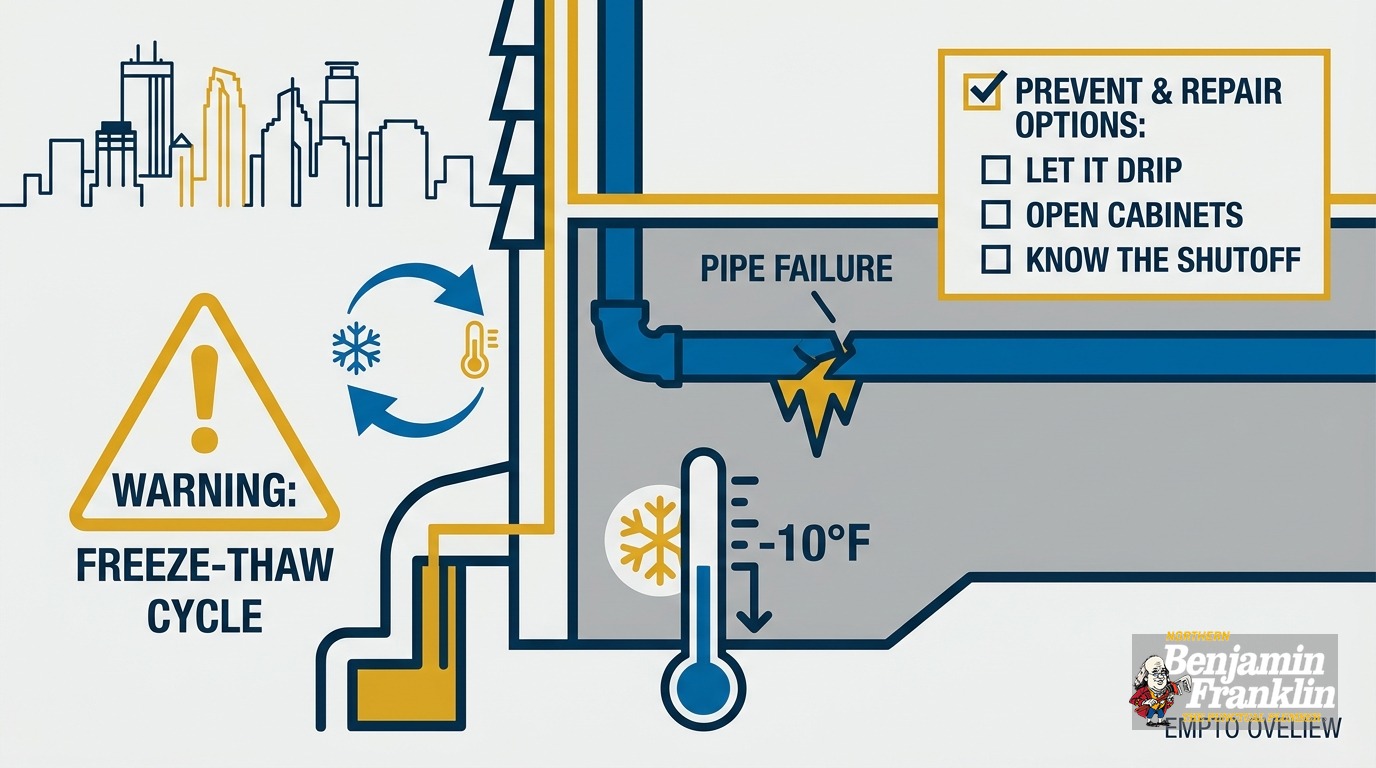
- Frost in the Twin Cities penetrates 4 to 6 feet deep. That cycle repeats dozens of times each winter, micro-shifting soil around buried pipes with every thaw.
- Post-war slab homes across Bloomington, Richfield, and the south metro were built in the 1950s through 1970s. The copper supply lines embedded in those slabs are now in their failure age window.
- Early warning signs include a climbing water bill, warm or damp spots on the floor, low water pressure without a clear cause, and the sound of running water when every fixture is off.
- Four repair options exist: pipe rerouting, under-slab tunneling, epoxy pipe lining, and direct jackhammer access. The right choice depends on the number of leaks, pipe condition, and access.
- Minneapolis homeowners own their private sanitary lateral all the way to the city main, including the portion that runs under the street.
- Late April through early June is the best window to schedule an inspection before summer construction fills the calendar.
What Makes Slab Leak Detection in Minneapolis Different?
Slab leak detection in Minneapolis is shaped by conditions specific to this metro: deep frost, a large inventory of post-war slab homes, aging pipe materials, and moderately hard water that narrows pipe bore over time. The result is a failure profile that generic national resources miss entirely.
Most slab leak articles describe the basic mechanics. Pipe cracks. Water seeps. Floor gets wet. What those articles skip is why Twin Cities homes face this problem at a higher rate than homes in most other parts of the country, why the damage builds quietly for years before surfacing, and why the repair decision here carries more variables than a simple pipe patch.
The answer comes down to cumulative stress. Minneapolis is not particularly unusual for any one factor in isolation. It is the combination, working on the same pipes for 50 or 60 years, that produces the failure profile local plumbers see in older slab homes. By the time a homeowner notices the water bill climbing, the damage has usually been building for a while.
This guide covers the mechanism, the warning signs, how detection works, what repair options make sense for Minnesota conditions, and the one piece of homeowner liability that surprises nearly everyone.
What Is a Slab Leak, and How Does Freeze-Thaw Cause It?
A slab leak is any water or drain line failure located beneath a concrete slab foundation. In the Twin Cities, the primary driver is cumulative joint fatigue from decades of freeze-thaw cycles. The mechanism is not a single freeze event but hundreds of small soil shifts acting on the same joints over years.
Here is the specific sequence.
Frost penetrates 4 to 6 feet deep in the Twin Cities, depending on snowfall, soil type, and temperature severity. Frozen water expands roughly 9% in volume. In a single Minnesota winter, that cycle runs through dozens of repetitions.
Pipes buried below the frost line are not automatically safe. The soil above and around buried pipes still expands and contracts even when the pipes themselves are below the frost line, shifting older brittle materials out of alignment with each cycle. Minnesota Plumbing Code (MN Rules Part 4714.0609) requires supply and yard piping to be buried at least 12 inches below the maximum local frost depth. In the Twin Cities metro, that frost depth is approximately 48 inches. In northern counties, it reaches 60 inches. Correct burial depth protects against direct freeze loading, but it does not protect against the soil movement that continues above.
The pipes at highest risk in the existing housing stock are the copper supply lines embedded in post-war slab-on-grade construction. Slab construction concentrated in Bloomington, Richfield, and southern metro suburbs was built between the 1950s and 1970s. Those copper lines are now 50 to 70 years old, solidly in the failure window for supply pipe that has never been accessed or inspected.
Drain lines carry their own risk. Older Minneapolis sewer systems commonly use clay tile, cast iron, and Orangeburg pipe, all of which become more brittle with age and are especially vulnerable to joint separation from seasonal soil movement. When those materials sit beneath a concrete slab, inspecting or repairing them requires planning.
The key word is cumulative. One freeze-thaw cycle does very little visible damage. Three hundred of them, acting on the same joint, is a different story.
What Are the Warning Signs of a Slab Leak?
Watch for a climbing water bill, warm or damp spots on the floor, low water pressure throughout the house, the sound of water running when every fixture is off, and cracked or heaving concrete. Any single sign can have another explanation. Two or more together warrant an immediate call to a licensed plumber.
Here are the signs to take seriously:
A water bill spike with no obvious cause. A pressurized supply line leak under a slab can lose thousands of gallons a month before any surface damage appears. If your bill climbed and nothing in your habits changed, the water is going somewhere you cannot see.
Warm or damp spots on the floor. A leaking hot-water supply line heats the concrete above it. Walk your floor barefoot on a cool morning. A spot noticeably warmer than the surrounding slab is a red flag. A persistently damp patch on an otherwise dry floor in a cool season points in the same direction.
Low water pressure throughout the house. Pressure drops when water escapes before it reaches the fixture. If the drop is house-wide rather than isolated to one faucet or one zone, the leak is likely on the main supply side. Localized low pressure at a single fixture has other common causes; a whole-house drop is different.
The sound of running water with everything off. Turn off every fixture, the dishwasher, and the washing machine. Stand quietly on the main floor. A faint hiss or gurgle that stops when you close the main shutoff valve is a strong indicator of an under-slab supply leak. If you have not located your main valve, our guide to finding and testing your main water shutoff valve walks through that step.
Cracked, heaving, or wet concrete. A slow slab leak saturates the sub-base over months. The concrete may crack, buckle slightly, or feel damp in patches. By the time you can see or feel this, water has been moving under the floor for a while.
A persistent mold or mildew smell at floor level. Sustained moisture under a slab creates ideal conditions for mold even when no visible water is present. If the smell is specific to one area and lingers after ventilating, treat it as a leak signal, not a cosmetic issue.
If you see two or more of these at the same time, close the main water shutoff before running more water through the system. Additional flow through a compromised line makes the damage worse and makes the eventual repair more complicated.
How Does Slab Leak Detection Minneapolis Actually Work?
Licensed plumbers use acoustic listening devices, electronic amplification equipment, and thermal imaging cameras to locate a leak under a slab without opening the floor. The goal is to arrive at a repair with exact coordinates, not guesses, so demolition is as targeted as possible.
The process typically runs in a few stages:
Pressure testing. The plumber isolates sections of the supply or drain system and subjects each to a controlled pressure test. A line that loses pressure faster than expected confirms a leak in that section. This step narrows the search before any specialized equipment is deployed.
Acoustic detection. Specialized microphones amplify the sound of water or gas escaping through a breach. The technician moves the sensor across the slab surface and maps the acoustic signature. Water escaping a pressurized pipe produces a distinctive sound pattern that shifts in frequency and amplitude as the sensor approaches the source. Experienced technicians can narrow the location to within a foot or two before touching the floor.
Thermal imaging. A leaking hot-water line heats the slab above it. An infrared camera turns that temperature difference into a visual map, usually confirming what the acoustic scan found. In Minnesota’s colder months, the contrast between a heated leak point and the surrounding cold slab is particularly sharp. Thermal imaging works well here for exactly that reason.
Camera scoping. For drain lines, a camera probe travels the length of the pipe and transmits a live image while a surface locator tracks the camera head’s exact position. This reveals joint offsets, root intrusion, pipe material condition, and the precise depth and location of any damage across the full run.
None of this is speculative opening of the floor. The process produces a confirmed location with depth, not a rough estimate. That matters because the cost of repair scales directly with how much concrete has to move.
What Are Your Repair Options?
Twin Cities homeowners have four main paths for a slab leak: pipe rerouting, under-slab tunneling, epoxy pipe lining, and direct jackhammer access. The right choice depends on how many leaks exist, how corroded the line is, and where it runs relative to your foundation and floor plan.
Here is how the options compare, with third-party cost figures for context:
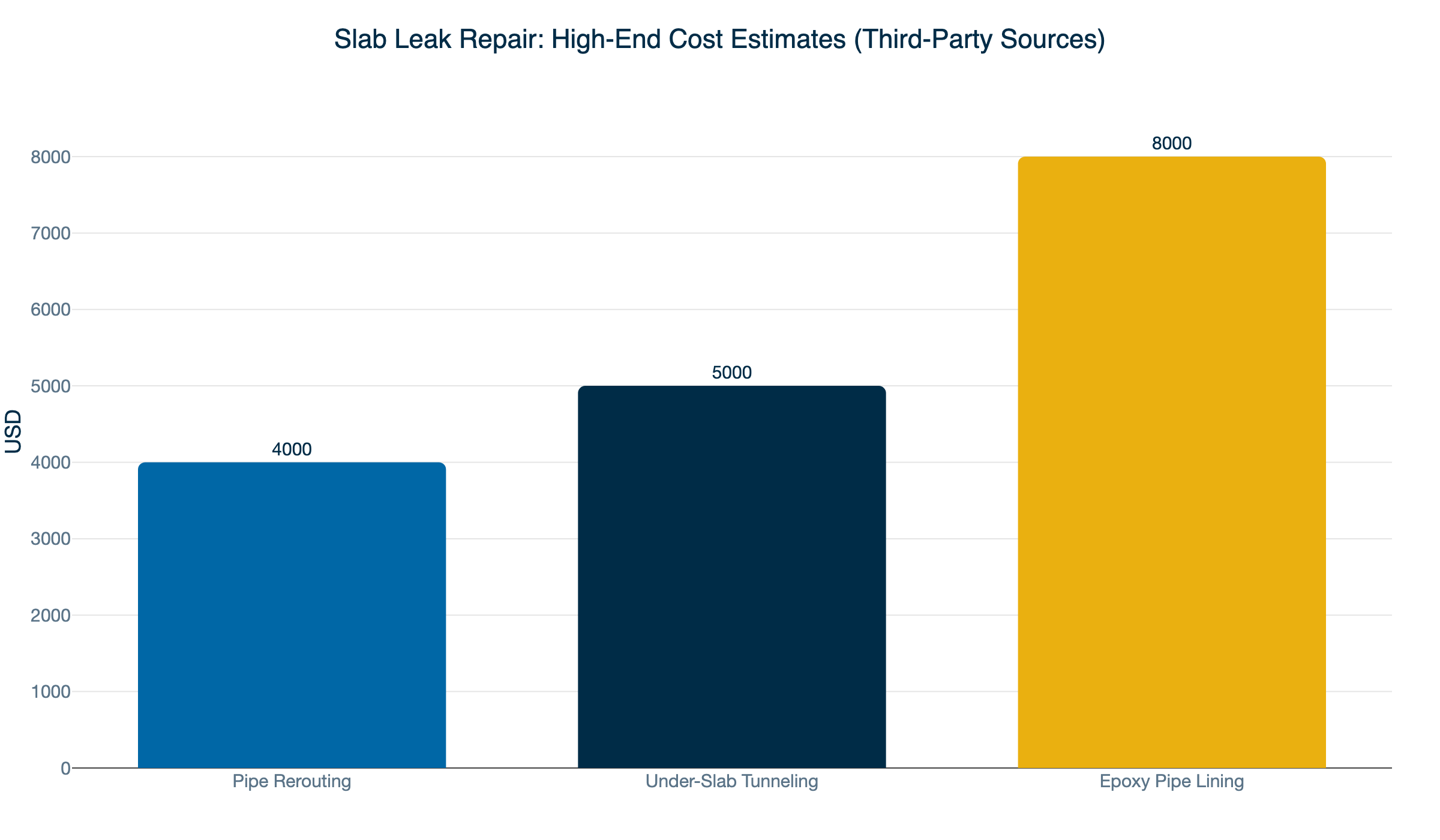
Pipe rerouting. The plumber abandons the slab-embedded line and runs a new one through the walls, ceiling, or attic. Third-party cost estimates run $1,500 to $4,000 for this method. It is the right choice when a pipe has multiple failure points or is corroded throughout. You are not patching the problem; you are bypassing the entire degraded run with new material. Rerouted lines are typically PEX, which handles Minnesota’s freeze-thaw stress better than aging copper. For a full comparison of materials in an older home, see our post on PEX versus copper for a whole-house repipe.
Under-slab tunneling. Workers dig horizontally beneath the foundation from outside, without cutting the floor from above. Third-party cost estimates run $2,000 to $5,000 for this approach. It is the preferred option for a single, isolated, accessible leak. Your finished floor stays intact, the excavation is contained, and the disruption is far lower than anything involving a jackhammer. When frozen ground limits exterior access through March, this option requires scheduling into the spring window.
Epoxy pipe lining (trenchless). A flexible liner coated in epoxy is inserted into the damaged pipe and inflated against the interior wall, creating a smooth new surface inside the old one. Third-party cost estimates run $3,500 to $8,000. The method works only when the host pipe is not severely corroded; the liner needs structural material to bond against. In older Twin Cities slab homes with decades of mineral scale and thin-walled copper, pipe condition often rules this option out before cost becomes a factor.
Direct jackhammer access. When the leak is in a deep, inaccessible location and neither tunneling nor rerouting solves the problem, the slab is opened from above. This carries the highest disruption: concrete removal, subfloor disturbance, and potentially temporary relocation during the work. It is the method of last resort.
Minnesota-specific consideration: permit requirements apply to certain drain and lateral repairs. A licensed plumbing contractor pulls the permit on your behalf. Skipping it creates a liability and the city will not accept an unpermitted repair as compliant.
For guidance on drain and sewer infrastructure repairs that extend beyond the slab, see our sewer line repair and replacement service page.
Who Owns the Pipe Under Your Slab and Under Your Street?
In Minneapolis, homeowners own their private sanitary lateral from the house foundation all the way to the city main, including the portion that runs beneath the street. If a pipe fails anywhere on that stretch, the repair cost is yours, unless a professional diagnosis finds the fault is in the city’s portion.
This surprises a lot of homeowners. Most assume the city takes responsibility somewhere at the property line or the curb. In Minneapolis, that assumption is wrong, and discovering it mid-emergency is expensive.
Minneapolis homeowners are responsible for their private sanitary lateral from the house all the way to the city main, including the section under the street. That lateral can run 30 feet or more beneath the pavement before it connects to the city system.
A permit is required for lateral repair in Minneapolis. A licensed plumbing contractor typically pulls it on your behalf. Do not skip the permit: unpermitted sewer work creates a legal liability, and the city will not accept the repair as compliant without documentation in hand.
There is one important exception. If a homeowner hires a plumber and the problem turns out to be in the city’s pipe, the city will reimburse a portion or all of the repair cost. This does not happen often, but it does happen. A thorough professional diagnosis before you authorize a full lateral replacement tells you exactly which scenario you are in, and that information alone is worth the cost of the inspection call.
One More Factor: Minneapolis Water Hardness
Water chemistry is part of the slab leak equation in this market, and most national articles never mention it.
Minneapolis finished (treated) water hardness runs approximately 92 ppm, or 5.4 grains per gallon, per the city’s monthly plant effluent analysis. That is moderate. The city removes hardness from its Mississippi River source water before distribution; pre-treatment source water runs significantly harder.
Over decades, even moderate hardness deposits mineral scale on the interior walls of copper pipes. In a pipe embedded in a slab, where access is difficult and replacement requires excavation, that scale narrows the bore gradually and raises internal operating pressure over time. Higher pressure accelerates the fatigue cracking that freeze-thaw soil movement initiates. The two failure mechanisms reinforce each other: the frost weakens the joint, the elevated pressure finds the opening.
This is why slab leak repair in older Twin Cities homes sometimes turns up pipes that are not just cracked at one point but thinned and pitted across a long run. The crack is where the water came out. The scale and operating pressure are part of why the pipe could not hold the stress anymore.
For a full look at how Twin Cities water hardness affects your pipes and what homeowners can do about it, see our post on water hardness in Minneapolis and St. Paul.
When Is the Best Time to Schedule a Slab Leak Inspection in Minnesota?
Late April through early June. The freeze cycle is over, joint offsets from heaving soil are fully visible, the ground has thawed enough for exterior access if tunneling is needed, and the full summer construction window is open. Waiting until fall means scheduling into a compressed calendar with fewer available contractors.
The optimal window to scope a Minnesota lateral and inspect under-slab systems is late April through early June. Root systems become active in spring and push into any existing cracks or joint gaps, which makes intrusion easier to find. Any joint offsets caused by winter soil heaving are at peak visibility. Summer contractors book fast in the Twin Cities, particularly for work that involves excavation or concrete restoration.
If you noticed warning signs this past winter, spring is the time to confirm what happened. A problem found in May gives you months to plan the repair and choose the right method. A problem found in November gives you a short window before the ground freezes again and your options narrow.
If your post-war slab home has never had its under-slab lines professionally inspected, that is enough reason to schedule a look this spring. You do not need an active symptom to justify a diagnostic call. Prevention is a better outcome than emergency repair.
Get Slab Leak Detection from a Team That Knows Minnesota Winters
If you are seeing warning signs, or if your slab home has never been inspected, our team is ready to take a look.
Northern Benjamin Franklin Plumbing is locally owned and operated in the Twin Cities, backed by the Benjamin Franklin Plumbing network. We use acoustic detection, thermal imaging, and camera scoping to locate the problem before anything is opened. Once we know what we are dealing with, we walk you through the repair options honestly: which method fits your pipe condition, your floor plan, and your timeline.
Every appointment runs on the On-Time Guarantee(R). Arrive in the window you book, or we pay you $5 for every minute we are late, up to $300. “If there is any delay, it’s you we pay!” For jobs that involve significant repair work, ask us about financing options when you call.
Call (763) 296-1844 or book online. Spring inspection schedules fill quickly, and the repair window that works best opens in late April.
Frequently Asked Questions
What causes slab leaks in Minneapolis homes? +
How is a slab leak detected without tearing up the floor? +
Who is responsible for the sewer pipe under the street in Minneapolis? +
When is the best time to schedule a slab leak inspection in Minnesota? +
Need a technician now?