
Shower Cartridge Replacement: Right Part, Right Limit
Key Takeaways
- Replacing a shower cartridge is permit-exempt in Minnesota and manageable for most homeowners with basic tools.
- Cartridges are brand- and series-specific. Moen Posi-Temp showers use the 1222. Delta Monitor 1300/1400 uses the RP19804. Kohler Rite-Temp valves use the GP800820.
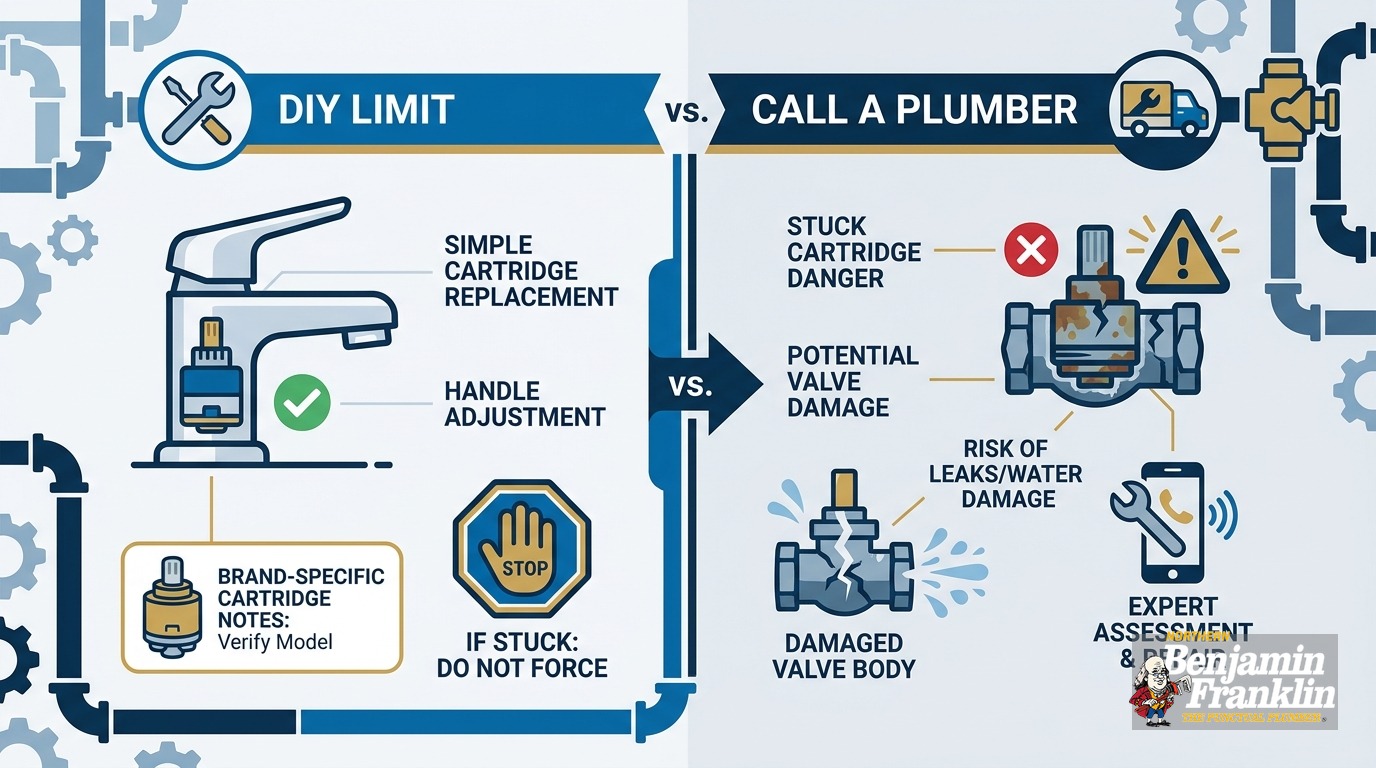
- Forcing a stuck cartridge without the brand-specific puller tool risks cracking the valve body. That converts a small part swap into a job requiring wall access, a permit, and a code-compliant ASSE 1016 valve.
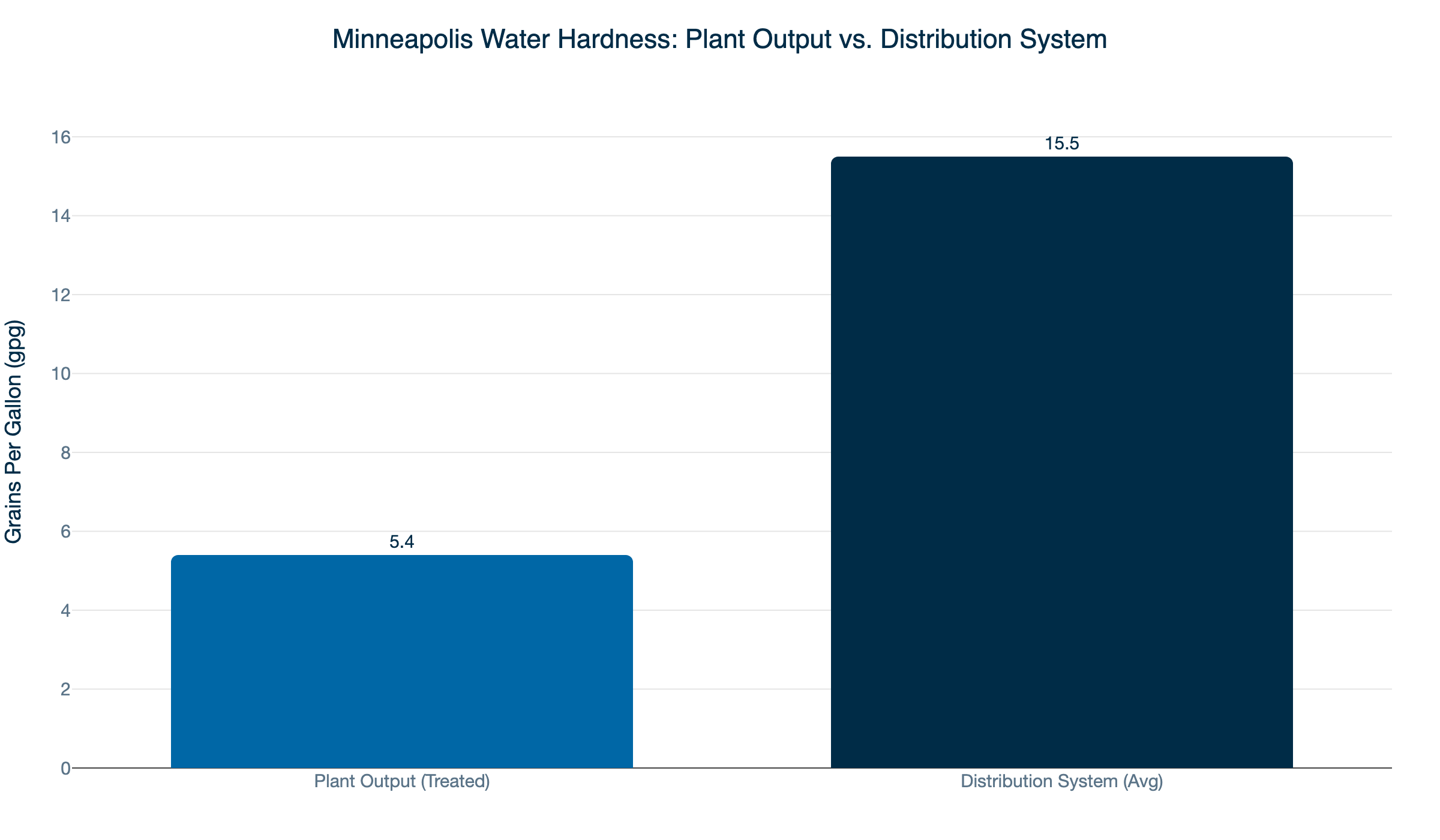
- Twin Cities distribution water averages 15 to 16 grains per gallon at the fixture, well above what Minneapolis treats at the plant. That mineral load bonds cartridges to valve seats over time.
- Original Moen homeowners can request a free replacement cartridge by calling 1-800-289-6636 with the fixture model number.
- Replacing a valve body requires a permit and an ASSE 1016 pressure-balancing valve.
- For rental properties in Minnesota, a cartridge swap requires a licensed plumber even though the work is permit-exempt for owner-occupants.
The Cartridge or the Valve Body: Why This Distinction Matters
A leaking shower handle or a temperature control that won’t cooperate usually points to the cartridge. The cartridge is the internal valve component that meters the mix of hot and cold water as you move the handle. It seals against the valve body, and when those seals fail, you get drips, temperature swings, or a handle that takes too much force to turn.
Replacing the cartridge is a legitimate DIY job. It is permit-exempt in Minnesota for owner-occupied homes. The part is available at most hardware stores, and most installations take under an hour.
The valve body is a different story. It is the brass or plastic housing cast into your wall, connected to the hot and cold supply lines. If a stuck cartridge gets forced out the wrong way and cracks the valve body, the repair jumps to a licensed plumber, a wall opening, and likely tile work. That gap between a manageable cartridge swap and a much larger job is what this post is about.
What Are Signs of a Bad Shower Cartridge?
The short answer: A worn cartridge shows up as one of four things: dripping when the handle is off, water that is hard to adjust from hot to cold, a handle that has become stiff or hard to turn, or water that never reaches the right temperature. Any of these points to the cartridge before other components.
A drip that continues after the handle is turned off means the cartridge’s seals have failed. Water is getting past them and finding its way out. The same worn seals cause temperature-control problems. The cartridge is what physically restricts the mix of hot and cold as you rotate the handle. When the seals degrade, the mixing ratio becomes inconsistent and unpredictable.
A handle that has grown difficult to adjust is a specific type of failure. You turn it and it moves in small stuttering increments instead of a smooth arc. That usually means wear at the cam and packing, not just the O-ring seals. The repair is the same either way, but the handle behavior tells you the wear is more advanced.
A stiff handle is worth catching early. In the Twin Cities, high mineral content in the distribution water gradually deposits scale inside the valve seat. The cartridge bonds to that scale over years. The handle gets progressively harder to turn, and eventually the drip starts. None of these symptoms demand an emergency call. But catching a stiff handle before it becomes a steady drip is easier on both the repair and your water bill.
How Do You Find the Right Shower Cartridge?
The short answer: Match by brand and then by valve series. Shape and size are not reliable guides. Three brands cover most Twin Cities showers: Moen, Delta, and Kohler. Each uses a distinct cartridge. They are not interchangeable across brands or even across series within the same brand.
Start with the brand. If there is no logo on the handle, look at the escutcheon plate or check any access panel behind the wall. Once you have the brand, the valve series gives you the part number.
The most reliable match is the model number stamped on the side of the old cartridge after you pull it. If you are ordering before you open the wall, use the brand-specific numbers in the section below.
Moen, Delta, and Kohler: The Cartridge Numbers That Matter
Each of the three major brands has one thing worth knowing before you start, beyond the part number itself.
Moen
Moen Posi-Temp single-handle shower valves use the cartridge. Most single-handle Moen faucets use the 1225. Fixtures manufactured after roughly 2009 may use the 1255 instead. These three are not interchangeable. Check the fixture model number before ordering.
Moen includes a cartridge puller tool with replacement cartridges. It is also sold separately. If you are the original purchaser of the fixture, Moen offers a free cartridge replacement under its Limited Lifetime Warranty. Call 1-800-289-6636 with the model number. Moen ships the part at no charge. Labor is not covered, and the warranty does not transfer to subsequent owners.
Delta
Delta Monitor 1300 and 1400 series valves use the RP19804. The Monitor 1700 series uses the RP32104. The plastic tops differ in color: white on the RP19804, grey on the RP32104. They are not interchangeable. For seized cartridges, Delta offers the RP25594 puller tool.
Delta explicitly warns against using channel-lock pliers on the bonnet nut. Side pressure on that nut can crack the valve body. Use a proper socket or wrench, and use the puller tool if the cartridge does not lift straight out by hand.
Kohler
Kohler Rite-Temp valves on both the K-304 and K-8304 platforms use the GP800820 pressure-balancing cartridge. The full kit including cap is GP876851. The older GP500520 has been superseded by the GP800820. A quick identification shortcut: a brass valve body indicates the K-304 platform. A black plastic mudguard indicates the K-8304 platform. The correct cartridge is the same either way.
For all three brands: shut off the water at the shower’s dedicated supply stops or at the main shutoff before removing the handle. Open the faucet after shutting off supply to relieve line pressure before you pull the cartridge.
Can You Replace a Shower Valve Cartridge Yourself?
The short answer: For most homeowners with basic tools, yes. The hard limit is the valve body. If it is cracked, corroded through, or damaged during removal, that is a licensed plumber job. The cartridge itself is the DIY limit.
A standard cartridge replacement involves these steps:
- Shut off the water supply at the shower stops or the main valve
- Open the faucet to bleed line pressure
- Remove the handle (usually one screw under a decorative cap)
- Remove the retaining clip or bonnet nut
- Pull the cartridge straight out using the brand-specific puller
- Insert the new cartridge in the same orientation as the old one
- Reinstall the retaining clip or bonnet nut, then the handle
- Turn the water back on slowly and test for leaks
Orientation matters more than most instructions emphasize. A Moen 1222 installed 180 degrees off will deliver hot water on the cold side and cold on the hot side. Most cartridges have a tab or flat edge that keys to the valve body to prevent this. Note the orientation of the old cartridge before you pull it, or take a photo first.
Under Minnesota Plumbing Code, replacing the internal components of an existing valve is permit-exempt. For owner-occupied homes, you do not need to pull a permit for a cartridge swap.
Why Does Twin Cities Hard Water Wear Out Cartridges Faster?
The short answer: Minneapolis treats water at the plant to about 5.4 grains per gallon. By the time it reaches a shower fixture through the distribution system, that hardness climbs to an average of 15 to 16 grains per gallon. That mineral load is what bonds cartridges to the valve seat over time.
Minneapolis Water Works removes roughly 65,000 pounds of hardness per day in treatment. Even so, the city’s own water quality data shows that treated plant effluent has measurable mineral content. The distribution system picks up additional calcium and magnesium as water moves through aging infrastructure before reaching your fixtures. Consumer-facing hardness averages 15 grains per gallon at the tap.
That difference matters for any component that water contacts repeatedly at a joint or seat. The cartridge is in constant contact with the valve seat. Mineral deposits accumulate at that interface year after year. In a home without a water softener, this process accelerates noticeably. The cartridge that should slide out with the puller tool can end up fused to the valve seat.
If your home has a water softener on the main line, it reduces the mineral load reaching the valve seat and extends cartridge life. The key is keeping the softener working correctly. A softener that has run out of salt or lost resin capacity passes hard water through as if it weren’t there. Our Twin Cities water hardness guide covers how local distribution hardness affects fixtures throughout your home.
What Happens When You Force a Stuck Cartridge?
The short answer: Forcing a fused cartridge with pliers instead of the brand-specific puller tool can score the brass valve seat, snap the cartridge stem inside the valve body, or crack the valve body itself. Any of those outcomes ends the DIY repair and starts a more involved job.
Before forcing anything, follow this sequence:
- Apply penetrating oil around the base of the cartridge where it meets the valve seat
- Wait 30 to 60 minutes for the oil to work into the mineral deposits
- Use the brand-specific puller tool (not pliers, not a screwdriver)
- Pull straight out, not at an angle
If the cartridge stem snaps off inside the valve body, stop. A broken stem cannot be extracted with hand tools. Attempting to dig it out risks scoring the valve seat further. This is past the DIY limit at any skill level.
A cracked or scored valve body cannot be patched or repaired. The entire rough-in valve has to be replaced. That means opening the finished wall, removing tile if it is a tiled surround, cutting and re-soldering or re-pressing the supply connections, and installing a new valve. It also requires a permit, and the replacement valve must meet current code. More on that in the next section.
If you open the wall and find damage you weren’t expecting, call us at (763) 296-1844. We can assess what is there and walk you through what the repair actually involves.
What Does Minnesota Code Require When the Valve Body Is Involved?
The short answer: A cartridge swap is permit-exempt. Replacing the valve body is not. Any new or replacement shower valve in Minnesota must meet ASSE Standard 1016 for pressure balancing and must hold mixed water temperature at or below 120 degrees Fahrenheit.
Minnesota Rules Chapter 4714, the Minnesota Plumbing Code, requires all shower and tub-shower combination valves to be pressure-balancing, thermostatic, or combination type per ASSE Standard requirements. This applies to both new installation and replacement work. If you are replacing a damaged valve body with an older non-anti-scald type, it will not pass inspection.
Replacing the internal components of an existing valve (the cartridge) is explicitly permit-exempt under the code. Brooklyn Park’s permit exemption list and 4Front Energy’s Minneapolis permit guide both confirm this. You do not need a permit to swap a cartridge in an owner-occupied home.
Replacing the rough-in valve itself is a different job and requires a permit. The Anoka County residential plumbing checklist and the state code both confirm this requirement. If your shower repair escalates to a valve body replacement, the new valve must be ASSE 1016-compliant. A like-for-like swap of a non-pressure-balancing valve body is not a code-compliant repair.
One more consideration for rental property owners. The homeowner permit exemption applies only to owner-occupied primary residences. Minnesota Plumbing Authority’s residential requirements make clear that rental property repairs require a licensed plumber, even for work that would be permit-exempt for an owner-occupant.
If the valve body repair intersects with broader pressure issues in your home, it is worth checking your pressure reducing valve before the plumber visits. A failing PRV can affect shower performance even after the valve is replaced.
When to Call Northern Benjamin Franklin Plumbing
The cartridge is the DIY limit. When the work moves past it, you need a licensed plumber, the right parts, and a permitted installation.
We are locally owned and operated in the Twin Cities. Northern Benjamin Franklin Plumbing backs every service call with the On-Time Guarantee(R): we arrive in the window you pick, or we pay you $5 for every minute we are late, up to $300. “If there is any delay, it’s you we pay!”
Call us at (763) 296-1844 or book a service call if any of these apply:
- The cartridge stem snapped off inside the valve body
- The valve body is cracked or shows scoring at the seat
- You pulled the cartridge and found internal corrosion or damage you did not expect
- Your shower valve is not an ASSE 1016 pressure-balancing type and needs a code-compliant replacement
- You own a rental property in Minnesota
- You cannot identify the brand or valve series
For related faucet questions, our guide on whether a kitchen faucet swap is a DIY job or a pro call walks through the same decision framework. If your shower scalds when a toilet flushes, that is a pressure-balancing valve issue, not a cartridge problem. We can handle both.
Frequently Asked Questions
Are bathtub faucet cartridges universal? +
Does Moen cover shower cartridges under warranty? +
Need a technician now?