
Under Sink Tankless Water Heater: Is It Right for Your Home?
Key Takeaways
- An under sink tankless water heater is a point-of-use (POU) electric unit that heats cold water on demand at a single fixture. There is no stored tank and no standby heat loss.
- It solves the long-wait problem best when your home has no practical path for a hot water return line.
- Pre-1980 Twin Cities homes are the most common candidates. They were rarely plumbed with a dedicated return loop.
- Minnesota groundwater runs 40-45°F in winter. Size up one class from what the national spec sheet recommends.
- Twin Cities metro water is hard: roughly 9-10 grains per gallon on city water, 12-20 on suburban private wells. That accelerates scale buildup inside small heating elements.
- POU units do not qualify for ENERGY STAR utility rebates, Xcel Energy rebates, or the federal 25C tax credit.
- Installation requires a licensed plumber and a plumbing permit. A new dedicated electrical circuit needs its own permit and a licensed electrician.
The Problem With Waiting for Warm Water
You turn on the kitchen faucet and wait. Twenty seconds. Forty seconds. A full minute. The water finally warms up, and by then a half-gallon or more has gone down the drain.
This is one of the most common complaints we hear from Twin Cities homeowners. Your water heater is probably fine. The problem is distance.
Hot water sitting inside a long pipe loses heat to surrounding walls, floor joists, and concrete. When you open the tap, that cold water has to travel the full length of the supply line before anything warm arrives. A kitchen 50 or more feet of pipe away from a basement water heater can take 60 seconds or longer.
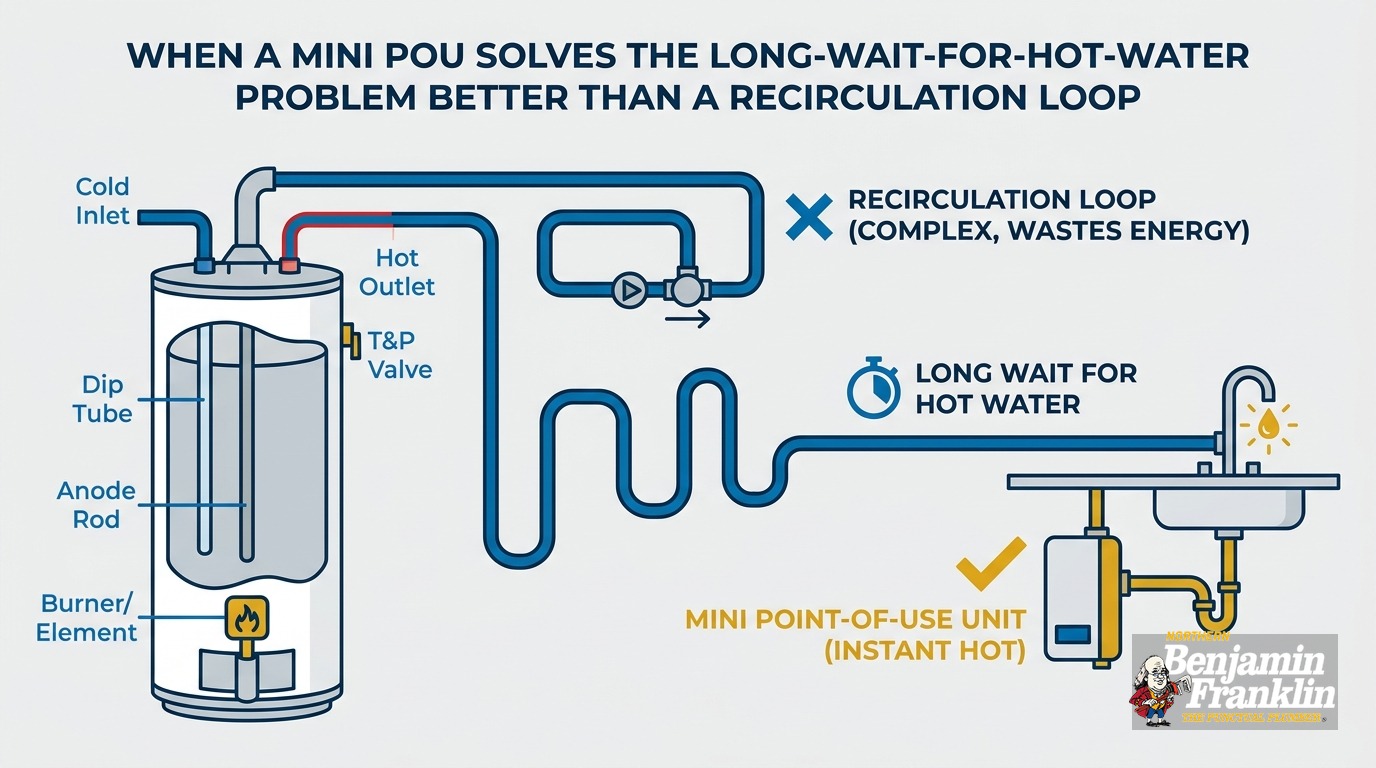
Two solutions exist for this problem. A hot water recirculation pump keeps hot water moving through a return loop so it is always nearby. An under sink tankless water heater skips the loop entirely and heats water right at the fixture where you need it.
Both solve the same complaint. The right choice depends on your home’s layout, your pipe configuration, and your electrical panel.
What Is an Under Sink Tankless Water Heater?
A small electric unit installed in the cabinet beneath a sink or near an appliance. It heats cold water on demand as it flows through, delivering warm water to that fixture in seconds. There is no stored tank and no water sitting hot between uses.
These are also called point-of-use units or mini-tankless heaters. They supplement your existing water heater rather than replacing it. A typical kitchen unit draws 3.5-8 kW and mounts inside the under-sink cabinet. Water enters cold, passes through the heating element, and exits at the temperature you set.
The tradeoff is equally straightforward: you are solving one fixture at a time. If you want fast hot water at every tap throughout the house, you need a different strategy. An under sink tankless water heater is a targeted solution, not a whole-home one.
Understanding that distinction saves homeowners from buying the wrong product for the wrong reason.
When Does a Recirculation Pump Win Instead?
When your home has an accessible hot water return line, or your plumber can route one without major disruption. A whole-home recirculation pump delivers fast hot water at every fixture in the house. If the pipe layout cooperates, it is usually the better investment per fixture.
A recirculation system keeps hot water moving through a dedicated return loop back to the heater. When you open any tap, warm water is already nearby. Modern systems can learn your usage pattern and schedule recirculation automatically, which limits the energy cost of keeping the pump running.
The practical limit is the return line. The water needs a path back to the heater. Homes built in the last few decades often have that return line roughed in already, or a plumber can run one through accessible utility spaces.
Older Twin Cities homes frequently do not have that path. In a two-story home built in 1955 with finished first-floor ceilings and plumbing running through exterior walls, routing a new return line means opening walls you do not want to touch. Sometimes it is simply not feasible at a reasonable cost.
When your plumber cannot find a practical return-line route, recirculation cannot do its job. That is the specific situation where an under sink tankless water heater becomes the sensible solution.
Which Twin Cities Homes Are the Best Candidates?
Pre-1980 Twin Cities homes without an accessible hot water return line. A long pipe run with no practical recirculation path is the defining condition. If your plumber says routing a return line is not feasible, a POU unit is typically the right call.
Here is the decision broken down by scenario:
| Your Situation | Better Solution |
|---|---|
| Short run (under 15 feet from main heater) | Insulate the supply pipe |
| Long run, return path accessible | Whole-home recirculation pump |
| Long run, no accessible return path | Under-sink tankless (POU) unit |
| Very hard well water, no softener | Soften the water first |
| Electrical panel near capacity | Recirculation pump (low electrical draw) |
| Detached garage bath, ADU, or far addition | POU unit |
Twin Cities homes built before 1980 are the most likely candidates. That covers most of Minneapolis, St. Paul, and the inner-ring suburbs: Edina, Robbinsdale, Columbia Heights, South St. Paul, and dozens of neighborhoods throughout the metro.
These homes were built before return-line plumbing became common practice. If your plumber cannot route a return line without opening finished walls or ceilings, an under sink tankless water heater is not just convenient. It is the only practical option available.
Does an Under Sink Tankless Water Heater Save Energy?
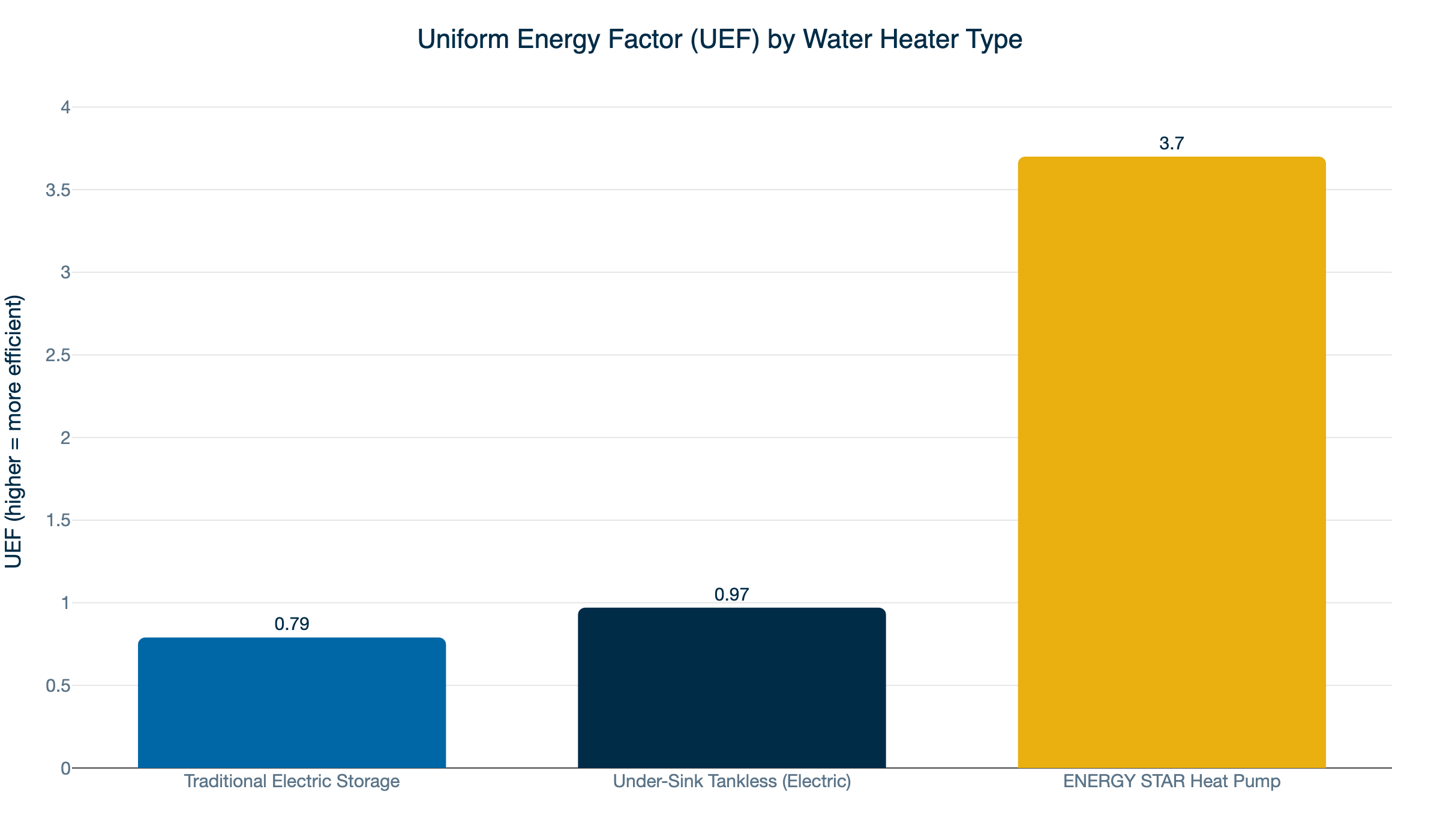
Yes, but modestly. POU electric units score 0.95-0.99 on the Uniform Energy Factor (UEF) scale, the DOE’s standard efficiency measure. That is better than a traditional storage tank. It is far below a heat pump water heater. The efficiency case is real, but it is not the reason to buy one.
Traditional electric storage water heaters score 0.63-0.95 UEF. Under-sink tankless units score higher because there is no tank of water sitting hot all day. Every unit of energy goes directly into water you are currently using.
The DOE’s April 2024 efficiency standards update projected $7.6 billion in annual U.S. household savings by pushing the market toward heat pump water heaters. Those units score 3.3-4.1 UEF, which is three to four times the efficiency of a standard electric tankless unit. If maximum energy savings is your primary goal, a whole-home heat pump water heater is a stronger case.
The energy story for a POU unit is more behavioral than mechanical. You stop running the tap for 60 seconds waiting for warm water. That is real water saved, real energy saved, and a real monthly reduction in your utility bill. The number is real; it is just harder to put a precise figure on because the variable is how long you personally let the tap run before giving up.
For a side-by-side comparison of tank and tankless options more broadly, see our post on tank vs. tankless water heaters.
Why Does Minnesota’s Cold Water Change the Sizing Math?
Because manufacturers rate their units at 58°F incoming water, and Minnesota does not have 58°F incoming water in winter. Minnesota groundwater runs 40-45°F in January and February. That gap directly reduces how much hot water a small unit can deliver at the flow rate printed on the box.
The DOE’s standard test condition for water heater ratings assumes 58°F inlet water. A unit rated for 1.0 gallons per minute at a 77°F temperature rise from 58°F will only deliver roughly 0.55-0.65 GPM at that same temperature rise from a 42°F Minnesota winter inlet. The heating element cannot warm the colder water fast enough to maintain the same flow.
The real-world result: water that feels lukewarm at the faucet even when the unit is working as designed. The problem is not the unit. The problem is buying a unit sized for Georgia and installing it in Bloomington.
The rule of thumb for Minnesota: size up one class from what the spec sheet suggests. A 3.5 kW unit is widely marketed for kitchen applications across warmer states. In Minnesota, that unit is marginal from November through March. For comfortable year-round performance at a kitchen sink, plan on 6-8 kW minimum.
This is not a small footnote. It changes which unit you should purchase. Before you buy anything, have a licensed plumber walk through the sizing with your specific fixture, pipe run length, and usage patterns. Call (763) 296-1844 to start that conversation.
What About Twin Cities Water Hardness?
Hard water shortens the life of small heating elements. The Twin Cities metro runs hard on city water and very hard in many suburban communities on private wells. Without annual descaling, scale buildup inside the unit reduces flow and eventually cracks the element.
Minneapolis Water Works treats Mississippi River surface water with lime softening. Their annual Consumer Confidence Reports show treated water hardness in the range of approximately 150-175 milligrams per liter as CaCO3, or roughly 9-10 grains per gallon. That falls in the “hard” classification by USGS standards.
Suburban and exurban communities on private wells often run considerably harder. Parts of Maple Grove, Lakeville, Woodbury, and Blaine regularly test at 200-350 mg/L or above. That is the “very hard” range, where scale buildup is aggressive.
This matters more for a POU unit than for a whole-home water heater. The heating element inside a small tankless unit is compact and runs at high temperature. Scale concentrates on it quickly. A 50-gallon storage tank has far more surface area to spread the same buildup across, which means scale accumulates more slowly and causes fewer problems over the same time period.
What to do about it:
- Descale annually if you are on Minneapolis or St. Paul city water.
- Descale every six months if you are on a suburban private well.
- If you are on a very-hard well with no treatment in place, consider installing a whole-home water softener before adding a POU unit. A softener protects every plumbing appliance in the house, not just the one under the sink.
Your plumber can evaluate your water quality and recommend a descaling schedule as part of the installation conversation.
Will This Qualify for Rebates or Tax Credits?
Almost certainly not. The ENERGY STAR rebate finder lists heat pump water heaters, high-efficiency electric storage units, and solar water heaters as rebatable product categories. Point-of-use electric under-sink units are not listed. Xcel Energy rebates in the Twin Cities metro have historically followed the same exclusion.
The federal 25C energy efficiency tax credit under the Inflation Reduction Act covers qualified heat pump water heaters. It does not cover standard electric resistance POU units.
CenterPoint Energy rebates focus on high-efficiency gas storage tanks and whole-home gas tankless units. Gas-fired POU units exist but are uncommon for under-sink applications, and their rebate eligibility varies by program year.
The absence of rebates is not a reason to rule out a POU unit. The product is solving a problem that rebates do not address: a specific fixture where hot water takes a minute to arrive and recirculation is not practical. If that is your problem, the solution stands on its own merits.
If rebates and long-term energy efficiency are your primary driver, a whole-home heat pump water heater makes the stronger financial case. The two goals point toward different products, and it is worth being clear on which one you are optimizing for before you commit to either.
What Does Installation Require in Minnesota?
A licensed plumber, a plumbing permit, and in almost every case a licensed electrician for a new dedicated circuit. Minnesota Plumbing Code Chapter 4715 requires a licensed plumber to install or replace any water heater, including point-of-use units. This is not a DIY project under Minnesota law.
Here is what installation involves in a typical Twin Cities home:
- Plumbing connections. The unit tees into the cold supply under the sink and feeds the hot side of the faucet. In most cabinets, this is an afternoon of work once the unit and circuit are in place.
- Plumbing permit. Required from your city’s building department. Minneapolis, St. Paul, Blaine, Brooklyn Park, and every suburban municipality set their own permit fee schedules. Verify current fees directly with your city.
- Electrical circuit. A 3.5-8 kW unit draws 15-40 amps at 240V. Most kitchen cabinets do not have a spare 240V circuit. A licensed electrician must run the dedicated circuit and pull a separate electrical permit.
- Panel capacity. This is the item homeowners most often overlook. Older Twin Cities homes, especially those with 100-amp service, may not have room for a new 30-40 amp circuit without a panel upgrade. A panel upgrade can easily cost more than the rest of the project combined.
If your panel is at or near capacity, the recirculation pump conversation comes back around. A recirculation pump draws a fraction of the current a POU unit requires. In a 100-amp-panel home, recirculation may be the more practical path even when the return-line routing is difficult.
Have your electrical panel evaluated before you purchase a unit. Your plumber can walk through the electrical tradeoffs with you before any money is spent on equipment.
Signs an Under Sink Tankless Water Heater Is the Right Call
You are a strong candidate if most of these apply:
- You wait more than 30 seconds for warm water at a specific fixture.
- The fixture is far from the water heater and there is no practical return-line path.
- Your home was built before 1980.
- Your electrical panel has room for a 30-40 amp dedicated circuit without an upgrade.
- You are on city water, or you already have a softener installed on a well system.
- You do not want to open finished walls to run a return line.
Consider recirculation or a different approach if:
- Your panel is at or near its capacity.
- You are on a private well with very hard water and no softener in place.
- You want fast hot water at more than one or two fixtures. A whole-home recirculation pump serves that need better.
- Rebate eligibility or maximum energy efficiency is your primary goal.
The right answer is not always visible from the outside. That is what the diagnostic visit is for.
We Are Locally Owned and We Know These Homes
Northern Benjamin Franklin Plumbing is locally owned and operated in the Twin Cities. That matters for this type of work.
We know which neighborhoods run 100-amp panels. We know which cities supply municipal water at 9-10 grains of hardness and which suburban communities draw from wells pushing 20 grains. We know which pre-war housing stock was never plumbed with a return line, and we know when a homeowner asking about a POU unit is actually better served by recirculation.
When you call us about a hot-water wait problem, we look at the actual cause before recommending a product. Sometimes it is a long uninsulated pipe run. Sometimes it is a layout that makes recirculation impractical. Sometimes the water heater itself needs attention, and our tankless water heater team handles that, too.
Our On-Time Guarantee(R) means we arrive in the window you booked or we pay you $5 for every minute we are late, up to $300. The promise in plain terms: “If there is any delay, it’s you we pay!”
If you have been standing at the sink waiting long enough to read this far, call (763) 296-1844 or book online. We will figure out whether an under sink tankless water heater, a recirculation pump, or something else entirely is the right move for your home.
Frequently Asked Questions
What is an under sink tankless water heater? +
Does an under sink tankless water heater save energy? +
Will an under sink tankless water heater qualify for rebates in Minnesota? +
Do I need a permit to install one in Minnesota? +
Need a technician now?