
Outdoor Kitchen Plumbing Minnesota: What MN Code Requires
Key Takeaways
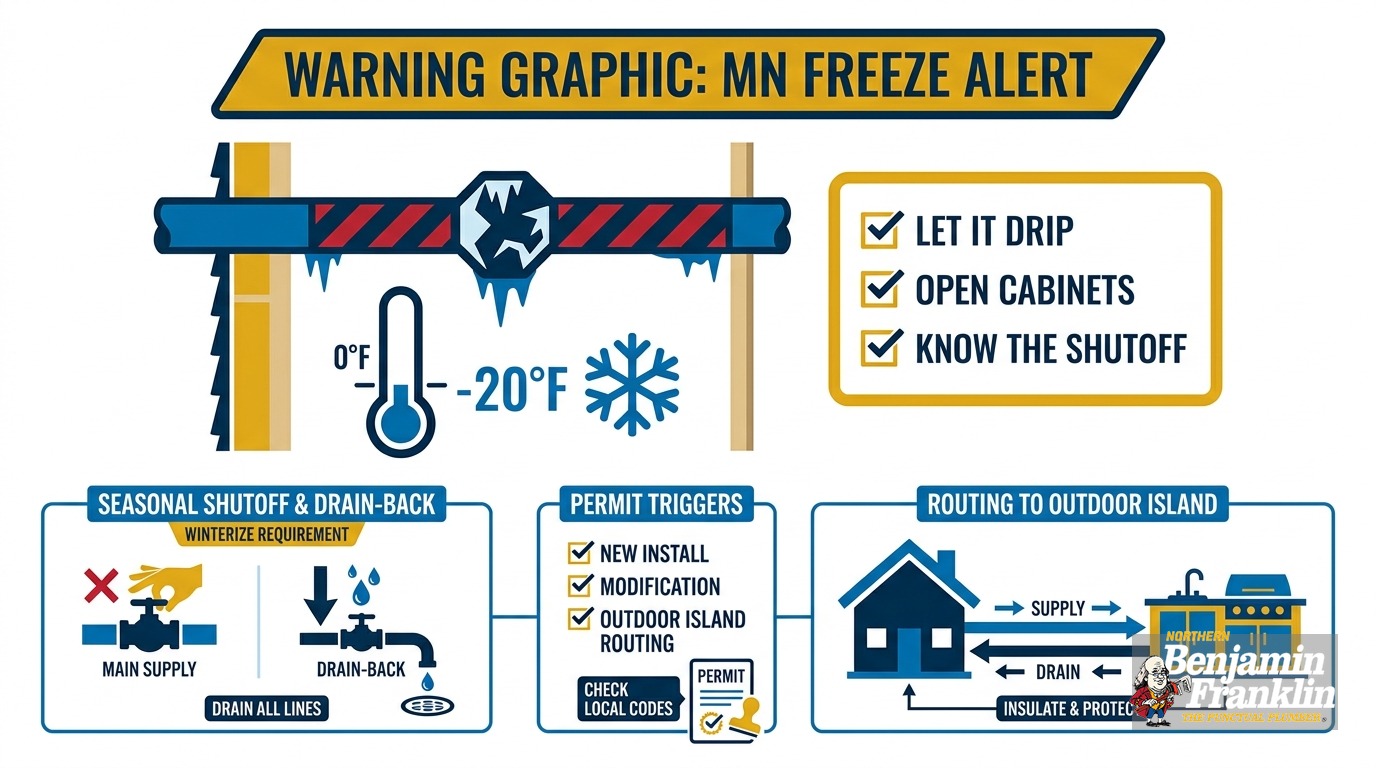
- In the Twin Cities metro, buried supply lines must extend below the 42-inch local frost depth plus 12 inches of required clearance per MN Plumbing Code Chapter 4714.
- Minnesota Plumbing Code requires a frost-free hose bibb with a backflow preventer on every outdoor water connection.
- Underground stop-and-waste valves that drain into the soil are prohibited. Use an interior shutoff or a yard hydrant instead.
- Your outdoor kitchen sink drain cannot go to a dry well or discharge to the yard. It must connect to the home’s sanitary sewer.
- Both the supply line extension and the new drain tie-in trigger a plumbing permit.
- Plan the fall winterization procedure before the project wraps up, not after the first cold snap.
Running water to an outdoor kitchen in Minnesota isn’t a summer project. It’s a freeze-thaw engineering problem that happens to involve grilling and a prep sink. The frost depth, the buried pipe pitch, the shutoff type, and the drain routing are all dictated by what happens to the ground between December and March. Get any piece wrong and you face a cracked supply line, a failed permit inspection, or a drain that can’t legally go where the contractor suggested.
This post covers the specific numbers and code requirements that govern outdoor kitchen plumbing in the Twin Cities and greater Minnesota. These are the decisions your plumber must get right and the things a permit inspector will verify before the trench gets backfilled.
Why Frost Depth Controls Every Design Decision
The Twin Cities metro sits in Minnesota frost Zone II. Hennepin, Ramsey, Dakota, Anoka, Carver, Scott, and Washington counties share the same design frost depth, measured from grade. That number comes from MN State Building Code Rules 1303.1600 and represents how deep the ground freezes in a design-year winter.
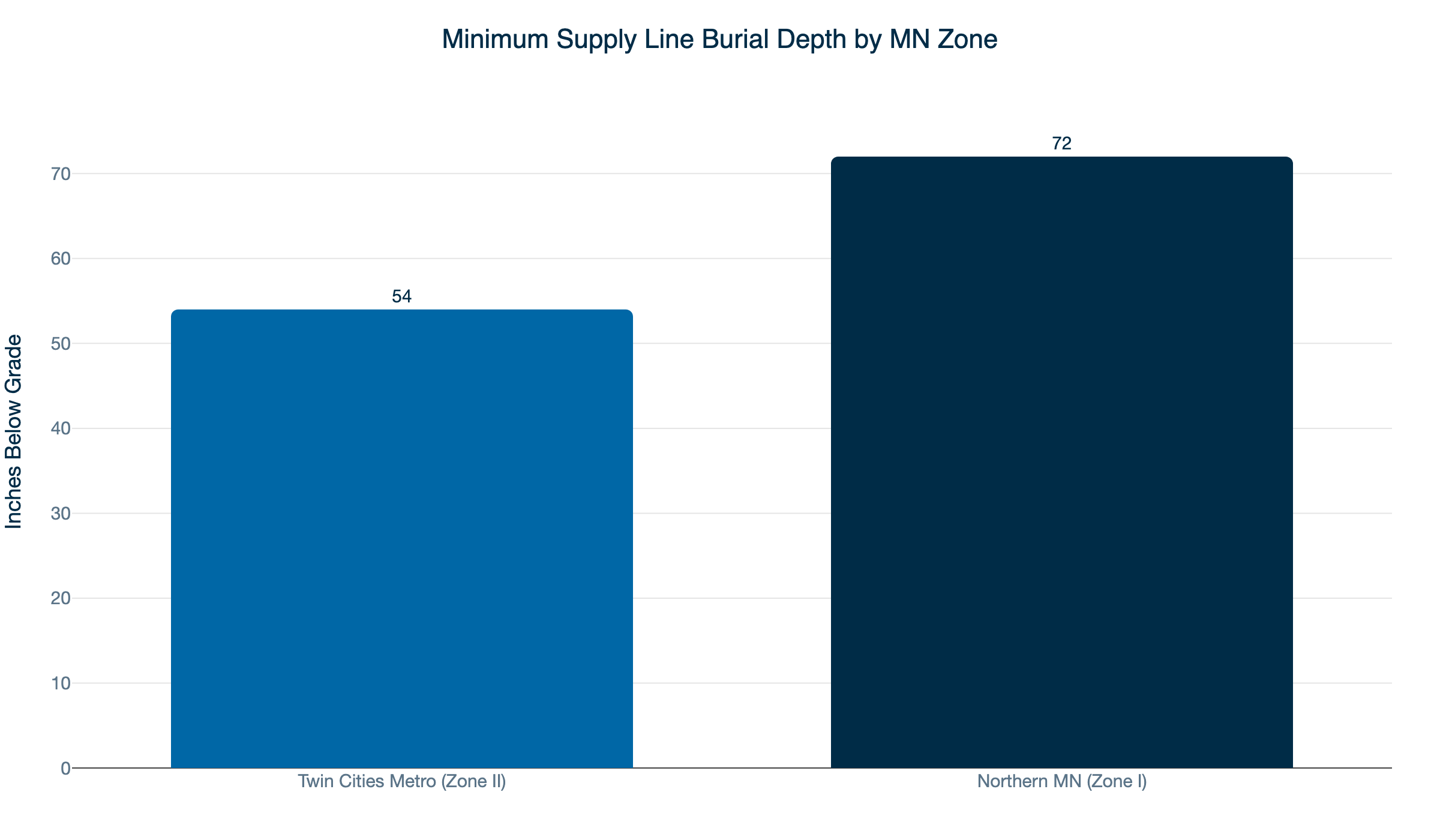
MN Plumbing Code Chapter 4714 adds a required clearance on top of that: buried supply and yard piping must be at least 12 inches below the local frost depth. In the Twin Cities, the math is 42 + 12 = 54 inches minimum burial for any outdoor supply line. That includes every foot of pipe from your house to an outdoor island.
In northern Minnesota, the numbers are steeper. Counties like St. Louis, Cook, Itasca, and Aitkin carry a 60-inch frost depth, pushing the minimum supply line burial to 72 inches below grade.
These aren’t contractor preferences. They are the code floor. A permit inspector checks burial depth before the trench is backfilled. Once the dirt goes back, the opportunity to verify is gone.
How Do You Plumb an Outdoor Kitchen?
Short answer: A licensed plumber extends a buried supply line from the home’s interior cold-water supply to the island (at least 54 inches deep in the Twin Cities), installs a code-required frost-free hose bibb, slopes the entire run so it drains back toward the house by gravity, and routes the sink drain to the home’s sanitary sewer. Every step triggers a permit.
The Supply Line: Depth, Material, and Pitch
The supply run starts at a tap inside the heated envelope of the home. A plumber branches off an existing cold-water line, typically near an exterior wall in a basement or utility space. The pipe travels through the house wall, down into a trench, and underground to the island.
Three things determine whether that buried run survives Minnesota winters:
Burial depth. The pipe must reach at least 54 inches in the Twin Cities. Shallower than that, the ground around it freezes solid in a hard winter. A frozen pressurized line either cracks the pipe or blows a joint fitting.
Pipe material. PEX tubing is the standard choice for buried supply runs. It handles the movement that comes with freeze-thaw cycles better than rigid copper and is flexible enough to navigate trench bends without additional fittings. Rigid copper is still installed in some cases, but PEX has become the default for outdoor buried runs in Minnesota.
Pipe pitch. The entire buried run must slope back toward the house. When you shut the system off in fall and open the bibb to depressurize, water drains back toward the house by gravity. A flat or island-pitched run leaves water sitting underground. That water freezes, expands, and damages the pipe or a fitting.
The slope is small, just enough to let gravity do the work. But it must be consistent across the entire run. Any section that dips lower than the segments on either side creates a belly that traps water and defeats the drain-back.
The Frost-Free Hose Bibb: Required by Minnesota Code
A frost-free hose bibb looks like a standard outdoor spigot. The difference is in the valve stem. A standard bibb closes at the face of the wall, leaving water in the short section between the valve seat and the spout. In a Minnesota winter, that section freezes, the ice expands, and the bibb cracks.
A frost-free bibb has a stem 8 to 12 inches long that reaches back into the heated wall. When you turn the handle off, the seat closes at the warm end of the stem. The water in the exposed section drains out the spout by gravity. Nothing sits in the freezing zone.
MN Plumbing Code Section 603.5.7 requires a frost-free bibb with an integral backflow preventer or vacuum breaker on every outdoor water connection where freezing temperatures occur. Minnesota qualifies in every county. The Star Tribune covered this requirement when it took effect in 2015, and it carried forward into the 2020 Minnesota Plumbing Code.
The backflow device must be listed to ASSE 1019, ASSE 1011, or ASSE 1052. It prevents outdoor contaminants from being siphoned back into the home’s drinking water if supply-side pressure drops.
Two installation details determine whether freeze protection actually works:
- The bibb must pitch slightly downward toward the exterior spout. Level or reverse-pitched installation traps water in the stem, and the gravity drain fails.
- The stem must extend into a space that stays above freezing. A bibb mounted on an unheated detached structure does not get the benefit of interior heat.
Drain-Back Design: The Whole Line Must Self-Drain
The frost-free bibb handles the last foot of pipe at the island connection. The entire buried supply run must also self-drain when the system is shut off for winter.
That means the trench must slope back toward the house along its full length. If your yard pitches away from the house toward the island, achieving a continuous back-slope may require a deeper trench at the house end. A plumber accounts for this during the design phase, before digging starts.
If any section of the run is trapped at a low point, water will remain there through the winter regardless of how the bibb is configured. Trapped sections must be cleared with compressed air each fall, the same way irrigation lines are winterized in Minnesota. If the blowout is skipped or incomplete, that trapped section freezes.
Where Should I Drain My Outdoor Kitchen Sink?
Short answer: Into the home’s sanitary sewer. Discharging to a dry well, a gravel bed, or the yard is prohibited under Minnesota Plumbing Code and there is no licensed workaround.
This is the most common design error on outdoor kitchen projects in Minnesota. Contractors unfamiliar with state rules sometimes suggest a dry well beneath or near the island: a gravel-filled pit where sink water percolates into the soil. In some states, that arrangement is permitted for residential greywater. In Minnesota, it is not.
MN Plumbing Code Chapter 4714 requires all plumbing fixtures to discharge into the public sanitary sewer or an approved individual sewage treatment system. Residential greywater discharged directly to the ground is prohibited. The Minnesota Pollution Control Agency’s greywater guidance addresses this directly. An outdoor kitchen sink is a plumbing fixture. Its drain must be piped back to the house.
What the Drain Run Involves
Routing a drain from an outdoor island to the home’s sanitary sewer is often the more complex half of the outdoor kitchen plumbing job. The main design elements:
Slope. Drain lines need a consistent grade to move waste. The standard minimum is 1/4 inch of drop per foot of run. Over a 20-foot run, that’s 5 inches of elevation change from island to house. The trench grade must support that slope across its full length.
Depth. Unlike the supply line, a drain does not need to reach 54 inches. Drains are not pressurized and do not freeze the same way a live water supply line does. But the drain still needs to be below grade, protected from freezing when it carries water, and sloped correctly. Your plumber sets the depth based on site conditions and local requirements.
Sanitary tie-in. The drain connects to the home’s sanitary stack or a cleanout near the foundation. This is the same principle as an indoor kitchen island drain installation: proper venting, correct slope, and a code-compliant tie-in point. The run is just longer.
Vent. An unvented drain gurgles, drains slowly, or backs up. For an outdoor kitchen, the vent typically ties back to the home’s existing vent stack rather than requiring a new roof penetration. The plumber sizes and routes it to meet code.
Outdoor island with a disposal. If the outdoor kitchen includes a garbage disposal, the plumber accounts for the increased drain volume during design. Raise this at the start of the project, before rough-in begins.
Do You Need a Permit to Put in an Outdoor Kitchen?
Short answer: Yes. Any new supply line extension or new connection to the sanitary sewer requires a permit under MN Plumbing Code and Minneapolis municipal rules, and there is no exempt threshold for residential plumbing work of this scope.
MN Rules Chapter 4714 requires a permit for any installation, addition, extension, alteration, or replacement of a plumbing system. Adding a supply branch to an outdoor island is an extension of the water supply. Tying a drain into the sanitary stack is an alteration of the sanitary system. Both require a permit.
In Minneapolis specifically, the list of permit-exempt work excludes anything that alters the supply line. A branch tap off the existing cold-water main falls outside the exempt category, regardless of size.
To apply in Minneapolis, email a completed form to development@minneapolismn.gov or call 612-673-3000. The Minneapolis plumbing permit page has the current application and requirements. Other Twin Cities municipalities run their own permit processes, but the state code trigger applies everywhere.
Work with a licensed plumber who pulls the permit as part of the job. An unlicensed installer cannot pull a plumbing permit. Unpermitted supply and drain work will surface in a home sale.
What the Permit Inspection Covers
A plumbing inspector checks:
- Supply line burial depth (before backfill)
- Frost-free bibb installation and downward pitch
- Backflow device listing (ASSE 1019, 1011, or 1052)
- Drain slope and sanitary tie-in
- Vent connection
The inspection happens before the trench is backfilled. If a contractor covers the trench before the inspection, excavation may be required to prove depth. That outcome is avoidable. Schedule the inspection before any buried work is covered.
Unpermitted outdoor kitchen plumbing also creates complications at resale. Home inspectors and buyers’ agents in Minneapolis and St. Paul ask for permit history. An unpermitted supply extension or sanitary tie-in becomes a negotiating point at best.
What Type of Outdoor Shutoff Does the Code Allow?
Short answer: An interior shutoff inside the heated envelope, or a yard hydrant. Underground stop-and-waste valves that drain into the soil are prohibited by Minnesota code.
Many homeowners expect a shutoff valve buried in the yard near the island. The instinct makes sense: close it in October, open it in May. But MN Plumbing Code Chapter 4714, adopting UPC Section 603.5.17, prohibits underground stop-and-waste valves that discharge into the ground. Potable water cannot be released into the soil.
Two code-compliant options:
An interior shutoff. Locate the shutoff valve inside the house, on the supply branch before it exits the heated envelope. Turn it off in fall, blow out the line, leave the bibb open for the winter. The valve stays in the basement or utility space where it is easy to find and clearly labeled. This is the right starting point for most outdoor kitchen installs.
A yard hydrant. A yard hydrant is the tall stand-up type with a handle that operates a valve deep underground. When the handle is pushed down to close, the valve seats below frost depth and the water column above it drains out through a weep hole. Yard hydrants are the one buried outdoor shutoff that code explicitly permits. They cost more to install and require their own permit work, but they make sense when a shutoff at the island location serves daily use rather than seasonal winterization only.
How Do You Winterize an Outdoor Kitchen Water Line?
Short answer: Close the interior shutoff, open the bibb fully to drain by gravity, blow out the line with a compressor, and leave the bibb open all winter. The sequence works reliably only if the pipe was pitched correctly during installation.
A properly designed outdoor kitchen supply line has a short fall winterization routine:
- Close the interior shutoff valve.
- Open the frost-free bibb fully. Pressure drops and the exposed stem section drains out the spout.
- Connect a compressor to the bibb and blow out the buried run to clear residual water.
- Leave the bibb open through the winter.
If the supply line was pitched correctly back toward the house, step 2 removes most of the water from the buried run by gravity. Step 3 is the backup that clears what gravity missed. Step 4 lets any remaining moisture escape rather than build pressure if it does freeze.
The plumber who installs the system should walk through this sequence with you before the first cold season. The shutoff location, bibb access point, and whether a compressor is needed all depend on your specific pipe routing and yard grade.
Notes for Older Twin Cities Homes
Outdoor kitchen builds are appearing on older Minneapolis and St. Paul properties, not only on newer construction. A few additional things to know before adding outdoor plumbing to an older home:
Galvanized supply lines. Homes built before roughly 1970 often have galvanized steel supply mains. Tapping an outdoor branch off corroded galvanized pipe stresses the tap point and introduces reduced flow at the island. If the home has galvanized mains, address those first. See the post on galvanized pipe replacement in Twin Cities homes for what to look for and when to prioritize a repipe.
Sewer lateral condition. The outdoor kitchen drain ties into the home’s sanitary sewer inside the house. If the existing lateral has root intrusion, a belly, or deteriorating joints, adding drain load to it accelerates the problem. A sewer camera inspection before the outdoor kitchen project confirms whether the lateral can handle the new connection.
Water pressure. Adding an outdoor supply branch can drop interior pressure if the home is already running near the low end of its range. Check pressure before design. A failing pressure reducing valve or undersized service line can make outdoor additions more complicated.
Permit history. Records for older Twin Cities homes are sometimes incomplete. If prior plumbing work was done without permits, the outdoor kitchen project is a reasonable opportunity to bring the system up to current code as part of the job.
Ready to Plan Your Outdoor Kitchen Plumbing?
Northern Benjamin Franklin Plumbing is locally owned and operated in the Twin Cities. We handle the supply run, the sanitary tie-in, and the permit process for outdoor kitchen plumbing across Minneapolis, St. Paul, Blaine, Bloomington, Brooklyn Park, Coon Rapids, Maple Grove, and the surrounding metro.
Our On-Time Guarantee(R) means we arrive in the window we commit to, or we pay you $5 for every minute we are late, up to $300. If there is any delay, it’s you we pay!
Call (763) 296-1844 or book a service appointment to get started. If you have questions about permitting, pipe routing, or what the full scope looks like for your property, we’re a phone call away.
Frequently Asked Questions
Is there an outdoor kitchen sink that doesn't require plumbing? +
Need a technician now?