
Gas Stove Flexible Connector Replacement: When to Act
Key Takeaways
- A flexible gas connector ages through movement, bending, and corrosion, not just through time.
- A Wisconsin utility says to replace connectors every 10 years, even if they are not brass. Treat that as a recommendation, not a code rule.
- Federal regulators have urged that any uncoated brass connector be replaced immediately.
- Never reuse an old connector on a new or moved stove. Fit a new one every time.
- Do not pull your range out to inspect the connector yourself. Federal regulators advise against it.
- Look for a listing label that shows the connector meets the recognized standard, ANSI Z21.24.
- If you smell gas, leave the home and call your gas utility or 911 from outside.
- A licensed plumber can replace the connector, check the shutoff valve, and test the joints in one visit.
Does the Flexible Connector Behind Your Stove Need Replacing?
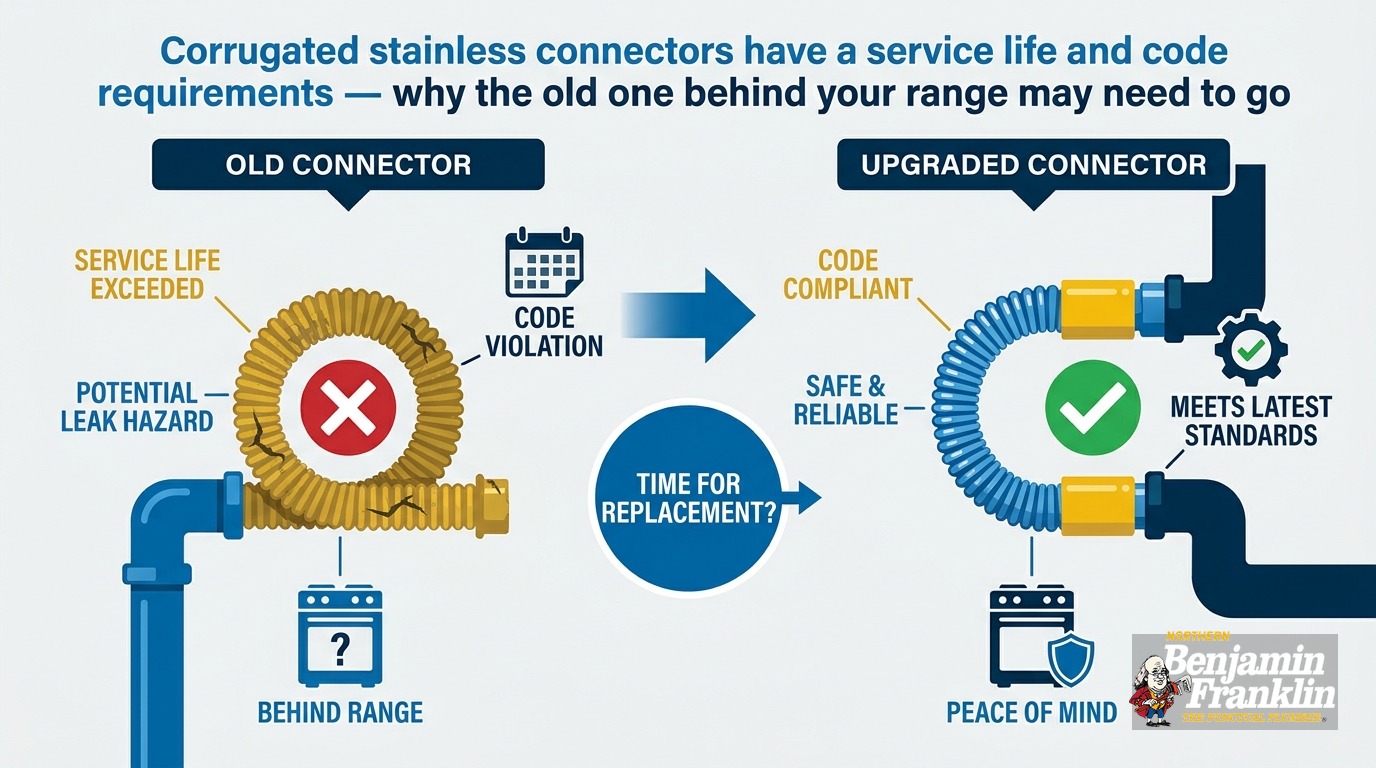
Yes, it may. A flexible gas connector is the short, bendable tube that links your range to the gas line. It does not last forever. A utility in the Upper Midwest says to replace connectors every 10 years. Replace it sooner if the stove moves, the connector is old brass, or you see damage.
Most people never look at this part. It hides behind the range, and a part you cannot see is easy to forget.
We are Northern Benjamin Franklin Plumbing, a locally owned and operated Twin Cities plumbing company. Gas lines are part of what we do every week.
What Is a Flexible Gas Connector, and Why Does It Wear Out?
A flexible gas connector is a short corrugated tube, usually stainless steel with a coating, that carries gas from the wall line to your stove. It bends so the range can sit in place. That flexibility is also why it wears. Movement, bending, and corrosion break the metal down over time.
Think of a paper clip. Bend it once and it holds. Bend it back and forth and it cracks. A connector faces a slower version of the same stress.
Wisconsin Public Service says connectors can weaken from “too much moving, bending or corrosion.” Read that list closely. Age is only one factor, and how you use and clean the kitchen matters too.
Three things that wear a connector down
Movement. Every time the range slides, the connector flexes. Wisconsin Public Service warns that even slight movement could result in the connector failing and causing a dangerous situation. That includes small shifts you barely notice.
Bending. A tight kink creates a weak spot. A connector that is too short for the gap behind the stove may get pinched. One that is too long may get crushed against the wall.
Corrosion. Kitchens are humid. Steam, spills, and cleaning products can reach the back of the range. Over the years, moisture and chemicals attack the metal and the coating.
Why cleaning behind the range counts
Many of us pull the stove forward to mop up crumbs and grease. That is a normal chore, but for the connector it is a stress event.
Each pull-out bends the tube. Each push-back bends it again. Over a decade, that adds up.
You should not stop cleaning. But if the stove has been moved many times, have a pro look at the connector.
How Often Should You Replace a Gas Stove Connector?
Plan on every 10 years as a working guideline. Wisconsin Public Service says you should replace them every 10 years, even if the connectors are not brass. That is a utility recommendation, not a Minnesota code requirement. Replace sooner if the connector shows damage or the stove has been moved.
The 10-year number is easy to remember, and it gives you a clear point to act.
The calendar is only part of the story, though. A connector in a rarely touched kitchen may age slowly. One behind a range that gets pulled out every month may age faster.
A simple way to track it
Pick a date and write it down. Many homeowners tape a note inside a cabinet or set a phone reminder. When you buy a new stove, note the date. When a plumber swaps the connector, note that date too.
If you bought your home and have no idea when the connector went in, assume it is old. Ask a plumber to look. A quick check beats guessing.
Replace on a schedule, and replace on an event
Think of two triggers:
- The schedule. Replace about every 10 years, per the utility guidance above.
- The event. Replace any time the stove is moved, swapped, or reconnected.
The second trigger matters just as much. A connector that has been bent, pulled, and reseated has already done its work. Treat a stove move as a new-connector moment.
What Did Federal Regulators Say About Old Brass Connectors?
The U.S. Consumer Product Safety Commission (CPSC) urged that any uncoated brass connector be replaced immediately. Its 1996 release reported 200 connector failures, 35 deaths, and 59 injuries. Those numbers are nearly 30 years old, but the warning about old brass connectors still shapes how pros think about this part.
The CPSC release is dated October 10, 1996. It states that “ANY uncoated brass connector be replaced immediately.”
The same release says the older uncoated brass connectors had not been made for at least the past 10 years at that time. So a brass connector today is very old. If you find a plain brass one behind your range, treat it as urgent.
Read the numbers with care
Keep the date in mind. The failure counts come from a 1996 release and are not a current tally. We cite them to show why the warning exists, not to claim how common problems are today.
Wisconsin Public Service describes the same concern in plain terms. It says older brass connectors are susceptible to cracking, breaking and deteriorating. That matches what plumbers see in older homes.
What this means in older Twin Cities homes
The Twin Cities has plenty of older housing stock. Many homes in Minneapolis and St. Paul have kitchens that were updated in pieces over decades. The range may be newer than the wall piping, and the connector may be older than you think.
If the stove came with your home, you may not know the install date. In that case, an inspection by a licensed plumber is a smart first step.
Is Your Connector Listed? How to Read the Label
A listed connector carries a label showing it was tested to a recognized standard. For these connectors, that standard is ANSI Z21.24. A Star Tribune column by an inspector calls ANSI Z21.24 the current standard and says connectors should never be reused.
That page did not fully load for our research, so we rely on its summary here. The point still holds across sources: use a connector that is listed, and use a new one.
A label helps a plumber, too. It tells us the material, the size, and the rated capacity. We match the connector to your stove’s gas demand, which is measured in BTU (British thermal units, a unit of heat energy).
What to look for
You do not need to be an expert. A few quick checks can tell you if it is time to call:
- The connector looks like plain, uncoated brass.
- You cannot find any label or marking.
- You see rust, flaking, or discoloration on the tube or fittings.
- The tube is kinked, crushed, or touching hot parts of the stove.
- The connector is the wrong length for the gap.
Do not pull the stove out to look. We cover why next. A flashlight from the side or a phone photo is often enough to see what you can see. If anything looks off, call.
When Should You Replace the Connector Even Before 10 Years?
Replace it right away if you move the stove, install a new range, or see damage. Also replace it if the connector is brass or unlabeled. A used connector should never go onto a new appliance. Treat each of those events as its own trigger, no matter how old the tube is.
Here are the common triggers in more detail.
You are buying a new stove
A new range deserves a new connector. Do not reuse the old one to save a few minutes. The old tube has been bent and seated to fit the old stove. It may not line up the same way with the new one.
The Star Tribune column cited above says connectors should never be reused. We agree. It is a small part and not worth the risk.
You are moving the stove
Remodels, floor refinishing, and deep cleans all mean moving the range. Once the stove has moved, the connector has flexed. Have it replaced before the stove goes back in place.
You see signs of wear
Look for kinks, rust, cracks, or flaking. Any of these means the connector is done. Do not wait for the 10-year mark.
You smell gas, even faintly
This is different. A gas smell is an emergency, not a maintenance item. See the safety section below for exactly what to do.
You are not sure when it was installed
If you cannot say when the connector went in, plan a replacement. It is a short job, and it gives you a known start date for the next 10 years.
Why Not Inspect or Pull the Stove Out Yourself?
Federal regulators advise against it. The CPSC warned consumers not to move their appliances to inspect the connectors themselves. It also said the connector should be inspected only by a professional service provider. Moving an old range can stress or break a worn connector and release gas.
That advice can feel backwards. Most homeowners want to check things first. With a gas connector, the check itself can cause the failure.
An old connector may already be fatigued. Sliding the range pulls and twists it, which is the exact movement that can crack a weakened tube.
The CPSC release is clear on both points. Do not move the appliance to look. Let a professional do the inspection.
What you can safely do
You can do a few simple things from the outside:
- Check that you can reach the shutoff valve without moving the stove.
- Note the age of the stove and any past connector work.
- Write down any odd smells or sounds near the range.
- Keep the area behind and beside the stove clear of clutter.
Then call a licensed plumber. A pro has the tools to inspect the connector safely, shut off the gas, and test the work.
A word on the shutoff valve
Your range should have a shutoff valve in the gas line behind it. If yours does not, one should be added. A shutoff lets you stop the gas fast in an emergency. It also lets a plumber work on the connector without shutting down the whole house.
If you also have worn shutoff valves elsewhere in your home, our guide on replacing an angle stop shutoff valve covers the water side of that same idea.
What a Licensed Plumber Checks During a Connector Swap
A proper swap is more than snapping on a new tube. A plumber shuts off the gas, removes the old connector, checks the valve and fittings, installs a listed connector sized for the range, and leak-tests every joint. We also look for damage to the line behind the wall opening.
Here is how a typical visit goes.
Step 1: Look before touching
We check the stove, the connector, and the shutoff valve. We note the age and condition of each and look for signs of past leaks or repairs.
Step 2: Shut off the gas
We close the valve to the stove. If the valve is stiff or leaking, we flag it. A bad valve is a reason to replace it on the spot.
Step 3: Remove the old connector
We disconnect the tube at both ends and do not reuse it. We check the threads and fittings on the gas line for wear.
Step 4: Install a new, listed connector
We choose a connector that matches the stove’s gas load and fits the gap without kinks. The label should show the recognized listing. We use the right fittings and tighten them properly.
Step 5: Test every joint
We test the joints for leaks before we call the job done. The leak test is the step that proves the work. Wisconsin Public Service and other utilities also point homeowners toward leak checks with soapy water, but a pro’s test is the one we trust.
Step 6: Slide the stove back with care
We set the range so the new connector does not bend sharply or get pinched. We make sure the stove sits level and stable.
Why one plumber visit beats a patchwork
Gas work can touch several parts at once: the connector, the valve, the line, and the stove. A plumber who handles all of it can spot problems early. If the line needs repair or extension, see our gas line repair and gas line installation services.
CenterPoint Energy’s safety page says only a qualified professional, such as a plumber, HVAC, or appliance repair contractor, should inspect and, if needed, replace your connector. That is a utility’s view, and it matches ours. This is not a DIY job.
What Do Minnesota Codes Say About Connectors?
Connector rules in Minnesota fall under the state’s fuel gas code, not the plumbing code, according to the research we reviewed. The details can change with each adopted edition. We do not quote section numbers or length limits here. Your plumber and your city building department can confirm what applies to your home.
One thing we can say with confidence: the 10-year interval is a utility recommendation. It is not a Minnesota code requirement. A good habit is not a legal rule, and we do not want you to confuse the two.
Some cities publish permit handouts that touch on gas connectors. For example, the Mounds View permit handout covers gas piping rules for that city. We could not fully read it for this post, so check it directly if you live there.
We also could not confirm whether a simple connector swap needs a permit. Rules differ by city. When we do the work, we confirm current local requirements for your address before we start.
If you plan bigger gas work, such as adding a new appliance line, permits are more likely. Our guide to gas line permits and safety in Minnesota walks through the process in plain English.
Why local knowledge matters
Code is adopted at the state level, but cities add their own handouts and inspection habits. A locally owned company deals with these offices all the time. We know who to call and what to ask, which saves you a round of guesswork.
What Should You Do if You Smell Gas?
Leave the home right away. Do not flip switches, use a phone inside, or light anything. From outside, call your gas utility’s emergency line or 911. Do not go back in until the utility or fire department says it is safe. Then call a plumber for repairs.
Gas utilities add a rotten-egg odor to natural gas so you can notice a leak. Treat that smell as urgent every time.
A faint smell near the stove can mean a loose fitting or a cracked connector. It can also mean a burner left on. Do not try to find the source yourself.
After the all-clear
Once the utility has checked the home, have a licensed plumber find and fix the cause. If the connector is the culprit, it gets replaced. If the line or valve is at fault, we repair those too.
Do not relight pilot lights or run the stove until the repair is complete and tested.
How Often Do Other Kitchen Connections Need Attention?
Gas is not the only line behind your kitchen cabinets. Water supply lines for the sink and dishwasher also flex, age, and fail. A quick plumbing check can cover all of them in one visit.
Braided water supply lines under the sink wear out in a similar way. They bend, they sit in damp cabinets, and they corrode. Our guide on under-sink supply line replacement explains when to swap them.
Pairing the checks makes sense. If a plumber is already at your stove, it is easy to look under the sink too. You get a clear picture of the flexible parts in your kitchen.
Build a short kitchen checklist
Here is a simple list to keep:
- Note the date of the last gas connector replacement.
- Confirm the stove shutoff valve is easy to reach.
- Check under the sink for damp spots or crusty buildup on supply lines.
- Test that the dishwasher and sink shutoffs turn freely.
- Schedule a plumber visit if anything is stuck, leaking, or very old.
None of this takes long. Ten minutes a year can prevent a big headache.
Who Should You Call in the Twin Cities?
Call a licensed plumber who works on gas piping. Do not hire a handyman for gas work, and do not do it yourself. Look for a company that is locally owned, shows up on time, and stands behind its work. Ask about the shutoff valve and the leak test before you book.
That is where we come in. Northern Benjamin Franklin Plumbing is locally owned and operated, and we serve homeowners across Minneapolis, St. Paul, Blaine, Bloomington, Brooklyn Park, Coon Rapids, Maple Grove, and the rest of the metro.
We are known as The Punctual Plumber for a reason. Our On-Time Guarantee(R) means we arrive in the window you pick, or we pay you $5 for every minute we are late, up to $300. In our words: “If there is any delay, it’s you we pay!”
We also back our work with a 100% satisfaction guarantee and the UWIN guarantee behind it.
What to expect when you call
You describe the stove, the age of the home, and anything you have noticed. We set a time window that works for you. A plumber arrives in that window, inspects the connector and valve, explains what we find, and gives you a clear plan.
We do not guess at costs over the phone for gas work, and we do not publish a price list here. After we see your setup, we give you a real quote for your home.
Tips for getting the most from the visit
- Clear the area around the stove so the plumber can work safely.
- Tell us if you have noticed any gas smell, even a faint one.
- Share the stove’s age and any recent moves or remodels.
- Ask us to check the shutoff valve while we are there.
- Keep your appliance manual handy if you have it.
Ready to Check the Connector Behind Your Range?
If your connector is old, brass, unlabeled, or you simply do not know its age, now is a good time to act. It is a small job with a big safety payoff. Winter in Minnesota keeps ranges and ovens busy, so fall is a smart time to get it done before the holidays.
Call Northern Benjamin Franklin Plumbing at (763) 296-1844 or book online. We will send a licensed plumber in the window you choose. If we are late, “If there is any delay, it’s you we pay!”
Replace the connector before it cracks, with a pro who tests the work before leaving.
Frequently Asked Questions
Who should I call to install a gas line for a stove? +
Who installs gas lines for stoves in the Twin Cities? +
Who can install a gas line for a stove? +
Need a technician now?