
Drain Flies in Your House: How to Get Rid of Them for Good
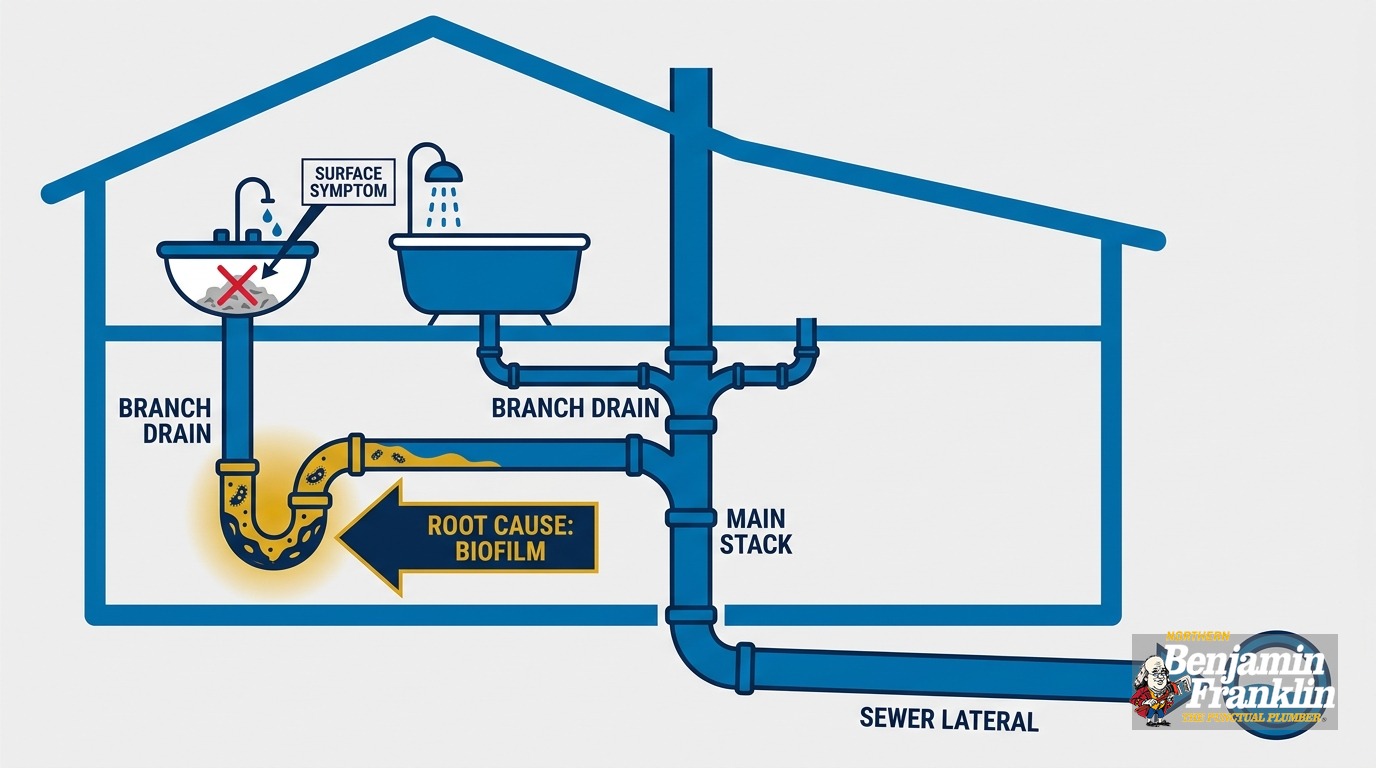
Key Takeaways
- Drain fly larvae (Psychoda spp.) live entirely within the biofilm on drainpipe walls. Killing the adult flies does nothing to the eggs and larvae still developing below.
- A slow drain is the real warning sign. Restricted flow means water sits longer against the pipe wall, feeding biofilm growth and creating a thicker, more stable breeding habitat.
- In Minnesota, the unused floor drain near your furnace or water heater is the highest-risk fixture. A dry P-trap is an open connection between your living space and the sewer.
- No insecticide is registered for use inside drains or sewer systems. Per University of Arkansas Cooperative Extension, pouring pesticides down a drain can also damage a septic system.
- Consumer enzymatic drain treatments are the right approach, but they require multiple applications sustained for at least three weeks to break the full life cycle.
- If flies return after two full treatment rounds, or if the drain runs slowly and DIY efforts have not cleared it, call a plumber. Clearing the pipe is the real fix.
What Are Drain Flies and Where Do They Come From?
Drain flies (Psychoda spp.) are moth-like insects about 1/8 inch long that breed inside drainpipes, not at the surface. Their larvae live entirely within the biofilm coating the pipe walls. The adults you see near your sink represent only the visible fraction of a population that is mostly inside the drain.
These insects are weak fliers. They rest on walls and tile close to the drain and are most active in the evening. They cluster near the fixture rather than flying across the room. If you find them in your bathroom or kitchen, the breeding site is the nearest drain.
Potential breeding sites include sink drains, tub and shower drains, floor drains, and anywhere organic matter builds up in dark, damp conditions. According to University of Arkansas Cooperative Extension, leaky shower pans are another entry point, since moisture beneath the pan creates a hidden wet zone. Any neglected or infrequently used fixture is a candidate.
University of Florida IFAS documents the complete biology: drain fly larvae live entirely within the biofilm on drainpipe interior walls. They hatch there, feed there, and pupate there. A female lays 30 to 100 eggs per batch directly back into the same biofilm she emerged from. The egg-to-adult cycle runs 8 to 24 days. Adults live another 14 to 20 days. Because generations overlap continuously, the population self-renews faster than adult trapping or surface spraying can deplete it.
The adults you see on the bathroom tile are the visible minority of a population that is mostly underground.
Why Doesn’t Cleaning the Drain Opening Fix a Drain Fly Problem?
Cleaning the opening, including scrubbing the stopper, clearing visible debris, and rinsing with a commercial product, removes material from the surface of the fixture. It does not reach the biofilm deeper in the trap arm or drainpipe. The larvae developing in that deeper zone mature undisturbed, and the population rebuilds within one to two life cycles.
Most consumer drain fly advice focuses on what is visible and reachable: the stopper, the strainer, and the first inch or two of pipe. That level of cleaning handles general maintenance. It is not enough to stop an active infestation.
Drain fly larvae are not drowned by a single flush of hot water, baking soda, or vinegar. The fizz of a baking soda and vinegar combination does loosen some surface buildup. It does not penetrate or degrade the structured biofilm deeper in the trap.
University of Arkansas Cooperative Extension is direct about the timeline. Effective control requires thorough cleaning sustained for at least three weeks. Some sources say “under a week.” That claim does not hold up against the life cycle data. The egg-to-adult cycle runs up to 24 days, and adults can lay another round of eggs before they die. A one-time cleaning removes some adults and disrupts the surface layer. The biofilm inside the trap survives, and the flies return on schedule.
What Is Biofilm and Why Does It Keep Drain Flies Coming Back?
Biofilm is a structured colony of bacteria, organic matter, and microbial waste that adheres to wet pipe walls. Drain fly larvae feed and live inside it. Consumer cleaning methods remove some surface material but rarely penetrate an established biofilm deep in the trap or drainpipe, which is why the infestation rebounds.
The word biofilm does not appear in most consumer drain fly guides. That absence is part of why the standard advice does not work. Biofilm is not loosely accumulated gunk. It is an organized biological community with layers, and it is far more resilient than a baking soda treatment can address.
Research published in Frontiers in Microbiology on floor drain biofilms illustrates the resistance directly. Biocide treatments, including bleach-equivalent compounds, alter the microbial composition of biofilm but do not eliminate it. Bacteria with chemical resistance become dominant after repeated biocide exposure. The biofilm survives. The larvae have their habitat. The flies return.
Why does this matter for a household drain? Drain fly larvae are biologically adapted to exactly this kind of environment. They are a documented component of the biofilm in wastewater trickling filters, as described in EPA Wastewater Technology Fact Sheet EPA832-F-00-014. More than 200 species of organisms, including Psychoda larvae, form the biofilm that processes wastewater. A household drainpipe is a smaller version of the same system.
Enzymatic or bacterial drain treatments are more effective at the consumer level. They break down the organic substrate biologically rather than trying to kill bacteria with a chemical. They work slowly and require sustained effort, multiple applications over several weeks. But they address the actual problem rather than the symptom.
Why Is a Slow Drain the Real Warning Sign?
A slow drain means water lingers against the pipe wall longer than it should. That extended contact feeds bacterial growth and accelerates biofilm formation. A drain running at partial capacity is not just an annoyance. It is a faster, more productive fly factory than a fully flowing drain.
Most homeowners tolerate a slow drain. The water still goes down. It does not feel urgent. Our post on slow drains and what they signal before they become bigger problems covers this pattern in detail.
The connection to drain flies adds a different kind of urgency. Biofilm thickness scales with water contact time. A fast-draining sink gives biofilm less time to build. A slow drain, where a partial blockage holds water against the pipe wall for minutes instead of seconds, gives biofilm more time, more food, and a thicker colony.
According to University of Arkansas Cooperative Extension, a drain fly infestation is a reliable indicator of stagnant water and organic accumulation. If you have drain flies coming from a sink or shower you use every day, check whether that drain runs at full speed. It almost certainly does not. Clearing the restriction is not optional preparation. It is the step that keeps biofilm from immediately rebuilding after enzymatic treatment.
If the slow drain is in the kitchen, grease accumulation in the drain line is the likely culprit. Bathroom sinks and tubs typically collect hair and soap scum. In either case, the restriction needs to be cleared, not just treated.
Does Bleach or Drano Kill Drain Fly Larvae?
No. Neither bleach nor chemical drain cleaners eliminate biofilm. They may reduce the adult fly count for a week or two. The biofilm inside the pipe survives, the larvae with it, and the population recovers on its own schedule.
This is a common point of confusion because chemical products produce a visible result. The flies thin out. Then they come back in the same numbers two or three weeks later. The science explains why.
As Frontiers in Microbiology documents, biocide treatments alter the bacterial composition of biofilm but do not eliminate it. The deeper biofilm survives. It re-establishes quickly. Repeated bleach applications do not produce a cumulative clearing effect. They produce a biofilm community that is increasingly resistant.
There is a safety concern beyond just ineffectiveness. University of Arkansas Cooperative Extension states that no insecticide is registered for use inside drain or sewer systems. Pouring pesticides into a drain is not only ineffective against larvae but can damage a septic system. If your home has a septic system, this is a real risk, not a hypothetical one.
The right consumer-level approach is an enzymatic or bacterial drain treatment. These products degrade the organic matter that biofilm feeds on. They require multiple applications over a minimum of three weeks. There is no single-pour solution to an established biofilm colony.
Minnesota’s Hidden Fly Factory: The Basement Floor Drain
Most pre-1980 Twin Cities homes have at least one basement floor drain. That drain was designed to handle emergency water, and in many homes, it has not received any water in months. That is the problem.
A P-trap works by holding a small amount of standing water. That water blocks sewer gases, and sewer-side insects, from entering the living space. When the water evaporates, the seal is gone. During Minnesota’s heating season, roughly October through April, indoor humidity drops sharply. A floor drain P-trap can evaporate at roughly one inch per week under normal indoor conditions, and faster near a forced-air furnace or water heater. A basement floor drain in the mechanical room, the standard layout in a Minnesota home, can go dry within two to four weeks of the heating season beginning.
That window is often when homeowners first notice drain flies in the basement.
Minnesota Plumbing Code (MN Rules 4714.1006) requires all floor drains to have a trap seal and a removable strainer. A dry trap is not just a fly nuisance. It is a code compliance issue. The seal exists specifically because a dry floor drain is an open connection to the sewer side of your system.
Exterior areaway floor drains face additional pressure from Minnesota’s climate. MN Rules 4660.8000 requires these drains to have a running trap located inside the building to prevent freeze-up in winter. That means two traps in the system, both of which can lose their seal if the drain sees no regular water use.
The preventive fix is straightforward: pour a quart of water down every infrequently used floor drain once a week during the heating season. That is enough to maintain the seal. For drains where the water evaporates especially quickly, a trap primer, a mechanical device that automatically adds small amounts of water when supply-line pressure drops, is the code-recommended long-term solution. The Minnesota DLI plumbing FAQ identifies trap primers as the standard answer for infrequently used floor drains.
If your flies are emerging from the basement floor drain rather than from a kitchen or bathroom fixture, the dry P-trap is almost certainly the entry point. Our post on dry floor drain traps and the sewer smell they cause covers that pathway in more detail, including how to confirm whether the trap has lost its seal.
Sump pits are a secondary breeding site worth checking. A sump pit accumulates standing water, dirt, minerals, and biofilm along the pit walls. Because the area stays dark, cool, and damp, drain fly larvae can develop even in a thin layer of sludge along the walls. If the pit has visible slime, add it to your treatment plan.
How to Get Rid of Drain Flies in Your House: The Real Fix
Getting rid of drain flies permanently means removing the biofilm they live in and restoring the drain flow that keeps it from rebuilding. Here is the sequence.
Find every affected drain. Cover each drain opening with a piece of clear tape, sticky side facing down, and leave it overnight. Adults emerging from that drain will stick. Do this for every floor drain, sink, tub, shower, and utility drain in the house. Start with whichever fixture is closest to where you see the most adults.
Clear the slow drain first. If the infested drain runs slowly, clearing the restriction is the first priority. A slow drain rebuilds biofilm faster than any product can remove it. A drain snake or plunger may handle a minor clog. For a drain that has been sluggish for months or years, professional hydrojetting is more thorough. A hydrojetter clears the pipe walls, not just the center channel, and removes built-up biofilm along with the physical blockage.
Apply an enzymatic drain treatment. Once the drain flows freely, apply an enzymatic or bacterial drain product per the manufacturer’s directions. Apply every two to three days. Maintain treatment for a minimum of three weeks. The full egg-to-adult cycle runs up to 24 days, according to Green Drain lifecycle data. Adults then live another 14 to 20 days. You are not finished when the visible flies stop. You are finished when three full weeks have passed with consistent treatment and a clear drain.
Run water in every unused drain weekly. For basement floor drains, utility sinks, and any fixture that does not see regular use, a weekly quart of water maintains the P-trap seal. Put it on your calendar. This single step prevents most Minnesota basement floor drain infestations from starting in the first place.
Check the sump pit. If the pit walls have visible sludge, scrub them with a stiff brush and apply an enzymatic cleaner before replacing the cover.
Expect a gradual decline. Adults continue emerging from larvae that were already developing when you started treatment. You will still see flies for the first week or two. Keep treating. The count should decline steadily over the three-week cycle if the drain is clear and the treatment is consistent.
When Should You Call a Plumber?
Call when flies return after two full rounds of enzymatic treatment, when the infested drain runs slowly and DIY methods have not cleared it, or when the infestation appears to be coming from the sewer side rather than a household fixture drain.
An enzymatic treatment works against biofilm that is accessible from the fixture opening. If the drain runs slowly because of a deep blockage, root intrusion, or a pipe condition the product cannot reach, the biofilm will keep rebuilding. A plumber with a drain camera can locate the exact point of restriction and clear it. Our drain clearing service covers both individual fixture drains and main-line issues.
If the flies are emerging from a floor drain and weekly water additions have not resolved the problem, a trap primer installation may be the right long-term fix. We can inspect the fixture, confirm whether the trap is holding its seal, and recommend the appropriate solution for the specific drain.
Northern Benjamin Franklin Plumbing is locally owned and operated in the Twin Cities. We back every appointment with our On-Time Guarantee(R): we show up in the window you choose, or we pay you $5 for every minute we are late, up to $300. “If there is any delay, it’s you we pay!”
Call (763) 296-1844 or book online to schedule a visit.
Frequently Asked Questions
How long does it take to get rid of drain flies? +
Why do drain flies keep coming back after I clean the drain? +
Can bleach kill drain fly larvae? +
What causes drain flies in a basement floor drain? +
Need a technician now?