
Connect Septic to City Sewer Minnesota: Timeline and Cost
Key Takeaways
- Connection is triggered by a notice from your municipality, not by state law. Most cities allow 2-3 years from the notice date to comply.
- In the 7-county Twin Cities metro, a sewer main extension must clear two permit layers before it reaches your street: Metropolitan Council Environmental Services (MCES) approval first, then an MPCA e-Services permit. You have no control over either step.
- The Metropolitan Council SAC charge is $2,485 in 2026. It appears on your permit invoice and is not in any contractor’s estimate. Budget for it separately.
- A short 40-foot lateral typically runs $4,700-$18,200 total, including permits, the SAC charge, and septic decommissioning. Longer runs push well past $40,000.
- Minnesota frost depth runs 42-60 inches in the metro. If a connection notice arrives in fall, act before the ground freezes. The deadline does not pause for winter.
- Leaving a septic tank buried without formal decommissioning creates a legal disclosure obligation at the time of sale under MN Statute 115.55. Decommissioning is not optional.
Why Sewer Extension Notices Are Arriving in More Twin Cities Neighborhoods
Across the Twin Cities metro and its surrounding suburbs, municipalities are extending public sewer mains into neighborhoods that have relied on private septic systems for decades. Blaine, Coon Rapids, Brooklyn Park, and dozens of other communities are doing this in phases as regional sewer capacity expands.
For homeowners, the first sign is a letter from the city. That letter starts a process most have never dealt with before. It has layers most people do not expect: a two-agency permit process that controls when the main gets built, a flat metropolitan fee that appears nowhere in any contractor’s quote, and a septic tank decommissioning requirement that carries legal consequences if you skip it.
This post covers the full sequence, from the notice to the first flush on city sewer, with realistic timelines and cost figures specific to the Twin Cities market.
What Triggers a Required Connection?
A notice from your municipality. Minnesota has no single statewide law requiring every septic user to connect. The requirement flows from local ordinance, activated when your city or suburb extends a public main to your street.
According to septicsysteminstallcost.com, most Minnesota municipalities give homeowners 2-3 years from the notice date to complete the hookup. Some communities allow an opt-out if the existing septic system is in good condition and has passed a recent inspection. Others do not.
One exception moves faster. A septic system classified as failing or an imminent threat to public health must be upgraded, replaced, or taken out of service within 10 months of notice. MN Statute 115.55, Subd. 5a sets that statewide floor. Local ordinance can shorten it further.
If the deadline in your notice feels unworkable, call your city’s building or public works department first. Municipalities sometimes grant extensions for documented hardship. They rarely waive the requirement entirely. A call on day one costs nothing and may buy you time.
Why Does the Twin Cities Metro Have a Two-Layer Permit System?
Twin Cities suburbs own their local sewer mains, but those mains flow into a regional interceptor system run by the Metropolitan Council. Any extension adding new flow to that system needs MCES approval before the MPCA will issue a construction permit.
Here is what that means in practice. Before a sewer main reaches your street, your municipality must complete three steps in sequence:
- Obtain Metropolitan Council Environmental Services (MCES) approval for the extension project.
- Submit an application through the MPCA’s e-Services system.
- Receive a written MPCA permit before any ground is broken.
As of January 1, 2026, all sanitary sewer extension applications must be submitted online. No construction may start until the written MPCA permit is in hand. That means no site clearing, no road work, and no pipe installation before the permit arrives. This two-agency requirement applies across all seven metro counties: Anoka, Carver, Dakota, Hennepin, Ramsey, Scott, and Washington.
Your own lateral does not require an MPCA permit. You need only a local building or plumbing permit from your city. But the fact that the main itself had to clear two agencies means you may have had no sewer main to connect to until recently. The connection deadline in your notice typically accounts for this lead time.
How Long Does It Take to Connect Septic to City Sewer in Minnesota?
From permit application to first flush, plan on 2-8 weeks. Permit review accounts for most of that window. The physical work - excavation, pipe installation, backfill, and surface restoration - typically takes 1-3 days once the permit is approved.
A more detailed breakdown, based on septicsysteminstallcost.com:
- Permit approval: 1-4 weeks, depending on your sewer authority’s workload and the time of year.
- Excavation and pipe installation: 1-3 days for a typical residential lateral.
- Final inspection and connection authorization: approximately one week after installation.
In Blaine, permit review alone can take up to 15 business days, and scheduling an inspection requires at least 3-4 business days of advance notice. During the June through August construction peak, both windows stretch.
Start your permit application the same week you receive the connection notice. Do not wait for a contractor to come out for an estimate first. Permit review runs in parallel with contractor scheduling. Waiting on the estimate before filing costs you 2-4 weeks of calendar time you may need later.
What Does It Cost to Connect Septic to City Sewer in Minnesota?
A short lateral, roughly 40 feet from your foundation to the public main, typically runs $4,700-$18,200 total. That total includes permits, the SAC charge, and septic decommissioning. A longer run crossing a driveway or deep yard can push well past $40,000.
Here is what drives the number, based on septicsysteminstallcost.com:
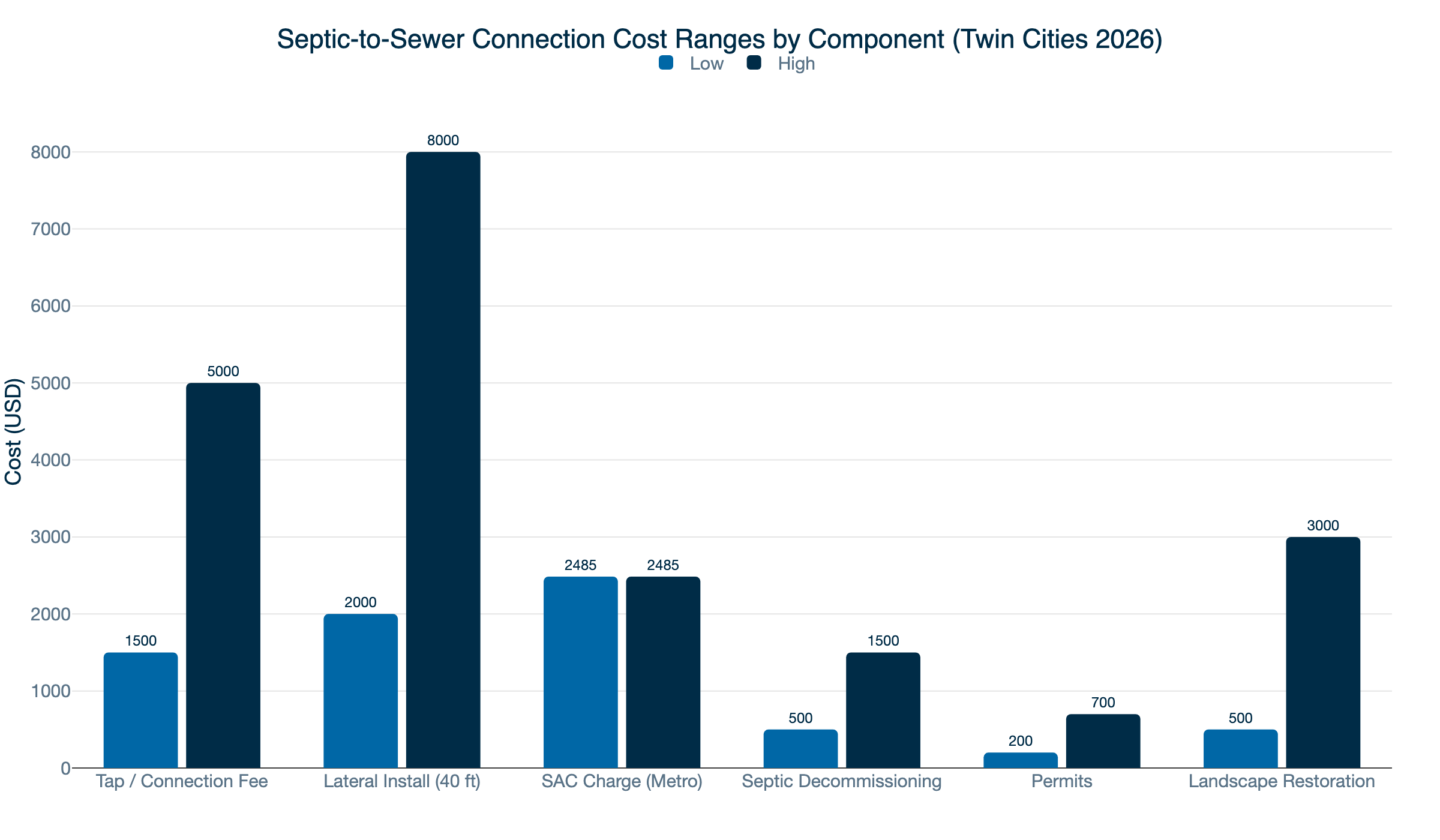
- Tap or connection fee (charged by the city): $1,500-$5,000. This is what the city charges for the physical tap into the public main.
- Lateral pipe installation: $50-$200 per linear foot. A 40-foot run costs $2,000-$8,000. A 150-foot run crossing a driveway runs $7,500-$30,000.
- Septic tank decommissioning: $500-$1,500 to pump, collapse, and fill the old tank.
- Local building and plumbing permits: $200-$700.
- Landscape restoration: $500-$3,000 to restore sod, concrete, or pavement over the trench.
Add the $2,485 Metropolitan Council SAC charge on top of all of those totals. That fee is separate from everything above (see the next section).
One Twin Cities-specific factor matters here: Minneapolis-area labor rates run 38% above the national average, based on Bureau of Labor Statistics wage data. When a national cost guide quotes a range, assume the upper end applies in this market.
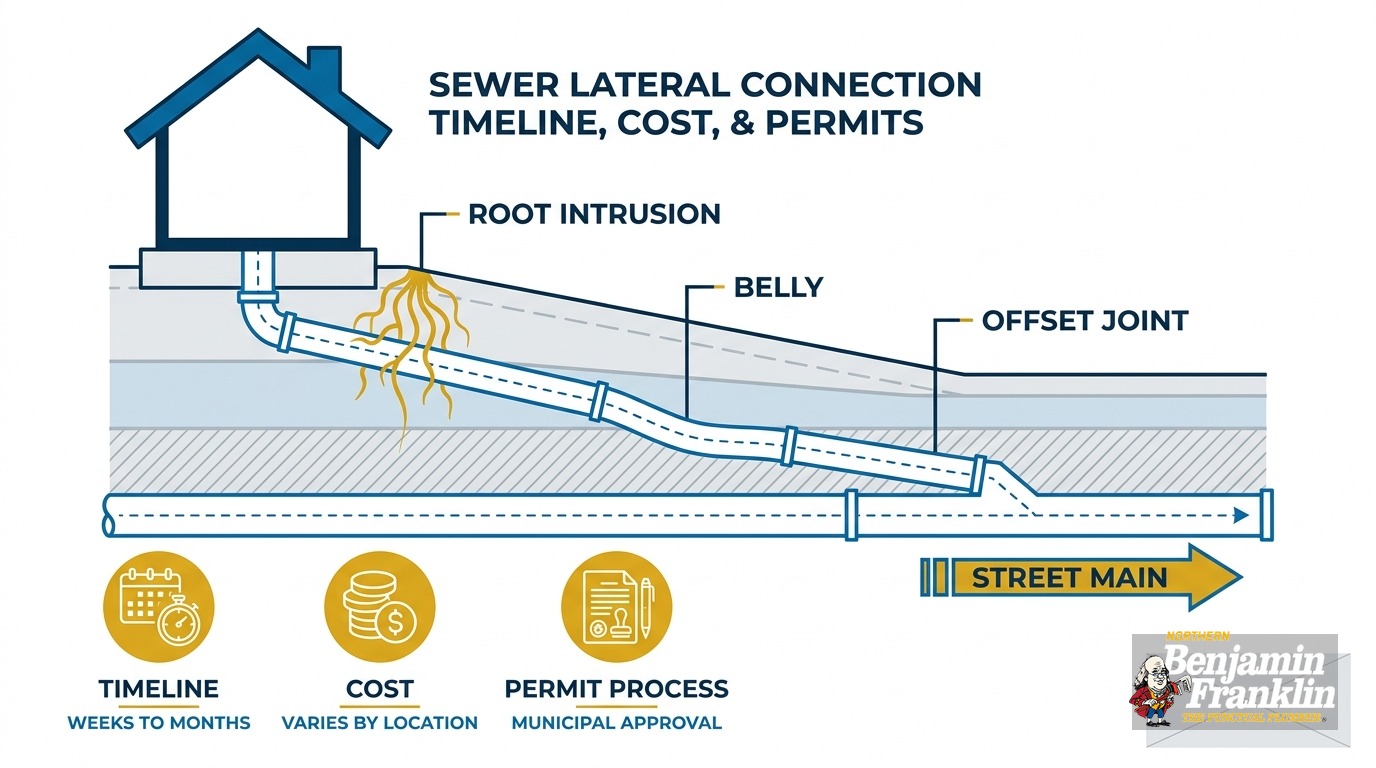
Older Twin Cities homes often have clay or galvanized pipe from the foundation to the property line. A sewer line camera inspection before the lateral work starts shows whether that section also needs replacement. Doing both in one excavation costs less than scheduling them separately.
The SAC Charge: A Fee That Catches Most Homeowners Off Guard
The Metropolitan Council Sewer Availability Charge (SAC) is a one-time fee assessed on every new residential connection in the 7-county Twin Cities metro. In 2026, the rate for a standard single-family home is $2,485, unchanged from 2025.
Here is why it surprises people. It does not appear in any contractor’s quote. Your plumber quotes the lateral installation. Your city quotes the tap fee. The SAC charge lands separately on your permit invoice, collected by the municipality and passed through to the Metropolitan Council.
If your property is in a rural center community, the rate is higher. East Bethel charges $3,185 per unit. Elko New Market charges $4,685. Confirm your exact rate with your city before you set your budget.
Ask your city one more question: whether a special assessment applies to your parcel. When a municipality bonds the cost of a sewer main extension, it often bills adjacent homeowners through a property tax line item. That assessment can run $500-$3,000 per year for 10-20 years, according to septicsysteminstallcost.com. It is a separate cost from the lateral, permits, and SAC charge. It may have already appeared on your tax statement without a clear explanation.
What Happens to Your Old Septic Tank?
It gets decommissioned - pumped out, then either collapsed in place or filled with sand, gravel, or concrete. You cannot leave an intact or connected tank buried under a property you plan to sell.
The physical process runs $500-$1,500 in most cases. It involves:
- Pumping remaining tank contents.
- Collapsing the tank walls or filling with an inert material.
- Capping off the distribution box and all drain field pipes.
The legal reason this step is mandatory: MN Statute 115.55 requires any seller to disclose in writing how sewage is managed on the property, before signing a sale or transfer agreement. If an abandoned SSTS exists on the property, its location must be mapped and included in that disclosure. An improperly decommissioned tank does not disappear at closing. It follows the property. It follows the seller if a disclosure dispute arises after the transaction.
Scheduling decommissioning at the same time as the lateral installation is the smart move. The contractor’s excavation equipment is already on site. The soil is already open. You avoid a second mobilization fee.
Once you are on city sewer, any backup you experience in the house looks like a standard drain and sewer problem. Knowing whether that backup is a clog in your drain lines or an issue with the new lateral matters. Our post on the difference between a sewer backup and a drain clog walks through the signs to watch in your first year on public sewer.
Does Winter Affect Your Septic-to-Sewer Connection Timeline?
Yes, significantly. Minnesota frost depth in the Twin Cities metro runs 42-60 inches. Trenching through frozen ground requires specialized equipment, costs more, and can push your project to spring. The connection deadline in your notice does not pause for winter.
This is the most common timing mistake. A homeowner receives a notice in October. The deadline is two years out. The homeowner puts the project on the back burner. Meanwhile, fall contractor schedules fill up. The ground freezes in mid-November. Winter excavation - when contractors will schedule it at all - runs higher due to frost-breaking time and shortened daily work windows.
If you receive a connection notice any time between September and November, act within the next two to three weeks. Get a plumber on site for an estimate and secure a spot on their schedule before freeze-up. The permit application runs in parallel. If the job cannot finish before mid-November, plan for an early spring start and communicate with your city about your timeline.
For a broader look at how Minnesota winters stress your plumbing system, see our post on what December does to your pipes.
Who Is Allowed to Do the Work in Minnesota?
Any licensed plumber or holder of a Minnesota pipe-laying contractor certificate. The installing business must carry a $25,000 surety bond. Pulling a permit yourself while using an unlicensed contractor does not satisfy Minnesota’s licensing requirement.
Minnesota rules treat the building sewer as both a plumbing component and a septic system component. Both the plumbing code and septic system rules apply. Before signing any contract, confirm the following:
- A valid Minnesota DLI plumbing license or pipe-laying contractor certificate.
- A $25,000 surety bond in force.
- Whether the contractor will pull the local permit, or whether you are responsible for that.
- A written, line-item estimate that separates the lateral cost, city tap fee, decommissioning, permits, and landscape restoration. Do not accept a single lump-sum figure without a breakdown.
Getting a camera inspection of your existing drain line before the lateral is installed gives you a complete picture of your plumbing from the house out. Homes built before 1980 in the Twin Cities often have pipe materials that look fine from the outside and show serious problems under a camera. Catching that before the trench is filled saves you a second excavation.
How to Get Started When the Notice Arrives
The sequence is straightforward.
1. Call your city’s building or public works department. Confirm your deadline. Ask whether a special assessment applies to your parcel and what local permits are required before work begins.
2. Contact a licensed plumber. Have them assess the run length, depth, soil conditions, and access to the public main. Ask for a written line-item estimate that separates each cost component.
3. Apply for your local permit right away. Do not wait for the estimate first. Permit review takes 1-4 weeks and runs while the contractor is being scheduled.
4. Budget separately for the SAC charge. In the 7-county metro, a standard single-family home pays $2,485 in 2026. It will appear on your permit invoice, not in any contractor quote.
5. If the notice arrived in fall, call this week. Fall schedules fill fast. Frozen ground makes excavation harder and more expensive. The sooner you act, the more options you have.
Northern Benjamin Franklin Plumbing is locally owned and operated in the Twin Cities. Our licensed plumbers handle sewer lateral installations and work through the permit process with you. We back every appointment with our On-Time Guarantee(R): you choose the arrival window, and we are there. If we miss it, we pay you $5 for every minute we are late, up to $300. “If there is any delay, it’s you we pay!”
Call (763) 296-1844 or book online to get a plumber on your schedule.
Frequently Asked Questions
Does every Minnesota homeowner have to connect to city sewer? +
What is the Metropolitan Council SAC charge and how much is it? +
Can I do the septic-to-sewer connection myself in Minnesota? +
What happens if I leave the old septic tank in the ground? +
Need a technician now?