
Refrigerator Ice Maker Water Line Installation in Minnesota
Key Takeaways
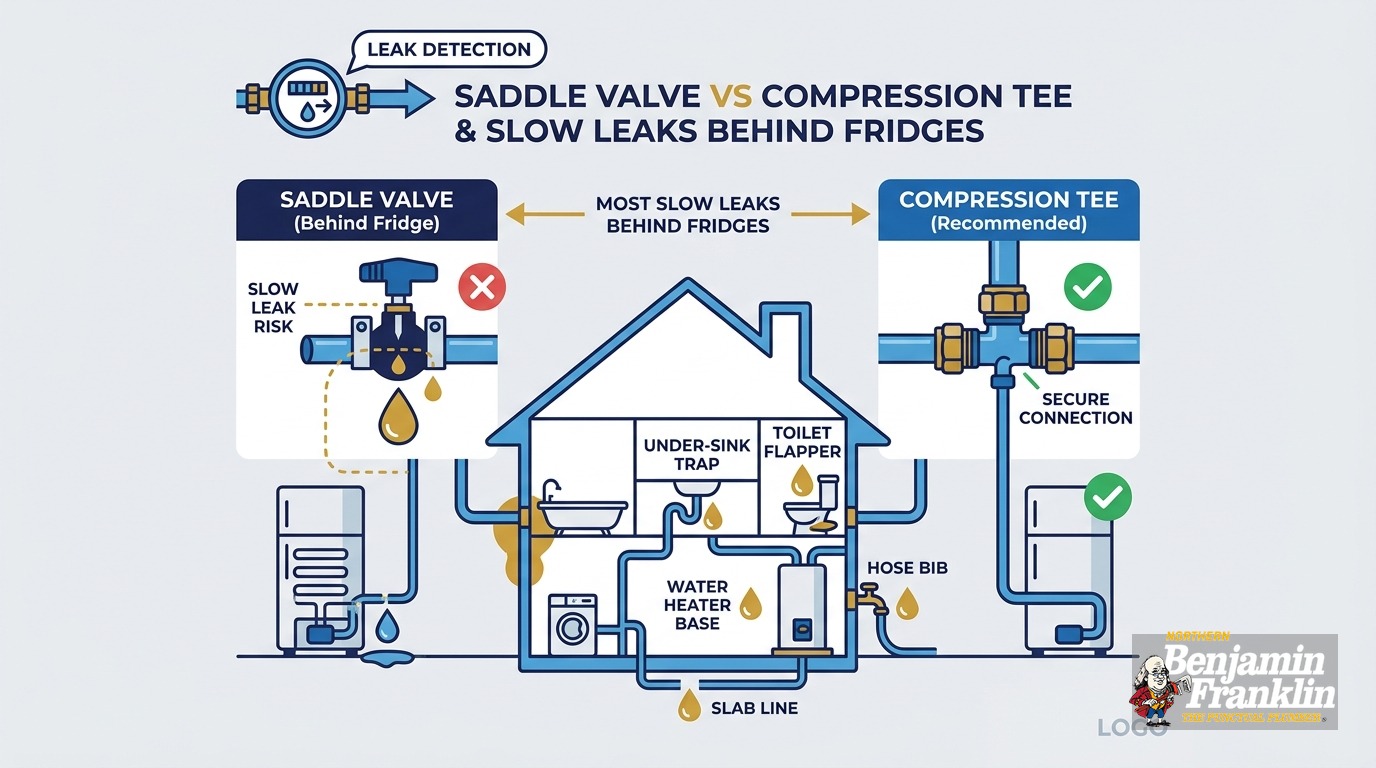
- Saddle valves are the most common refrigerator water connection in older Twin Cities homes and the most common source of slow leaks behind the fridge.
- Three mechanisms drive saddle valve leaks: galvanic corrosion between the steel clamp and copper pipe, rubber seal degradation from continuous chlorine exposure, and a piercing hole that widens every time the valve is operated.
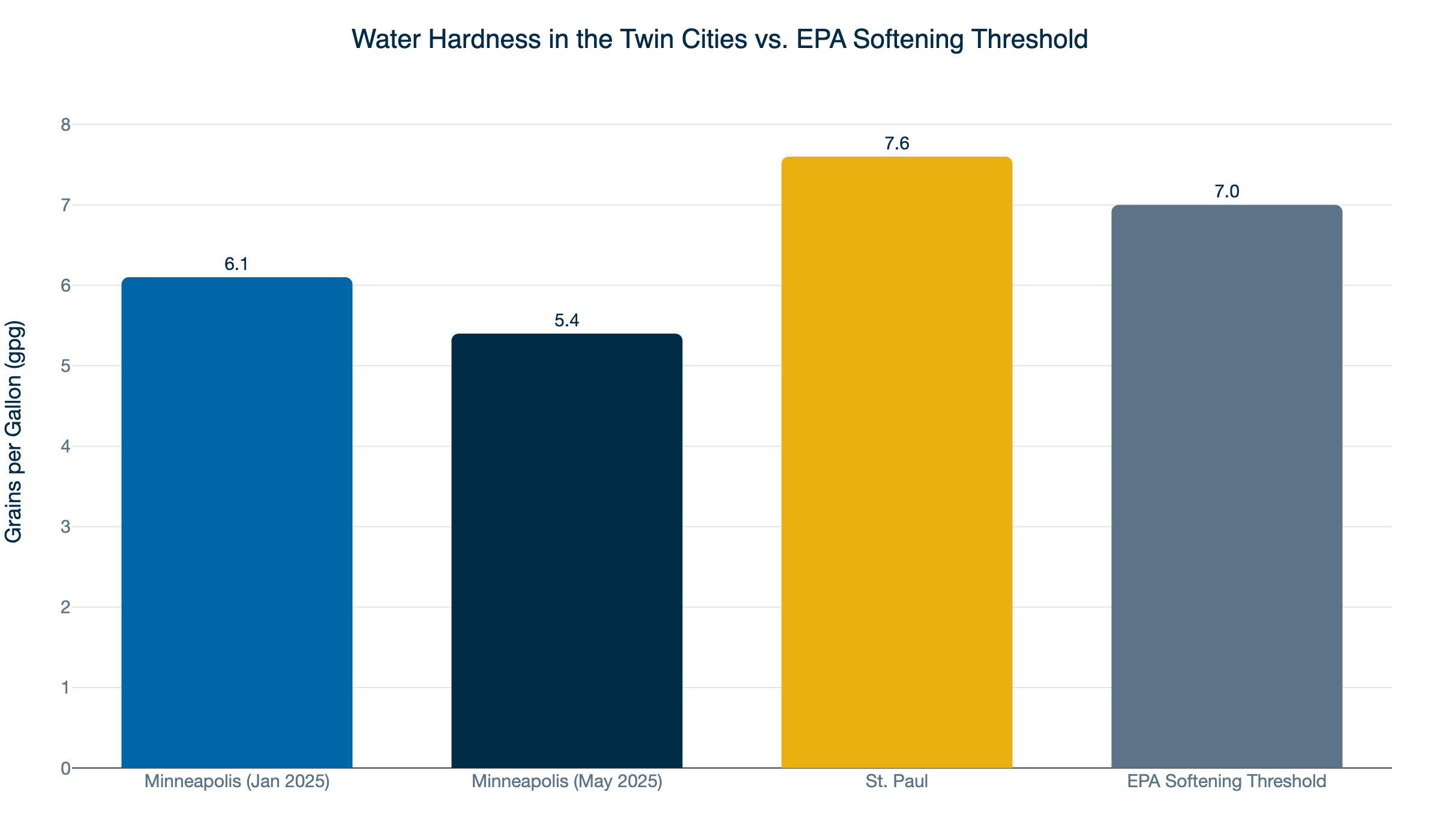
- Minneapolis finished water measures 5.4 to 6.1 grains per gallon depending on the season. St. Paul runs around 7.6 grains per gallon. Both levels deposit mineral scale inside the tiny saddle valve orifice, slowing ice production before the valve fails outright.
- Saddle valves are not code-approved under Minnesota Rules Chapter 4714. The correct connection is a compression tee or push-fit tee with a dedicated ball valve.
- New water line work requires a permit in Minnesota. Owner-occupied homestead properties may self-permit; all other work requires a licensed plumber.
- Replacing a saddle valve takes about an hour. The water damage a slow leak causes can take weeks to surface and much longer to repair.
Getting a refrigerator connected to a water line is a manageable job. A supply line runs from a cold water pipe to the back of the fridge, and the refrigerator’s internal valve controls flow to the ice maker and door dispenser. Whether you need a plumber depends on your property type and which connection method is used. In most Twin Cities homes, the answer is yes, the reason almost always traces back to a small clamp fitting that should have stayed on the shelf: the saddle valve.
What Is a Saddle Valve?
A saddle valve is a two-piece clamp that fastens around an existing copper pipe. A threaded bolt drives a steel needle through the pipe wall to open a flow path. Turning the needle opens and closes the valve, compressing a rubber O-ring against the pipe as it seats.
Hardware stores sell them for under $10. They require no cutting, no soldering, and no special tools. You clamp them onto the pipe, pierce it, and run a supply line to the refrigerator. That simplicity made them the default quick-connect fitting for decades of kitchen remodels in the Twin Cities and across the country.
They turn up in kitchen supply lines, bathroom vanity connections, and anywhere a fast branch was needed. Many Twin Cities homeowners have saddle valves they never installed themselves. They were left by a previous owner or a contractor who added an ice maker or a humidifier connection years ago. In older homes, some have been clamped onto the same copper pipe for 20 or 30 years, long past the point where the rubber seal has any flexibility left.
Why Do Saddle Valves Cause Slow Leaks?
Short answer: A saddle valve relies on a rubber O-ring pressed against a hole it punched in your pipe. The seal degrades through corrosion, chlorine breakdown, and mechanical wear each time the valve is operated. The leak is almost always a slow weep that goes unnoticed for weeks.
The failure happens through three mechanisms at the same time.
Galvanic corrosion. A steel clamp body in direct contact with copper creates a galvanic couple. In the presence of moisture, the steel corrodes over time. Corrosion products work under the seal and open a weep path. The seal can look intact while water moves past it.
Rubber seal breakdown. Minneapolis and St. Paul finish their water with chlorine disinfection. Continuous chlorine exposure stiffens and cracks rubber O-rings over months and years. As the rubber hardens and loses flexibility, it cannot maintain the compression the seal needs to stay tight.
Needle-hole widening. The piercing needle scores the pipe wall every time the valve opens or closes. StructureTech, a Minneapolis-based home inspection firm, puts it directly: “Every time you operate the valve, you increase the potential for a leak.” A homeowner who shuts off the saddle valve before leaving for a vacation and reopens it on return has created a new leak risk with every turn.
This risk is especially real in Minnesota. An empty house during a winter trip away is the worst time to discover that reopening the ice maker valve has started a new weep. Nobody is home to notice. The next inspection of that cabinet space may not happen until spring, or until a kitchen remodel forces the refrigerator out.
The result is almost always a slow weep rather than a sudden flood. Water moves behind the fridge, soaks the subfloor insulation, and saturates the hardwood or vinyl above it. You may not find the damage until the refrigerator finally gets moved and reveals soft flooring or mold at the baseboard. By then, remediation is part of the project.
Does Twin Cities Water Hardness Make Saddle Valves Worse?
Short answer: Yes. Minneapolis water measures 5.4 to 6.1 grains per gallon by season. St. Paul runs around 7.6 grains per gallon. Both levels deposit mineral scale inside the narrow saddle valve orifice, slowing ice production before the valve fails mechanically.
Minneapolis treats its finished water before delivery. Hardness data from January and May 2025 shows that finished hardness varies by season. The treatment plant removes approximately 65,000 pounds of hardness per day. The delivered water still carries enough dissolved calcium and magnesium to scale small-orifice fittings over time.
St. Paul finished water runs approximately 130 ppm (7.6 gpg), placing it at or above the EPA threshold of 7.0 gpg where softening may benefit water quality. Saint Paul Regional Water Services uses lime softening to bring raw hardness down from the 20-gpg range, but delivered water still builds scale in fittings over time.
The saddle valve orifice is the smallest flow restriction in the refrigerator’s water supply path. It is the first place scale accumulates. Ice cubes start coming out smaller and less uniform before the valve shows any visible sign of failure. That symptom is easy to dismiss as a refrigerator problem rather than a plumbing one. Meanwhile, the valve continues to corrode.
A compression tee does not share this weakness. The branch opening matches standard tubing diameter. Scale has far less surface area to accumulate on, and flow stays consistent through the supply line’s lifespan.
For more on how Twin Cities water hardness affects fixtures and supply connections, see our guide to hard water solutions for Twin Cities homeowners.
Are Saddle Valves Legal in Minnesota?
Short answer: No. Saddle valves are not approved under Minnesota Rules Chapter 4714, the current state plumbing code. Minnesota has adopted the IRC as a baseline residential standard, and IRC Section P2906.6.1 explicitly prohibits saddle tap fittings in residential plumbing.
Chapter 4714 requires all plumbing materials to meet a listed approval standard. Consumer piercing saddle valves carry no IAPMO listing in the code tables. An older code section, MN Rules 4715.0805, did allow saddle-type fittings for aboveground water distribution under narrow conditions: the fitting must be galvanized, carry a collar gasket, and hold IAPMO approval. Hardware-store saddle valves meet none of those three requirements.
This matters beyond the plumbing itself. A homeowner who files a water damage insurance claim after a saddle valve leak may face questions about the installation. If an inspector identifies an unapproved connection as the source of the damage, it can complicate coverage.
The code-correct connection is a compression tee or push-fit tee with a dedicated ball valve. That is also what a licensed Minnesota plumber will install. If you are doing this work yourself on your own homesteaded property and self-permitting, the same fittings are required.
What Is the Right Way to Install a Refrigerator Ice Maker Water Line?
Short answer: A compression tee is installed in the nearest cold water supply line. A quarter-turn ball valve goes on the new branch. A braided stainless supply line runs from that valve to the refrigerator inlet. A permit is pulled before any work starts.
Here is what each component does in a complete installation.
The tee. A plumber cuts the cold supply line and solders or presses in a compression tee. This creates a branch without piercing or scoring the pipe wall. The new branch accepts a ball valve and supply line without touching the main line again.
The shutoff valve. A quarter-turn ball valve closes fully with one 90-degree turn. It does not score any pipe surface and does not rely on a rubber O-ring held against a puncture. If you need to disconnect the refrigerator for a repair or an appliance swap, you turn the valve and the water stops cleanly.
The supply line. Braided stainless steel is the current standard for refrigerator supply connections. Stainless braided lines resist kinking and abrasion at the connection point behind the fridge. Older plastic tubing lines are brittle and prone to cracking at the wall exit over time. For a closer look at what can go wrong at this part of the connection, see our guide on preventing supply line failures behind your refrigerator.
The permit. MN Rules Chapter 4714 and the DLI are clear: running a new water line requires a permit. Homeowners of owner-occupied homestead properties may self-permit that work. Any other property type requires a licensed plumber to hold the permit. Your city or county building department handles issuance and inspection scheduling.
For other kitchen appliance connections, see how dishwasher water and drain line installation works in Minnesota, where the same permit and fitting requirements apply.
Do You Need a Plumber to Install a Fridge Water Line?
Short answer: For most Minnesota homeowners, yes. State law requires a licensed plumber for new plumbing work. The exception is an owner-occupied homestead, which may be self-permitted by the homeowner. In both cases, the installation must meet the same code requirements.
The practical case for hiring a plumber goes beyond the legal requirement. Cutting into a supply line and installing a compression tee requires the right tools and materials. Done wrong, the joint leaks at the tee or at the valve connection. Done with the wrong fitting, a saddle valve, the failure comes later and behind an appliance most homeowners never pull forward.
A licensed plumber pulls the permit, uses code-approved fittings, and leaves you with an installation that does not need revisiting. If you ever file a water damage claim, permitted and code-compliant plumbing work in your records is documentation that matters.
The DLI is the state authority on plumbing permits and licensing, and it can clarify what your specific project requires.
How Much Does It Cost to Hook Up a Water Line to a Refrigerator?
Short answer: Cost depends on access to the supply line, pipe material, permit fees, and whether any existing damage needs to be addressed first. We do not publish a price estimate without seeing the job. Call (763) 296-1844 or book online for an accurate quote.
Factors that typically increase cost:
- Poor access to the cold supply line, such as a pipe inside a finished wall or behind a base cabinet with no clearance
- Older galvanized supply lines that need replacement before a compression tee can be installed cleanly
- Permit and inspection fees, which vary by municipality across the Twin Cities metro
- Subfloor or wall repair work if a previous saddle valve has already caused hidden water damage
Factors that help keep cost lower:
- A supply line accessible from an open basement, utility space, or crawl space below the kitchen
- An existing modern copper or PEX line in good condition
- A straightforward tee-and-ball-valve installation with no secondary repair work needed
Older Twin Cities homes, many built before 1970, tend to carry more variables. Supply line age, access limitations, and local permit fees all figure into the final number. The only accurate figure for your situation comes from a quote based on your actual installation.
How to Tell If Your Ice Maker Line Is Already Leaking
Saddle valve leaks rarely announce themselves. The water goes behind the refrigerator, not onto the visible floor. Here are the signs worth checking for.
- Soft or springy flooring near the refrigerator. Hardwood that gives slightly underfoot, or vinyl that feels unstable, points to subfloor moisture below the surface.
- Water stains or mineral deposits on the wall or the back of the fridge. White or rust-colored rings show where water sat, evaporated, and left dissolved minerals behind.
- A musty smell near the appliance. Mold and mildew begin forming in as little as 48 hours in a persistently wet enclosed cavity.
- Smaller ice cubes or slower ice production. Mineral scale in the saddle valve orifice restricts flow to the ice maker’s fill cycle.
- Reduced pressure at the door water dispenser. The same restriction that slows the ice maker affects the dispenser.
- A visible weep at the valve body. Pull the refrigerator forward and look at where the valve clamps onto the pipe. A small water ring or mineral crust at the clamp contact is a leak in progress.
If any of these describe what you are seeing, pull the refrigerator away from the wall and inspect the valve and the floor beneath it. Then call a plumber before the damage spreads further.
Why Saddle Valve Leaks Are More Damaging in Older Twin Cities Homes
Much of the Twin Cities housing stock was built between the 1920s and the 1970s. Those homes have wood subfloors and structural members that have been through decades of Minnesota humidity cycles, freeze-thaw stress, and seasonal moisture changes. Older wood takes water damage faster than newer construction. It also holds moisture longer before it dries out.
A saddle valve installed during a 1980s kitchen remodel may still be in place today, long past the point where its rubber seal has any elasticity left. The leak may be slow enough that water never pools on a visible surface. Over months, it soaks into the subfloor cavity and works toward structural members below it. The flooring above starts to cup or bubble before the damage is visible anywhere else.
Replacing a saddle valve now, before failure, is the lowest-cost version of this repair. A plumber cuts in a proper tee and ball valve in about an hour. The remediation and flooring replacement that follow a multi-year slow leak do not fit into an afternoon.
Schedule the Right Connection
Northern Benjamin Franklin Plumbing is locally owned and operated in the Twin Cities. Our plumbers follow Minnesota code, pull permits where required, and arrive when they say they will. Our On-Time Guarantee(R) backs every appointment: you choose the window, and we are there. If there is any delay, it’s you we pay!
To schedule a refrigerator ice maker water line installation, or to have an existing saddle valve replaced with a code-approved compression tee and ball valve, call (763) 296-1844 or book online.
Frequently Asked Questions
Do you have to hook up an ice maker to a water line? +
Is the water line and ice maker line the same? +
Need a technician now?