
Shower Pan Leak: Liner vs. Drain Collar and the Flood Test
Key Takeaways
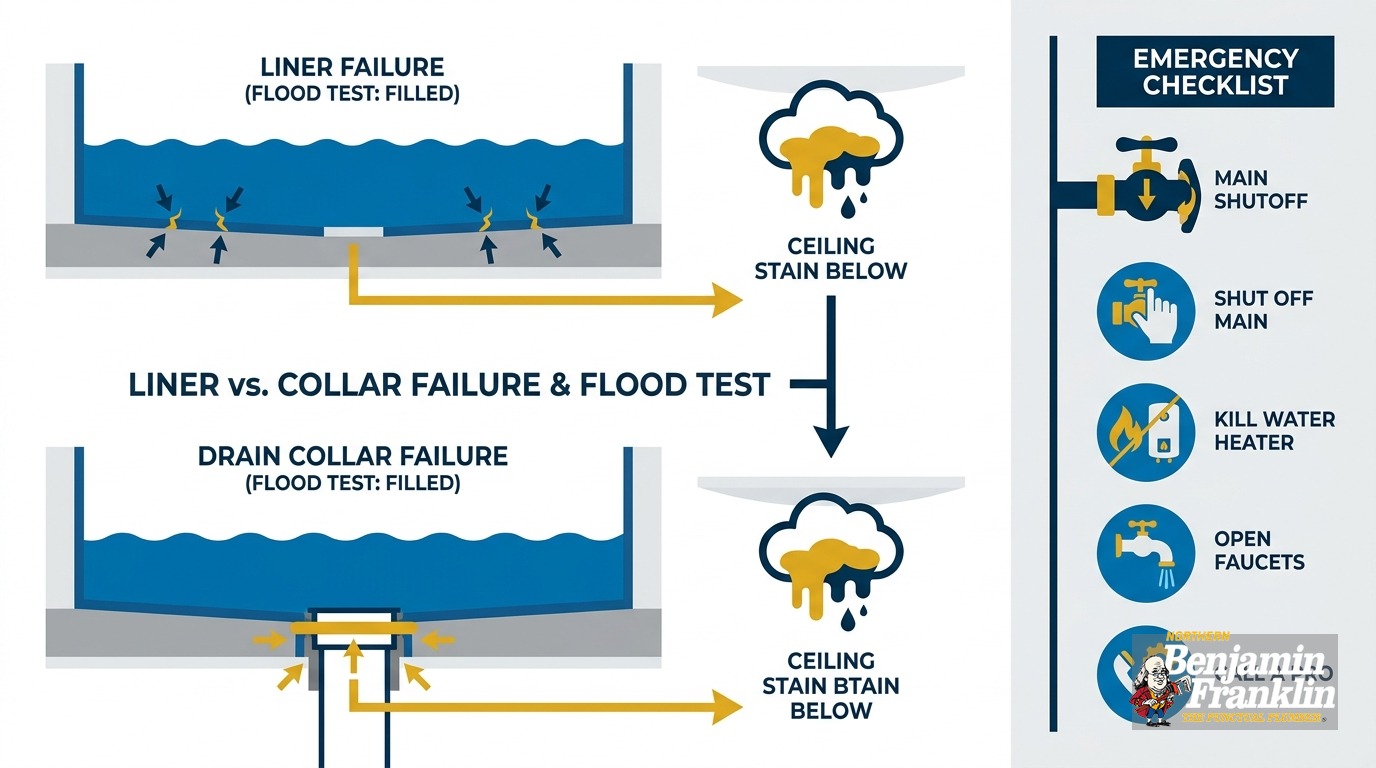
- A shower pan leak originates at one of two points: the waterproof liner membrane beneath the tile, or the drain collar assembly where the liner meets the drain body. These are different repairs.
- The 24-hour flood test tells you which failure you have. Water level drops = liner breach. Water level holds but shower still leaks = drain collar, caulk joint, or door seal.
- Ceiling stains appear one floor below because water saturates the mortar bed, wicks through the subfloor along wood grain, and drips at a point that can be several feet from the actual failure.
- Minnesota code requires a licensed-plumber-supervised, inspector-witnessed flood test before tile is installed. Skipping it turns a small repair into a potential full demolition.
- Stop using the shower the moment you see a ceiling stain below it. Every additional shower cycle pushes more water into the structure.
What Is a Shower Pan, and Where Does a Shower Pan Leak Begin?
The short answer: A shower pan is a layered waterproofing assembly beneath the tile. The critical layer is the liner membrane - a sheet of flexible waterproof material that forms the actual basin. Leaks start either at a breach in that membrane or at the joint where the membrane connects to the drain body.
Most homeowners think of the shower floor as tile over concrete. The reality is more involved. Under the tile is a mortar bed. Under the mortar bed is the liner - typically sheet PVC, CPE, or in older Twin Cities homes, sometimes lead or copper. The liner is the waterproof basin. It slopes toward the drain at a minimum pitch of 1/4 inch per foot, channels water toward the drain body, and extends several inches up the wall so any water that works under the tile stays contained.
The liner connects to the drain through a two-piece clamping ring assembly. The lower drain body is set in the pre-slope mortar first. The liner is then laid over it, cut to fit the drain opening, and sandwiched between the upper and lower clamping rings with bolts. Small weep slots in the clamping ring let water that wicks under the tile layer drain back into the drain body rather than ponding on top of the liner.
Every shower pan leak originates at one of those two locations: the liner membrane, or the drain collar assembly at the junction between liner and drain body.
How Do You Know If Your Shower Pan Is Leaking?
The short answer: The most common sign is a ceiling stain one floor below the shower. Other early signs are soft or hollow tile near the floor-wall joint, grout or caulk pulling away at the base of the shower walls, and a musty smell in the room below. The timing of the stain - whether it appears during use and clears quickly, or lingers after the water is off - tells you a great deal about where the water is coming from.
Most shower pan leaks go undetected for months. The mortar bed can absorb substantial volume before any exterior sign appears below. By the time a ceiling stain shows up, the subfloor and framing have already been wet for some time. That is the entire argument for the permit-required flood test: it catches a liner breach before any tile is installed, when the repair is still simple.
Additional signs to watch for:
- Tile or grout that sounds hollow when you tap it near the shower floor or curb
- Grout or caulk lines cracking or pulling away at the wall-floor transition
- A persistent damp smell in the room directly below the bathroom
- Paint bubbling or peeling on the ceiling below the shower
- Water stains that grow over time rather than staying fixed
The Two Failure Points: Liner vs. Drain Collar
Understanding these two failures matters because they have opposite diagnostic signatures and require different repairs.
Liner failure means the waterproof membrane itself is breached. PVC liners are durable but not indestructible. Years of foot traffic compress the mortar bed, which can work the liner against the sharp edges of the drain clamping ring or against aggregate in the mortar. A puncture or tear lets water escape directly through the liner and into the subfloor. The flood test catches this reliably: fill the pan, mark the level, wait 24 hours. A drop means the liner is breached.
Drain collar failure means the seal between the liner and the two-piece clamping ring has degraded. The bolts may have loosened, or the rubber gasket between the clamping ring and liner has cracked. Water bypasses the liner at the drain and routes directly to the subfloor around the drain body. This failure does not show up on a standard flood test. The test plug sits inside the drain body above the clamping ring - so the flood test holds, but the shower still leaks every time it is used.
A related defect involves blocked weep holes. During construction, mortar can fill the small weep slots in the clamping ring. Water that wicks under the tile layer has nowhere to drain, ponds on top of the liner, and accelerates liner deterioration. A shower with blocked weep holes may pass an initial flood test and then develop a liner failure within a few years of regular use.
How Does the Flood Test Diagnose a Shower Pan Leak?
The short answer: Plug the drain, fill the pan to within 1 inch of the curb top, mark the water level precisely, and check it 24 hours later. A drop in water level means the liner is breached somewhere below the marked level. A stable level means the liner is intact. Washington Plumbers notes that conservative practice accepts zero measurable drop; some sources allow up to 1/4 inch for evaporation.
Here is the complete procedure:
- Remove any drain cover and plug the drain with a test plug placed so both the upper and underside of the subpan are tested at the drain clamp point.
- Fill the pan to within 1 inch of the top of the curb or threshold.
- Mark the exact water level - tape or a grease pencil line on the wall both work.
- Do not add water during the 24-hour hold. Adding water masks a slow drop.
- Return at 24 hours and measure the level against the mark.
If the level has dropped, the approximate breach elevation in the liner is just below the point where the water stopped dropping. Water stops escaping once it falls below the hole, so the final water line gives a rough depth for the failure location.
In Minnesota, MN Plumbing Code Section 408.7.1 requires this test for all site-built shower receptors before any tile is installed. The city of Blaine lists a witnessed Shower Pan inspection as a required inspection step before any tile work is concealed - the Plumbing Inspector must witness the filled pan.
What Does the Flood Test Result Actually Mean?
The short answer: The result is a decision tree with two branches. Water level drops: liner is breached, tile must come up, liner must be replaced. Water level holds but shower still leaks: liner is intact, failure is at the drain collar, caulk joint, or door seal - and no tile needs to come up until that specific assembly is isolated.
When the level drops. The liner has a breach. The repair requires removing tile, demolishing the mortar bed, locating the puncture or tear, and replacing the liner. Found during permitted construction before tile is installed, the repair is relatively inexpensive. Found years later after a ceiling stain appears, the full rebuild can run many thousands of dollars, not counting ceiling repair or mold remediation. The flood test at the construction stage is the only thing that separates those two cost outcomes.
When the level holds. The liner is intact. 247 Restoration Specialists uses a three-test isolation protocol for exactly this scenario: the 24-hour flood test for the liner, a 15-minute spray test targeting the door seals and glass panels, and a static pressure test for supply lines. Each test eliminates one layer so no tile comes up on a hunch. A holding flood test combined with leaks during use points to the drain collar, the caulk joint at the wall-floor transition, or the door threshold - all of which are repairable without full demolition.
The Twin Cities accelerant. Minnesota homes go through roughly 50 or more freeze-thaw cycles per year. That thermal movement works grout joints and caulk seams at the wall-floor transition - the most common surface entry point for water heading toward the liner. A Twin Cities shower that was watertight three years ago may develop grout cracks over a single hard winter. National articles about shower pan leaks rarely mention this. Local tile contractors do: one contractor commenting on the Structure Tech inspection blog noted he finds failed tile showers routinely on Twin Cities inspections and tests his new installs for 48 to 72 hours as standard practice.
Why Does the Ceiling Stain Appear One Floor Below?
The short answer: Water escaping through the liner enters the mortar bed, which absorbs a large volume before any exterior sign appears. It then saturates the plywood or OSB subfloor above the joist bay. Because wood wicks water along the grain, the drip point on the ceiling below can be offset several feet from the actual breach. The stain location is a starting point for diagnosis, not the address of the failure.
The shape of the stain gives you a clue about the failure type:
- A broad stain spread across much of the ceiling area under the shower suggests a liner breach. Water escaped across the full mortar bed before concentrating.
- A tight, defined stain directly below the drain suggests a drain collar failure. Water escaped at one concentrated point around the drain body.
Timing adds another diagnostic layer. A stain that appears during a shower and clears within minutes of shutting the water off is consistent with a pan or drain seal failure. A stain that continues to spread for hours after the shower is cold points to a pressurized supply line inside the wall - a separate problem that needs its own test sequence.
Once a ceiling stain appears below a shower, stop using that shower. Every additional cycle pushes more water through the breach and into the structure. A small liner puncture becomes a rotted joist bay and a mold remediation project in a matter of months. The cost difference between acting at first sign and waiting is substantial.
Minnesota Code and the Required Flood Test
Minnesota does not leave the flood test optional. MN Rules Part 4714.0408 amends the Uniform Plumbing Code to require that site-built shower receptors be lined with approved waterproof material, that the liner pitch at 1/4 inch per foot toward weep holes in the subdrain, and that the liner extend 3 inches above the finished threshold and be clamped at the drain.
The flood test requirement sits in MN Plumbing Code Section 408.7.1: fill to the level of the rough threshold, place the test plug so both the upper and underside of the subpan are tested at the drain clamp point. In Blaine and other Twin Cities suburbs, this is a required Shower Pan inspection that the city’s Plumbing Inspector must witness before tile is concealed.
For homeowners in older Twin Cities homes: ask whether a permitted flood test was ever done on the existing tile shower. Many showers installed before current enforcement, or by unpermitted contractors, never had one. A shower that was never tested may be leaking slowly right now, with no one aware until a ceiling stain appears.
Minnesota allows homeowners to perform plumbing work on property they own and occupy. But a licensed plumber must pull the permit, and the inspector-witnessed flood test is still required before tile goes in. Doing the work unpermitted means no flood test, no inspection, and no recourse if a liner failure surfaces years later.
What Does a Shower Pan Leak Cost to Fix?
The short answer: Cost depends almost entirely on when the leak is found. A liner breach caught before tile is installed is a fundamentally different repair from the same breach found years later after a ceiling stain appears. The flood test at construction exists precisely to keep repairs on the low end of that range.
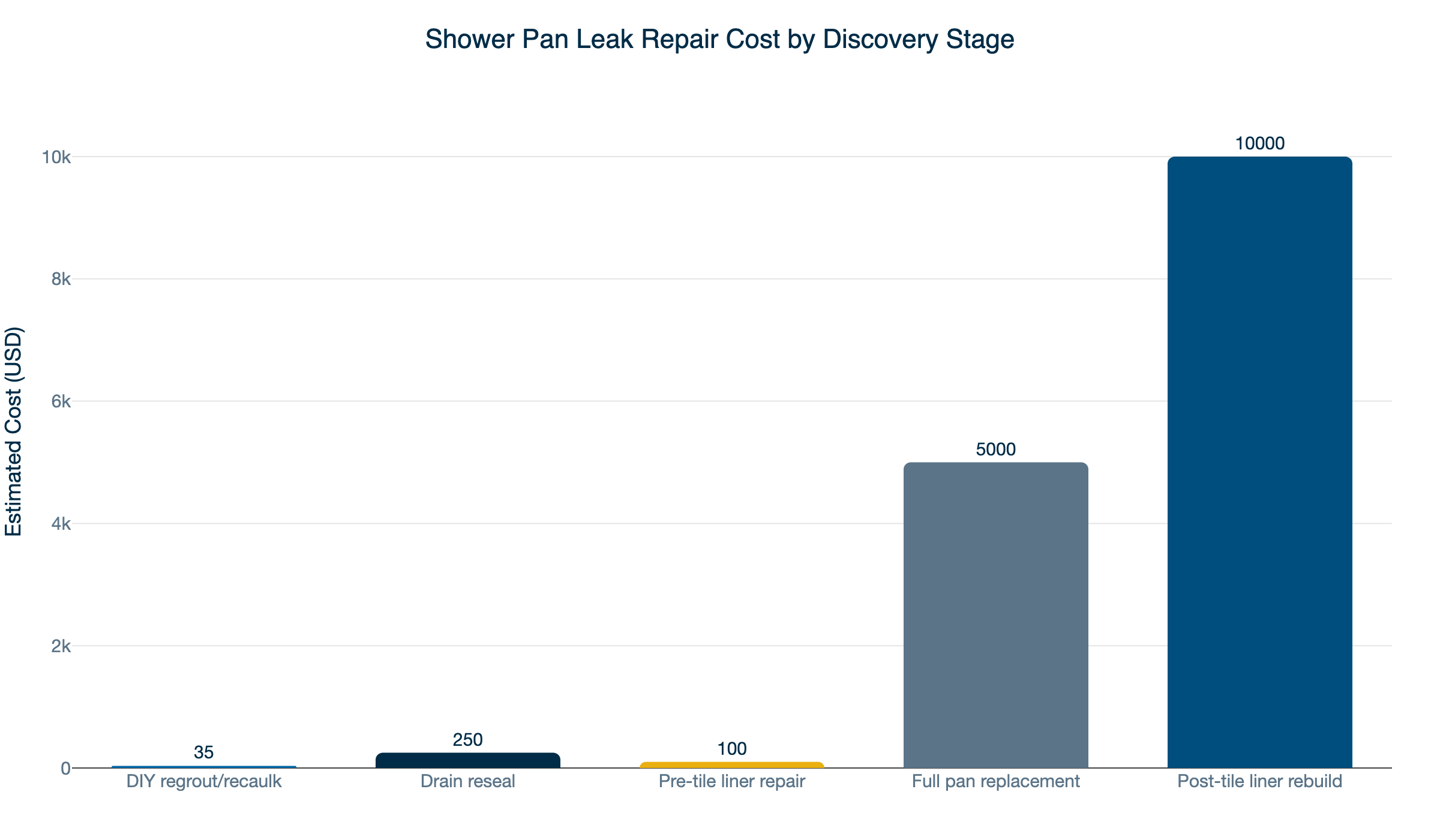
Per Washington Plumbers and EZ Plumbing, the range by scenario:
- DIY regrout or recaulk at the wall-floor joint: $20-50
- Drain reseal: $150-350
- Pre-tile liner breach found at the required flood test: $0-200 to repair
- Full pan replacement (post-tile, liner or drain): up to $5,000 in labor and materials, not including ceiling repair or mold remediation
- Post-tile liner failure found years later after ceiling stain appears: $5,000-15,000 for demolition, mortar removal, new liner, tile rebuild - sometimes more if framing has rotted
These figures are from third-party sources, not our prices. The actual cost for your shower depends on access, tile type, subfloor condition, and whether mold remediation is involved. For a real quote, call (763) 296-1844 or book a plumbing repair visit.
The key number here is the gap between the pre-tile and post-tile repair. That gap is the documented cost of a missed flood test.
When to Call Northern Benjamin Franklin Plumbing
A shower pan leak is not a burst-pipe emergency, but it is not a watch-and-wait situation either. Call when:
- A ceiling stain has appeared below the shower. Stop using the shower first. Call immediately after.
- Grout or caulk at the floor-wall transition is cracking, pulling away, or has gone missing entirely. That joint is the most common surface entry point for water heading toward the liner.
- Tile near the shower floor or curb sounds hollow when tapped. Delaminated tile means the mortar bed below has been wet.
- You are tiling a new shower and need the permit-required, inspector-witnessed flood test.
- You bought an older Twin Cities home and have no record of a permitted flood test for the existing tile shower.
- You have a slow or backed-up shower drain alongside a suspected pan issue - both can be assessed in one visit.
If the stain pattern or the leak detection findings suggest the water has reached the main drain line, we can camera the line and identify the full scope before any tile comes up.
We are locally owned and operated in the Twin Cities, backed by the national Benjamin Franklin Plumbing franchise. Our On-Time Guarantee(R) means we arrive in the scheduled window - and if we do not, we pay you $5 for every minute we are late, up to $300. “If there is any delay, it’s you we pay!”
Call (763) 296-1844 or book online.
Frequently Asked Questions
How do I know if my shower pan is leaking? +
What does a failed flood test mean for a shower pan? +
How much does it cost to fix a shower pan leak? +
Need a technician now?