
Radon in Well Water Minnesota: Testing and Treatment
Key Takeaways
- Minnesota’s average indoor radon level is more than three times the national average. More than 2 in 5 Minnesota homes have levels that pose significant health risk.
- Private well owners face a second, often untested exposure source. For every 10,000 pCi/L of radon in your well water, indoor air radon rises by approximately 1 pCi/L.
- The EPA estimates 89% of the health risk from radon in water comes from inhalation. Radon releases into air during showers, dishwashing, and laundry, not primarily from drinking.
- The Mount Simon-Hinckley and Jordan Aquifers in southeastern Minnesota carry the highest radionuclide concentrations in the state’s source water. Very few private wells in those areas have ever been tested.
- Two proven point-of-entry treatment options exist: aeration (95-99% removal, preferred above 5,000 pCi/L) and granular activated carbon filtration (lower upfront cost, suited below 5,000 pCi/L, but spent media requires professional disposal as low-level radioactive waste).
- Point-of-use filters do not solve this problem. Treatment must happen at the point of entry, before water reaches any fixture in the home.
- Water softeners do not remove dissolved radon gas. They reduce radium, radon’s parent element, but that is not a substitute for dedicated radon treatment.
- Minnesota requires radon contractors to hold a valid MDH license. Verify before hiring.
- Discounted test kits are available through MDH’s partnership with Air Chek, Inc. Ordering information is on the MDH radon safety factsheet.
Why Minnesota’s Radon Risk Is Already Elevated
According to the Minnesota Department of Health, Minnesota’s average indoor radon level exceeds three times the U.S. average. More than 2 in 5 homes in the state carry levels that pose significant health risk. The EPA action level for indoor air is 4 pCi/L. MDH recommends mitigation at 4 pCi/L or higher and says homeowners should consider it for levels between 2 and 4 pCi/L.
Two factors drive this. First, Minnesota’s underlying geology is rich in uranium-bearing formations, which produce radium and radon through natural decay. Second, the climate extends the problem. Minnesota homes are sealed and heated for more of the year than homes in most states. That prolonged closure gives radon more time to accumulate indoors before it disperses.
The air problem alone is serious enough to test for. For private well homeowners, water adds a second source of exposure, and most have only ever measured the first one.
How Does Radon Get Into Well Water?
Short answer: Radon is a radioactive gas produced when radium in soil and rock decays naturally. It dissolves readily into groundwater as water moves through those formations. Private wells pump that water directly into your home, where dissolved radon escapes into air every time a fixture runs.
Radon does not stay suspended in water indefinitely. It escapes whenever water is agitated, heated, or sprayed. A shower aerosolizes water under pressure and releases radon into a small, often poorly ventilated space. A dishwasher does the same, along with hot steam. A running faucet releases it at a lower rate.
The EPA estimates that 89% of the health risk from radon in water comes from inhalation, not from drinking. The shower is the bigger problem, not the glass of water. This is also why point-of-use filters, including the reverse osmosis system under your kitchen sink, do not solve the problem. They treat one tap. Every other fixture in the house continues releasing untreated water radon into your air.
Which Minnesota Aquifers Carry the Highest Risk?
Short answer: The Mount Simon-Hinckley and Jordan Aquifers in southeastern Minnesota have the highest known radionuclide concentrations in the state’s source water. Communities across Dakota County and the southeastern Twin Cities suburbs draw heavily from groundwater, and most private wells in those areas have never been tested for radionuclides.
The MDH radionuclides page confirms that the highest concentrations occur in those specific aquifer systems and notes that very few of the state’s private wells have ever been tested. The full scope of the problem remains largely unknown because the wells that are most likely to be affected are also the least likely to have been measured.
Dakota County data shows that more than 90% of county residents get their drinking water from groundwater, through either municipal systems or private wells. That covers Lakeville, Farmington, Hastings, Apple Valley, and the rural areas between them. Similar patterns extend through neighboring counties across southeastern and south-central Minnesota.
In 2014, MDH data found nine Minnesota municipal water systems with treated water carrying radium above the EPA standard of 5 pCi/L. Those are regulated public systems, required to test and report. Private wells face no equivalent requirement. They go untested at far higher rates, and the homeowner often has no way of knowing what the water actually contains.
The practical takeaway: if you are in the southeastern Twin Cities suburbs or exurbs and your home draws from a private well, the geology makes testing more urgent, not optional.
How Does Radon in Well Water Raise Minnesota Indoor Air Levels?
Short answer: For every 10,000 pCi/L of radon in your well water, indoor air radon rises by approximately 1 pCi/L. At Minnesota’s already-elevated baseline, even moderate well water concentrations can push a home past the EPA action threshold.
The math compounds quickly. If your home already tests at 3 pCi/L from soil gas, and your well tests at 10,000 pCi/L for water radon, the water adds 1 pCi/L to your air. Combined: 4 pCi/L, right at the EPA action level. A well at 20,000 pCi/L adds 2 pCi/L. At 40,000 pCi/L, the water contribution alone would push air radon past the threshold even from a low soil-gas baseline.
Most of that release happens in enclosed, high-use areas. Bathrooms carry the highest concentration risk because showers combine hot water, pressurized spray, and a small room that is usually not well-ventilated. That is where your family gets the most concentrated exposure if dissolved radon is in the water.
An air test alone cannot separate how much of your exposure comes from the foundation versus the well. Testing both sources is the only way to understand the full picture and target the right fix.
Should You Test Your Well Water for Radon?
Short answer: Yes, if you are on a private well anywhere in Minnesota. MDH recommends water testing for all private well owners in the state. If you draw from a deep sandstone or glacial aquifer in southeastern or south-central Minnesota, the case for testing is especially strong.
Testing is the only way to know your actual level. Being near a high-risk aquifer is a reason to test sooner. It is not a substitute for testing. Two neighbors drawing from the same formation can test differently based on well depth, casing age, and where in the aquifer each well draws.
Contact your county environmental services office before you start. Some counties have programs that simplify testing for private well owners or reduce the cost. After that, locate an MDH-accredited laboratory, request a sample kit, and follow the collection protocol. Most labs require collecting from the cold-water tap after the system has rested overnight, which captures the true dissolved radon concentration rather than a post-flush reading.
MDH has partnered with Air Chek, Inc. for discounted test kits for Minnesota residents. Ordering information, including how to reach mn.radon.com, is on the MDH radon safety factsheet. Public entities can get kits for approximately $5 each. The program covers both air and water testing kits.
Your air radon level and your water radon level are separate measurements. Testing one does not substitute for the other.
How to Get Your Well Water Tested for Radon in Minnesota
The process follows five steps:
- Contact your county environmental services office to ask about local testing programs or referrals.
- Find an MDH-accredited laboratory through the MDH environmental lab directory.
- Request a sample container and written instructions from the lab.
- Collect your water sample from the cold-water tap per the lab’s protocol. Most require the system to rest overnight before sampling.
- Mail the sealed sample back to the lab. If results show elevated radon, contact an MDH-licensed contractor to evaluate your treatment options.
State guidance notes that the EPA’s proposed guidance level for radon in public drinking water is 300 pCi/L, though no enforceable federal standard exists for private wells. Your lab will provide context on interpreting your specific result.
Aeration vs. GAC: Which Treatment Is Right for Your Well?
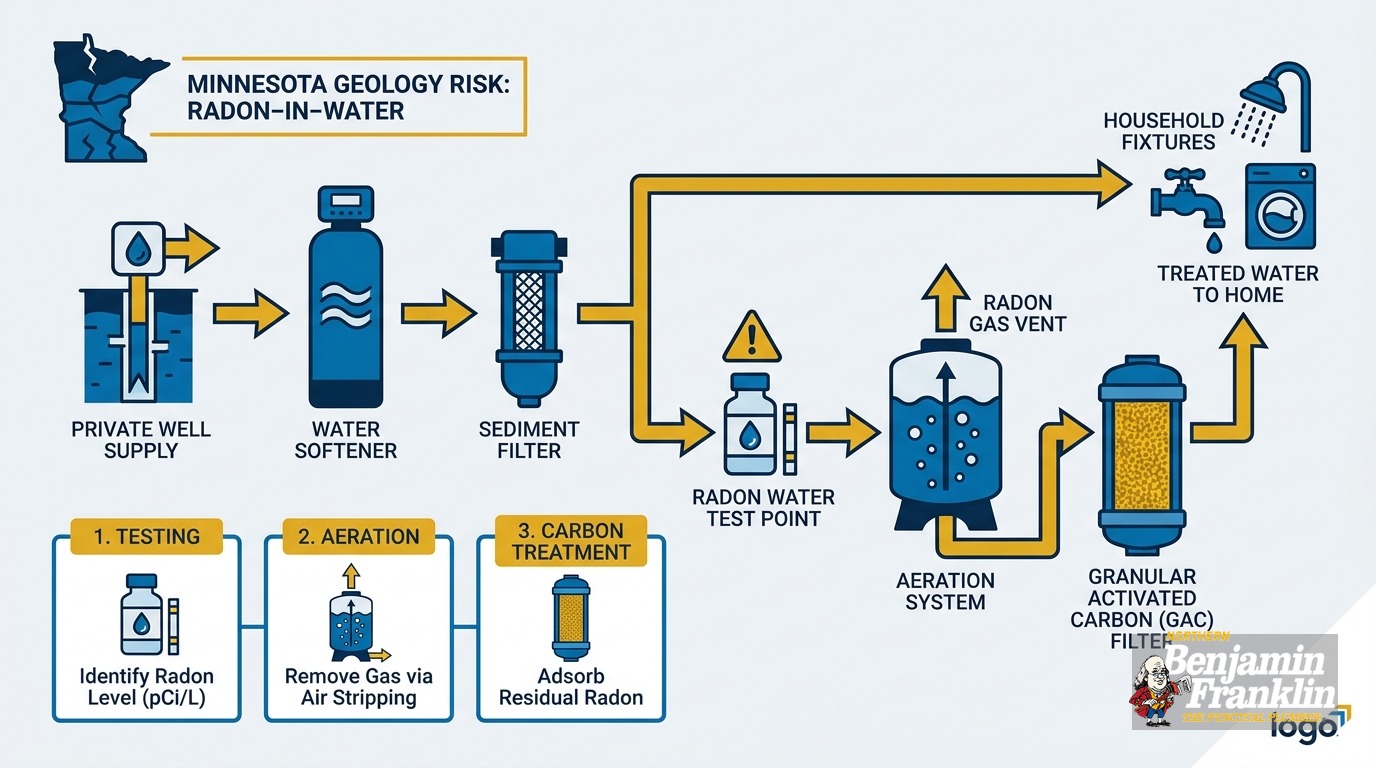
Short answer: Aeration removes 95-99% of dissolved radon and is preferred for concentrations above 5,000 pCi/L. Granular activated carbon (GAC) costs less upfront and works well below that threshold, but spent carbon media accumulates radioactive decay products and must be professionally disposed of as low-level radioactive waste. Both must be installed at the point of entry.
The foundational rule for both systems: treatment must happen where water enters the home, before it reaches any fixture. The National Radon Program Services is clear that point-of-use filters are not effective for radon mitigation. They treat one faucet. Every shower, dishwasher, and laundry machine in the house continues releasing untreated water radon into your air.
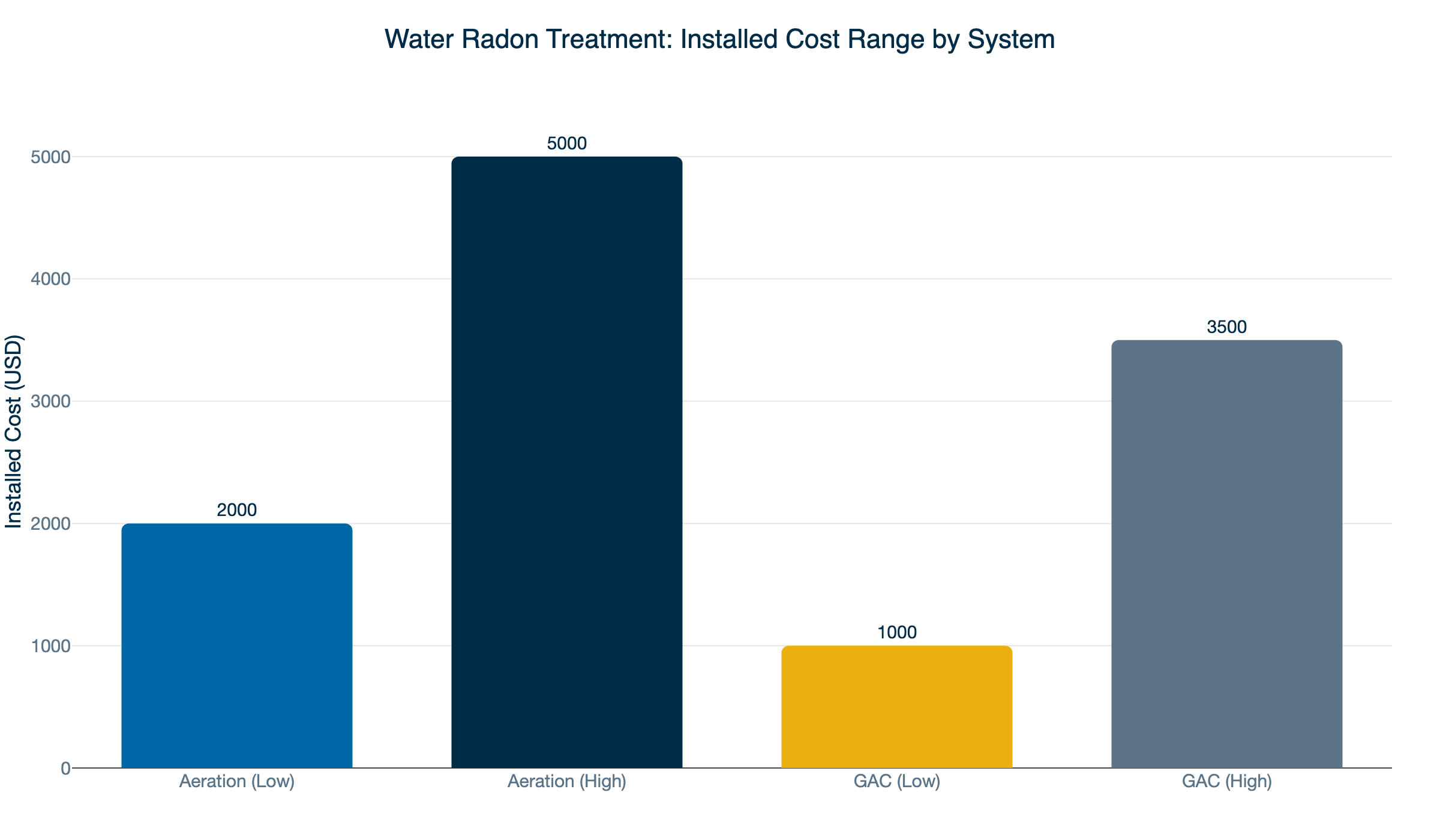
Aeration systems inject air into the water stream and strip dissolved radon out before the water enters your home’s plumbing. The radon-concentrated air is vented outdoors through a dedicated discharge pipe. Per data cited by radonlocal.com, aeration removes 95-99% of dissolved radon at an installed cost of $2,000 to $5,000 (source figures; not our pricing). It is the EPA’s preferred best available technology for radon in water, particularly when concentrations exceed 5,000 pCi/L. Long-term maintenance is lower than GAC because no radioactive byproducts accumulate in the system itself.
GAC systems pass water through a bed of granular activated carbon that adsorbs dissolved radon from the water stream. Per radonlocal.com and sosradon.org, installed cost ranges from $1,000 to $3,500. The lower upfront cost makes GAC worth comparing when well concentrations are moderate, below 5,000 pCi/L.
The catch is the carbon media itself. As it removes radon, it traps radon’s decay products: polonium, lead, and bismuth isotopes. Over time the media becomes mildly radioactive. When it is spent, it cannot go in household trash or a standard waste container. It must be handled and disposed of as low-level radioactive waste through a licensed hauler. That cost and logistics requirement recurs each time the media needs replacing. Factor it into your decision and your ongoing maintenance budget before committing.
Neither system is maintenance-free. Both require periodic servicing. GAC requires disposal planning from the moment the system is installed.
Will My Water Softener Remove Radon?
Short answer: No. Water softeners remove radium from water through ion exchange, which limits how much new radon can form downstream. But they do not remove dissolved radon gas already in the water. A softener is not a substitute for point-of-entry radon treatment if your well tests positive.
Most Twin Cities homeowners run a water softener because hard water is nearly universal across the metro and surrounding communities. The softener exchanges calcium and magnesium ions for sodium, which removes hardness. During that process it also removes some radium, which is chemically similar to calcium and magnesium. Less radium in the system means slightly less radon produced over time.
But dissolved radon gas that is already in the water is a different matter. Ion exchange does not capture it. The softener passes it through unchanged, and it releases into your air at every fixture.
There is one additional consideration worth noting. Radium can deposit gradually in softener resin beds and in sediment filters, creating mild localized radioactivity at those components over time. For homeowners in high-radionuclide areas who have run the same softener for years, this is worth factoring into routine maintenance conversations with your service provider.
Test your water. If radon is elevated, add the appropriate point-of-entry system. A softener and a radon treatment system are solving different problems.
What Cold-Climate Factors Affect Aeration Systems in Minnesota?
Short answer: Aeration system exhaust vents must be protected against freeze-up at sub-zero temperatures and must terminate away from windows and doors. These installation details matter every Minnesota winter. Generic national guides never address them.
An aeration system vents radon-concentrated air from inside the treatment unit to the outside through a dedicated discharge pipe. In mild climates, that vent is an afterthought. In Minnesota, where overnight temperatures in January and February regularly drop to minus 20 degrees Fahrenheit or lower, the vent design is part of the safety specification.
A few specifics to work through with your installer before the system is placed:
- Discharge clearance. The vent must terminate away from any window, door, or fresh-air intake. If radon-concentrated exhaust re-enters the home through an open window or a furnace air intake, the system makes your air quality worse, not better.
- Freeze protection. Uninsulated vent pipe near an exterior wall can ice at the discharge point in extreme cold. Ask how the installation handles freeze-up and whether the outlet location or pipe insulation addresses it.
- Condensate drainage. The vent pipe should slope outward so condensate drains away from the unit rather than pooling inside the pipe.
These are solvable problems at the design stage. Retrofitting the vent after the system is already in place is disruptive. Work through the plan before installation begins.
Does Minnesota Require a License for Radon Contractors?
Short answer: Yes. Minnesota requires all radon professionals to hold a valid MDH radon license, whether they are working on an air mitigation system or a water treatment system. Verify your contractor’s license before any work begins.
The MDH Radon Licensing System maintains a searchable list of currently licensed contractors in the state. Minnesota’s licensing is separate from the national NRPP certification. A contractor who holds NRPP credentials from work done in another state is not automatically licensed to work in Minnesota. Ask for the MDH license number directly and verify it against the state database before you sign anything.
MDH also maintains a financial assistance page for radon mitigation. Review it before assuming full out-of-pocket cost. Program availability changes, but it is worth a look before you start.
What to Do Next
If you are on a private well in the Twin Cities metro or greater Minnesota, here is the sequence:
- Test your indoor air if you have not done it. MDH recommends every Minnesota home do this.
- Test your well water. Contact your county first, then an MDH-accredited lab. Follow the lab’s cold-tap collection protocol.
- If either test comes back above the action threshold, contact an MDH-licensed radon contractor to evaluate your options.
- For water radon above 5,000 pCi/L, aeration is the stronger long-term choice. Below that level, compare GAC on upfront cost versus ongoing disposal requirements.
- Do not rely on a point-of-use filter or your water softener as radon mitigation. Neither one addresses the airborne exposure from showers and dishwashing.
Private wells in southeastern Minnesota often carry elevated iron and manganese alongside radionuclide concerns. See our post on iron and manganese in well water Minnesota for how those water quality problems interact with your treatment options. Addressing them together is usually the more efficient path.
For a broader look at how water treatment systems differ in what they solve, our comparison of water softeners vs. water filtration systems covers what each approach addresses and when each is the right tool.
Northern Benjamin Franklin Plumbing handles water treatment for Twin Cities homeowners, including private well systems. We are locally owned and operated. If you want a professional assessment of your water quality situation or need help evaluating point-of-entry treatment options, call (763) 296-1844 or book online.
Our On-Time Guarantee(R) covers every appointment. We arrive in the window we promise, or we pay you $5 for every minute we are late, up to $300. “If there is any delay, it’s you we pay!”
Frequently Asked Questions
How do I test my well water for radon in Minnesota? +
What is the difference between aeration and GAC for radon removal? +
Will my water softener remove radon from my well water? +
Does Minnesota require a license for radon contractors? +
Need a technician now?